Saturday, July 9, 2016

Police and Race:The Real Truth About Race and Policing According To An Ex-Cop

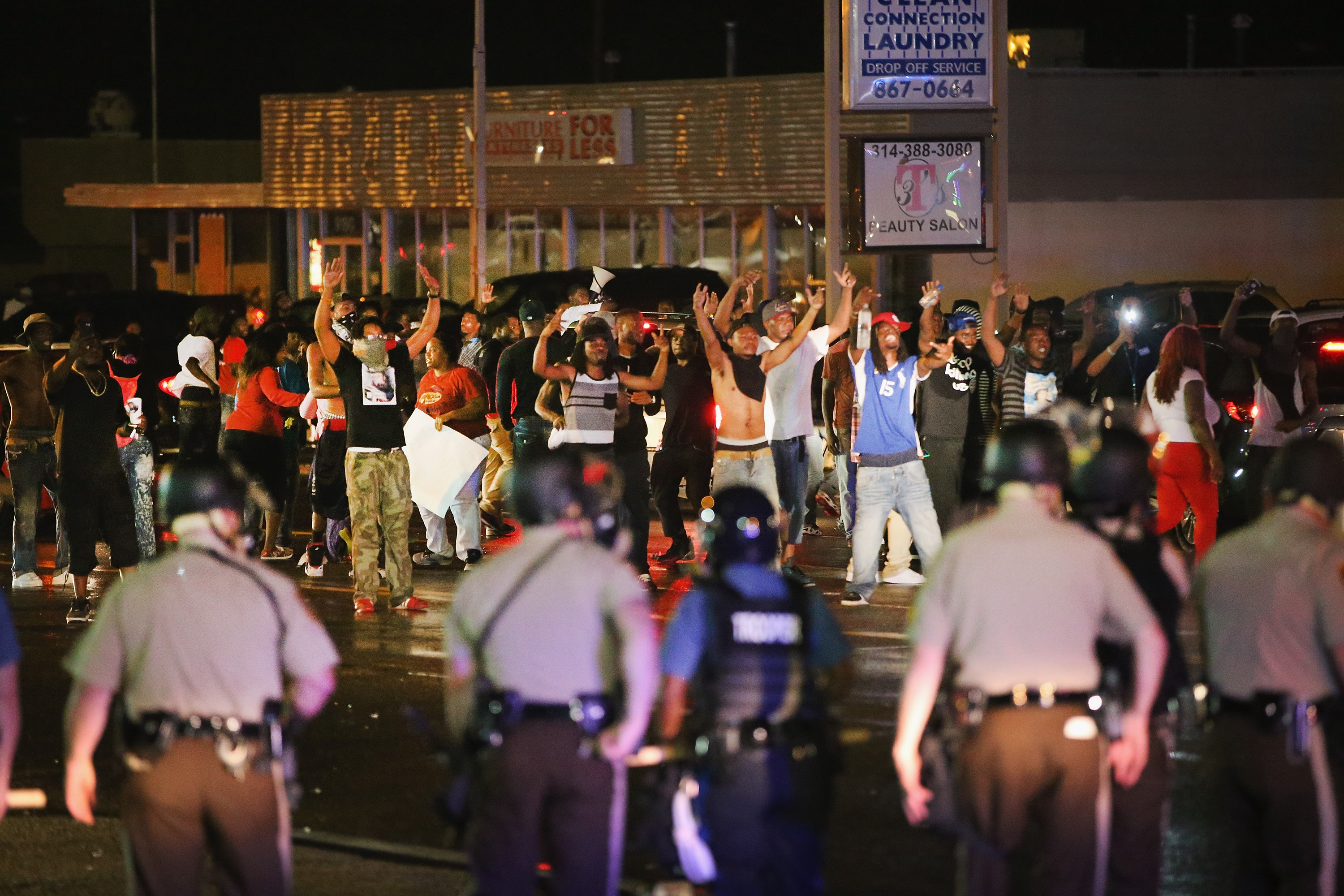
Hands up Ferguson

I'm a black ex-cop, and this is the real truth about race and policing

by Redditt Hudson on July 7, 2016

On any given day, in any police department in the nation, 15 percent of officers will do the right thing no matter what is happening. Fifteen percent of officers will abuse their authority at every opportunity. The remaining 70 percent could go either way depending on whom they are working with.
That's a theory from my friend K.L. Williams, who has trained thousands of officers around the country in use of force. Based on what I experienced as a black man serving in the St. Louis Police Department for five years, I agree with him. I worked with men and women who became cops for all the right reasons — they really wanted to help make their communities better. And I worked with people like the president of my police academy class, who sent out an email after President Obama won the 2008 election that included the statement, "I can't believe I live in a country full of ni**er lovers!!!!!!!!" He patrolled the streets in St. Louis in a number of black communities with the authority to act under the color of law.

That remaining 70 percent of officers are highly susceptible to the culture in a given department. In the absence of any real effort to challenge department cultures, they become part of the problem. If their command ranks are racist or allow institutional racism to persist, or if a number of officers in their department are racist, they may end up doing terrible things.

It is not only white officers who abuse their authority. The effect of institutional racism is such that no matter what color the officer abusing the citizen is, in the vast majority of those cases of abuse that citizen will be black or brown. That is what is allowed.

And no matter what an officer has done to a black person, that officer can always cover himself in the running narrative of heroism, risk, and sacrifice that is available to a uniformed police officer by virtue of simply reporting for duty. Cleveland police officer Michael Brelo was acquitted of all charges against him in the shooting deaths of Timothy Russell and Malissa Williams, both black and unarmed. Thirteen Cleveland police officers fired 137 shots at them. Brelo, having reloaded at some point during the shooting, fired 49 of the 137 shots. He took his final 15 shots at them after all the other officers stopped firing (122 shots at that point) and, "fearing for his life," he jumped onto the hood of the car and shot 15 times through the windshield.

About that 15 percent of officers who regularly abuse their power: they exert an outsize influence

Not only was this excessive, it was tactically asinine if Brelo believed they were armed and firing. But they weren't armed, and they weren't firing. Judge John O'Donnell acquitted Brelo under the rationale that because he couldn't determine which shots actually killed Russell and Williams, no one is guilty. Let's be clear: this is part of what the Department of Justice means when it describes a "pattern of unconstitutional policing and excessive force."
Nevertheless, many Americans believe that police officers are generally good, noble heroes. A Gallup poll from 2014 asked Americans to rate the honesty and ethical standards of people in various fields: police officers ranked in the top five, just above members of the clergy. The profession — the endeavor — is noble. But this myth about the general goodness of cops obscures the truth of what needs to be done to fix the system. It makes it look like all we need to do is hire good people, rather than fix the entire system. Institutional racism runs throughout our criminal justice system. Its presence in police culture, though often flatly denied by the many police apologists that appear in the media now, has been central to the breakdown in police-community relationships for decades in spite of good people doing police work.

Here's what I wish Americans understood about the men and women who serve in their police departments — and what needs to be done to make the system better for everyone.

1) There are officers who willfully violate the human rights of the people in the communities they serve

As a new officer with the St. Louis in the mid-1990s, I responded to a call for an "officer in need of aid." I was partnered that day with a white female officer. When we got to the scene, it turned out that the officer was fine, and the aid call was canceled. He'd been in a foot pursuit chasing a suspect in an armed robbery and lost him.

The officer I was with asked him if he'd seen where the suspect went. The officer picked a house on the block we were on, and we went to it and knocked on the door. A young man about 18 years old answered the door, partially opening it and peering out at my partner and me. He was standing on crutches. My partner accused him of harboring a suspect. He denied it. He said that this was his family's home and he was home alone.

My partner then forced the door the rest of the way open, grabbed him by his throat, and snatched him out of the house onto the front porch. She took him to the ledge of the porch and, still holding him by the throat, punched him hard in the face and then in the groin. My partner that day snatched an 18-year-old kid off crutches and assaulted him, simply for stating the fact that he was home alone.

I got the officer off of him. But because an aid call had gone out, several other officers had arrived on the scene. One of those officers, who was black, ascended the stairs and asked what was going on. My partner pointed to the young man, still lying on the porch, and said, "That son of a bitch just assaulted me." The black officer then went up to the young man and told him to "get the fuck up, I'm taking you in for assaulting an officer." The young man looked up at the officer and said, "Man ... you see I can't go." His crutches lay not far from him.

The officer picked him up, cuffed him, and slammed him into the house, where he was able to prop himself up by leaning against it. The officer then told him again to get moving to the police car on the street because he was under arrest. The young man told him one last time, in a pleading tone that was somehow angry at the same time, "You see I can't go!" The officer reached down and grabbed both the young man's ankles and yanked up. This caused the young man to strike his head on the porch. The officer then dragged him to the police car. We then searched the house. No one was in it.


These kinds of scenes play themselves out everyday all over our country in black and brown communities. Beyond the many unarmed blacks killed by police, including recently Freddie Gray  in Baltimore, other police abuses that don't result in death foment resentment, distrust, and malice toward police in black and brown communities all over the country. Long before Darren Wilson shot and killed unarmed Michael Brown last August, there was a poisonous relationship between the Ferguson, Missouri, department and the community it claimed to serve. For example, in 2009 Henry Davis was stopped unlawfully in Ferguson, taken to the police station, and brutally beaten while in handcuffs. He was then charged for bleeding on the officers' uniforms after they beat him.


~~~~~~~~~~~~~~~~~~~~~~~~~
What did the Justice Department's investigation into the Ferguson Police Department find?

In a searing report released in March 2015, the US Department of Justice uncovered a pattern of racial bias in the Ferguson Police Department. And it argued that the disparities could only be explained, at least in part, by unlawful bias and stereotypes against African Americans.

The disparities were rooted in the city's reliance on the police department and courts for local budget revenue: Federal officials found that city officials worked together at every level of enforcement — from city management to the local prosecutor to the police department — to make as much money from fines and court fees as possible, ranging from schemes to raise total fines for municipal code violations to asking cops to write as many citations as possible.

The report noted that, although black people made up about 67 percent of Ferguson's population, 88 percent of documented uses of force by Ferguson police from 2010 to August 2014 were against African Americans. In the 14 police canine bite cases for which racial data was available, the people bitten were black.

There were similar racial disparities in traffic stops. From 2012 to 2014, 85 percent of people stopped, 90 percent of people who received a citation, and 93 percent of people arrested were black. Black drivers were more than twice as likely as their white counterparts to be searched during vehicle stops, but 26 percent less likely to have contraband.

Some people's interactions with police turned downright abusive, as the report described:

We spoke with one African-American man who, in August 2014, had an argument in his apartment to which FPD officers responded, and was immediately pulled out of the apartment by force. After telling the officer, "you don't have a reason to lock me up," he claims the officer responded: "N*****, I can find something to lock you up on." When the man responded, "good luck with that," the officer slammed his face into the wall, and after the man fell to the floor, the officer said, "don't pass out motherf****r because I'm not carrying you to my car."

The Justice Department also exposed at least seven racist jokes police and court officials exchanged over email, all of which were sent by employees and were apparently sent during work hours. One of the emails, from November 2008, said President Barack Obama won't be president for long because "what black man holds a steady job for four years."

The Justice Department found no evidence that any of the police and court officials who engaged in these emails were ever disciplined, although the officials involved lost their jobs after the investigation's findings were released. The investigation also found no indication that any official asked the sender to stop sending such emails, or any proof that the emails were reported. "Instead, the emails were usually forwarded along to others," the report stated.

The emails show, as the Justice Department suggested, that at least some of the racial disparities in local law enforcement can be explained by outright racism.
~~~~~~~~~~~~~~~~~~~~~~~~
2) The bad officers corrupt the departments they work for

About that 15 percent of officers who regularly abuse their power: a major problem is they exert an outsize influence on department culture and find support for their actions from ranking officers and police unions. Chicago is a prime example of this: the city has created a reparations fund for the hundreds of victims who were tortured by former Chicago Police Commander Jon Burge and officers under his command from the 1970s to the early ‘90s.


The victims were electrically shocked, suffocated, and beaten into false confessions that resulted in many of them being convicted and serving time for crimes they didn't commit.  One man, Darrell Cannon, spent 24 years in prison for a crime he confessed to but didn't commit. He confessed when officers repeatedly appeared to load a shotgun and after doing so each time put it in his mouth and pulled the trigger. Other men received electric shocks until they confessed.
The torture was systematic, and the culture that allowed for it is systemic. I call your attention to the words "and officers under his command." Police departments are generally a functioning closed community where people know who is doing what. How many officers  "under the command" of Commander Burge do you think didn't know what was being done to these men? How many do you think were uncomfortable with the knowledge? Ultimately, though, they were okay with it. And Burge got four years in prison, and now receives his full taxpayer-funded pension.

3) The mainstream media helps sustain the narrative of heroism that even corrupt officers take refuge in

This is critical to understanding why police-community relations in black and brown communities across the country are as bad as they are. In this interview with Fox News, former New York City Police Commissioner Howard Safir never acknowledges the lived experience of thousands and thousands of blacks in New York, Baltimore, Ferguson, or anywhere in the country. In fact, he seems to be completely unaware of it. This allows him to leave viewers with the impression that the recent protests against police brutality are baseless, and that allegations of racism are "totally wrong — just not true." The reality of police abuse is not limited to a number of "very small incidents" that have impacted black people nationwide, but generations of experienced and witnessed abuse.

The media is complicit in this myth-making: notice that the interviewer does not challenge Safir. She doesn't point out, for example, the over $1 billion in settlements the NYPD has paid out over the last decade and a half for the misconduct of its officers. She doesn't reference the numerous accounts of actual black or Hispanic NYPD officers who have been profiled and even assaulted without cause when they were out of uniform by white NYPD officers.

No matter what an officer has done to a black person, that officer can always cover himself in the running narrative of heroism
Instead she leads him with her questions to reference the heroism, selflessness, risk, and sacrifice that are a part of the endeavor that is law enforcement, but very clearly not always characteristic of police work in black and brown communities. The staging for this interview — US flag waving, somber-faced officers — is wash, rinse, and repeat with our national media.

When you take a job as a police officer, you do so voluntarily. You understand the risks associated with the work. But because you signed on to do a dangerous job does not mean you are then allowed to violate the human rights, civil rights, and civil liberties of the people you serve. It's the opposite. You should protect those rights, and when you don't you should be held accountable. That simple statement will be received by police apologists as "anti-cop."  It is not.


4) Cameras provide the most objective record of police-citizen encounters available


When Walter Scott was killed by officer Michael Slager in South Carolina last year, the initial police report put Scott in the wrong. It stated that Scott had gone for Slager's Taser, and Slager was in fear for his life. If not for the video recording that later surfaced, the report would have likely been taken by many at face value. Instead we see that Slager shot Scott repeatedly and planted the Taser next to his body after the fact.


Every officer in the country should be wearing a body camera that remains activated throughout any interaction they have with the public while on duty. There is no reasonable expectation of privacy for officers when they are on duty and in service to the public. Citizens must also have the right to record police officers as they carry out their public service, provided that they are at a safe distance, based on the circumstances, and not interfering. Witnessing an interaction does not by itself constitute interference.

5) There are officers around the country who want to address institutional racism

The National Coalition of Law Enforcement Officers for Justice, Reform and Accountability is a new coalition of current and former law enforcement officers from around the nation. Its mission is to fight institutional racism in our criminal justice system and police culture, and to push for accountability for police officers that abuse their power.

Many of its members are already well-established advocates for criminal justice reform in their communities. It's people like former Sergeant De Lacy Davis of New Jersey, who has worked to change police culture for years. It's people like former LAPD Captain John Mutz, who is white, and who is committed to working to build a system where everyone is equally valued. His colleagues from the LAPD —former Sergeant Cheryl Dorsey, now a frequent CNN contributor (providing some much-needed perspective), and former officer Alex Salazar, who worked LAPD's Rampart unit — are a part of this effort. Several  NYPD  officers, many of whom are founding members of 100 Blacks in Law Enforcement Who Care, the gold standard for black municipal police organizations, are a part of this group. Vernon Wells, Noel Leader, Julian Harper, and Cliff Hollingsworth, to name a few, are serious men with a serious record of standing up for their communities against police abuse. There's also Rochelle Bilal, a former sergeant out of Philadelphia, Sam Costales out of New Mexico, former Federal Marshal Matthew Fogg, and many others.

These men and women are ready to reach out to the thousands of officers around the country who have been looking for a national law enforcement organization that works to remake police culture. The first priority is accountability — punishment — for officers who willfully abuse the rights and bodies of those they are sworn to serve. Training means absolutely nothing if officers don't adhere to it and are not held accountable when they don't. It is key to any meaningful reform.

Police abuse in black and brown communities is generations old. It is nothing new.
Racism is woven into the fabric of our nation.  At no time in our history has there been a national consensus that everyone should be equally valued in all areas of life. We are rooted in racism in spite of the better efforts of Americans of all races to change that.


Because of this legacy of racism, police abuse in black and brown communities is generations old. It is nothing new. It has become more visible to mainstream America largely because of the proliferation of personal recording devices, cellphone cameras, video recorders — they're everywhere. We need police officers.  We also need them to be held accountable to the communities they serve.

Thursday, July 7, 2016

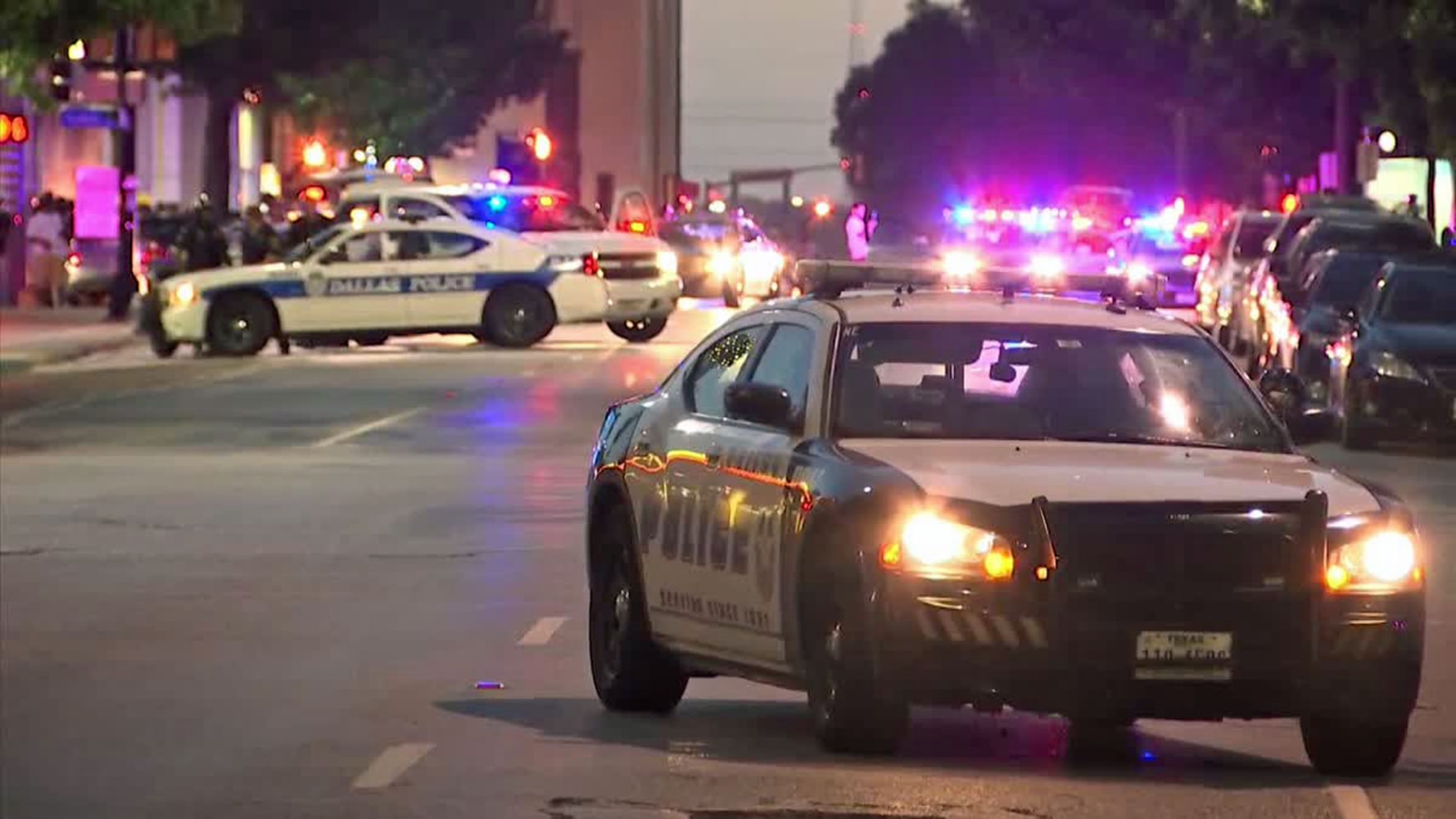
Dallas Officers Shot,11 shot, 4 Dead in Shooting as Protest Ended


Eleven Dallas law enforcement officers were shot, four fatally, on Thursday by what is believed to be two snipers who opened fire during a demonstration downtown over recent police shootings in Minnesota and Louisiana, the Dallas police chief said.

The snipers fired from an elevated positions on police officers minutes before 9 p.m. CT, according to Dallas Police Chief David Brown. He described the shootings as "ambush style."

"We believe that these suspects were positioning themselves in a way to triangulate on these officers from two different perches in garages in the downtown area, and planned to injure and kill as many law enforcement officers as they could," Brown said at a news conference — noting that some were shot in the back.

Police were in a standoff with one suspect in the second floor of a parking garage at around 12:30 a.m. and were exchanging gunfire with him, Brown said. Another suspect, a woman, was taken into custody near the garage, and two people seen leaving the area in a Mercedes were stopped and were being questioned.

The suspect in the standoff with police "has told our negotiators that the end is coming, and he is going to hurt and kill more of us, meaning law enforcement, and that there are bombs all over the place in this garage and downtown," Brown said.


There may be others out there. "We still don't have a complete comfort level that we have all the suspects," Brown said, warning that a search in downtown could last through morning.

Police were in contact with the FBI and federal Bureau of Alcohol, Tobacco, Firearms and Explosives, Brown said.

Police initially said three officers were killed. A fourth officer who had been in surgery later died, Brown said. Three of the four slain officers were Dallas police officers, and the fourth was a Dallas Area Rapid Transit officer, he said. A civilian was also wounded, authorities said.


Around 800 people were at the demonstration, and around 100 police officers were assigned to the event and the surrounding area, Dallas Mayor Mike Rawlings said. The shooting occurred after the demonstration ended and as a march was taking place.

"At 8:58, our worst nightmare happened," Rawlings said. "It is a heartbreaking moment for the city of Dallas, Rawlings said.

A person at the protest said they were "making our second lap" when gunfire erupted.


"We heard shots, we smelled gunpowder, and that's when everything got really intense and surreal," the witness told MSNBC. "We just started to run and grab kids," he said.


Monday, July 4, 2016

Blacks and the 4th of July


Since the American colonies declared independence from Great Britain in 1776, there have been questions of what that independence means for America’s black citizens. As early as 1781, states were officially observing Independence Day – a full 82 years before Lincoln would issue the Emancipation Proclamation and 85 years before the last slaves were freed in Galveston, Texas.

Abolitionist and former slave Frederick Douglass was asked to speak at an Independence Day celebration in 1852 at Rochester’s Corinthian Hall. In a time when most other blacks were still not free, he gave the speech – though it may not have been what the audience expected. Douglass told the crowd, “This Fourth of July is yours, not mine. You may rejoice, I must mourn.” And he asked them, “Do you mean, citizens, to mock me, by asking me to speak to-day?” That speech would later be named after a central question asked by Douglass within it, “What to the Slave Is the Fourth of July?”
In keeping with Douglass’ question and moving speech, NewsOne hit the streets to ask everyday people what Independence Day means to them, how they celebrate and if black Americans should celebrate it at all. Watch!

Saturday, June 4, 2016

Muhammad Ali, 'The Greatest of All Time', Dead at 74

Muhammad Ali was an American professional boxer, generally regarded as the most significant heavyweight in the history of the sport. Wikipedia
Born: January 17, 1942, Louisville, KY
Died: June 3, 2016, Phoenix, AZ
Spouse: Yolonda Williams (m. 1986–2016), More
Siblings: Rahman Ali

As the first black president of the United States, Barack Obama said Ali was "a man who fought for us" and placed him in the pantheon of civil rights leaders Martin Luther King Jr. and Nelson Mandela.


"His fight outside the ring would cost him his title and his public standing. It would earn him enemies on the left and the right, make him reviled, and nearly send him to jail. But Ali stood his ground. And his victory helped us get used to the America we recognize today," Obama said in a statement.
Muhammad Ali, the silver-tongued boxer and civil rights champion who famously proclaimed himself "The Greatest" and then spent a lifetime living up to the billing, is dead.

Ali died Friday at a Phoenix-area hospital, where he had spent the past few days being treated for respiratory complications, a family spokesman confirmed to NBC News. He was 74.


"After a 32-year battle with Parkinson's disease, Muhammad Ali has passed away at the age of 74. The three-time World Heavyweight Champion boxer died this evening," Bob Gunnell, a family spokesman, told NBC News.

Photos: Float Like a Butterfly: Muhammad Ali's Life in Pictures

Ali had suffered for three decades from Parkinson's, a progressive neurological condition that slowly robbed him of both his verbal grace and his physical dexterity. A funeral service is planned in his hometown of Louisville, Kentucky.

His daughter Rasheda said early Saturday that the legend was "no longer suffering," describing him as "daddy, my best friend and hero" as well as "the greatest man that ever lived."

Even as his health declined, Ali did not shy from politics or controversy, releasing a statement in December criticizing Republican presidential candidate Donald Trump's proposal to ban Muslims from entering the United States. "We as Muslims have to stand up to those who use Islam to advance their own personal agenda," he said.

The remark bookended the life of a man who burst into the national consciousness in the early 1960s, when as a young heavyweight champion he converted to Islam and refused to serve in the Vietnam War, and became an emblem of strength, eloquence, conscience and courage. Ali was an anti-establishment showman who transcended borders and barriers, race and religion. His fights against other men became spectacles, but he embodied much greater battles.


Born Cassius Marcellus Clay on Jan. 17, 1942 in Louisville, Kentucky, to middle-class parents, Ali started boxing when he was 12, winning Golden Gloves titles before heading to the 1960 Olympics in Rome, where he won a gold medal as a light heavyweight.


He turned professional shortly afterward, supported at first by Louisville business owners who guaranteed him an unprecedented 50-50 split in earnings. His knack for talking up his own talents — often in verse — earned him the dismissive nickname "the Louisville Lip," but he backed up his talk with action, relocating to Miami to work with top trainer Angelo Dundee and build a case for getting a shot at the heavyweight title.


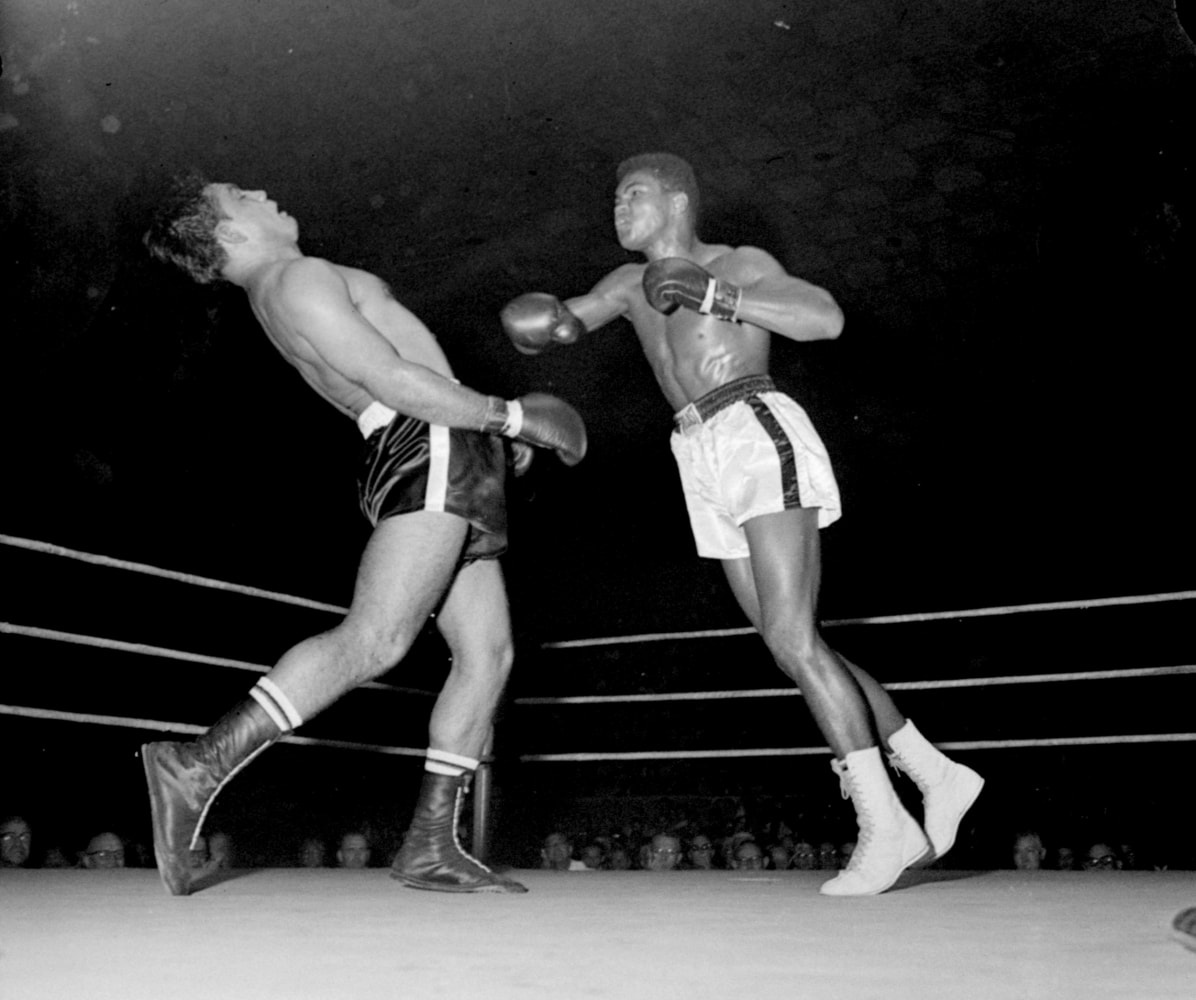
Muhammad Ali, right, attacks Alex Mitoff in the sixth round in which Ali clobbered the Argentinean to the canvas, on Oct. 7, 1961 in Louisville, Ky. H.B. Littell / AP, file

As his profile rose, Ali acted out against American racism. After he was refused services at a soda fountain counter, he said, he threw his Olympic gold medal into a river.

Recoiling from the sport's tightly knit community of agents and promoters, Ali found guidance instead from the Nation of Islam, an American Muslim sect that advocated racial separation and rejected the pacifism of most civil rights activism. Inspired by Malcolm X, one of the group's leaders, he converted in 1963. But he kept his new faith a secret until the crown was safely in hand.

Related: 'Blood Brothers': The Fatal Friendship Between Muhammad Ali and Malcolm X


That came the following year, when heavyweight champion Sonny Liston agreed to fight Ali. The challenger geared up for the bout with a litany of insults and rhymes, including the line, "float like a butterfly, sting like a bee." He beat the fearsome Liston in a sixth-round technical knockout before a stunned Miami Beach crowd. In the ring, Ali proclaimed, "I am the greatest! I am the greatest! I'm the king of the world."


A Controversial Champion

The new champion soon renounced Cassius Clay as his "slave name" and said he would be known from then on as Muhammad Ali — bestowed by Nation of Islam founder Elijah Muhammad. He was 22 years old.


The move split sports fans and the broader American public: an American sports champion rejecting his birth name and adopting one that sounded subversive.

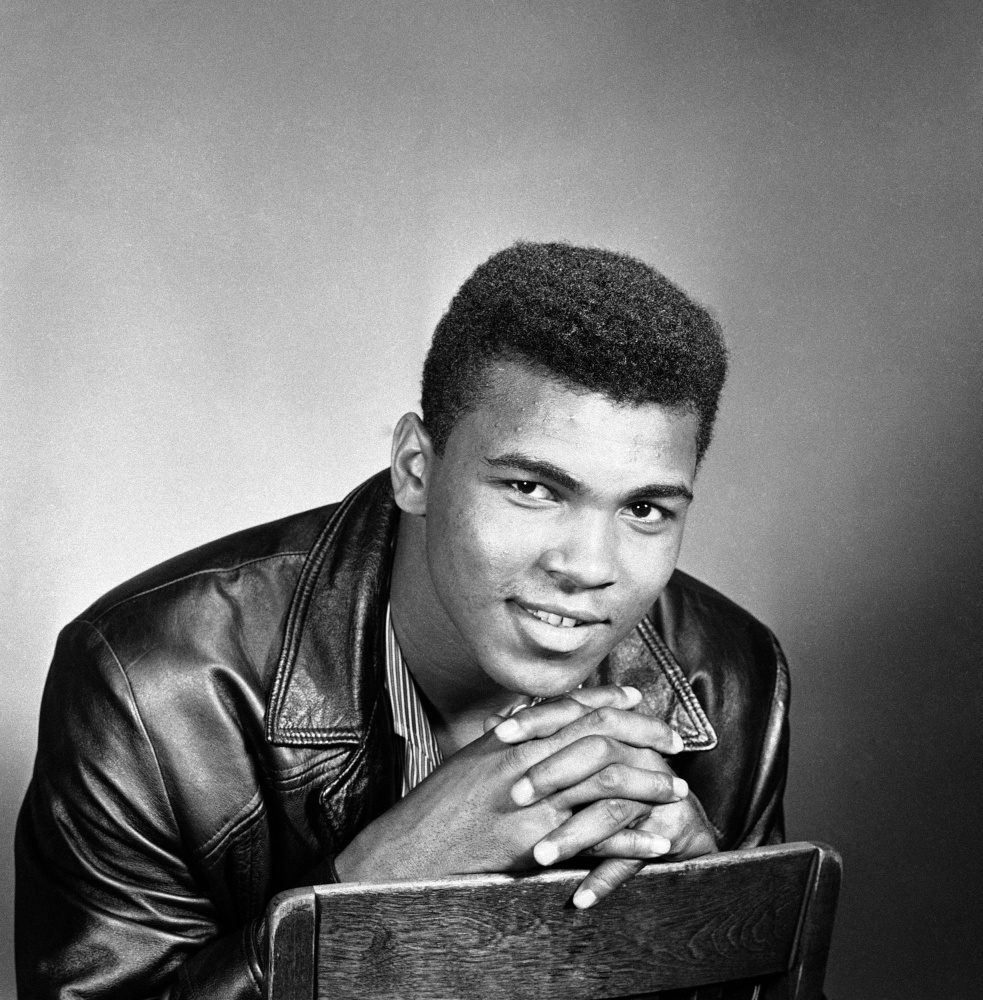
Speaking at a press conference in Chicago on Sept. 25, 1970, deposed world heavyweight champion Muhammad Ali "Cassius Clay" said he might fight Jerry Quarry in New York if Georgia Gov. Lester Maddox succeeds in halting the scheduled Atlanta bout. Charles Kolenovsky / AP, file

Ali successfully defended his title six times, including a rematch with Liston. Then, in 1967, at the height of the Vietnam War, Ali was drafted to serve in the U.S. Army.

He'd said previously that the war did not comport with his faith, and that he had "no quarrel" with America's enemy, the Vietcong. He refused to serve.

"My conscience won't let me go shoot my brother, or some darker people, some poor, hungry people in the mud, for big powerful America, and shoot them for what?" Ali said in an interview. "They never called me nigger. They never lynched me. They didn't put no dogs on me."

His stand culminated with an April appearance at an Army recruiting station, where he refused to step forward when his name was called. The reaction was swift and harsh. He was stripped of his boxing title, convicted of draft evasion and sentenced to five years in prison.

Released on appeal but unable to fight or leave the country, Ali turned to the lecture circuit, speaking on college campuses, where he engaged in heated debates, pointing out the hypocrisy of denying rights to blacks even as they were ordered to fight the country's battles abroad.


"My enemy is the white people, not Vietcongs or Chinese or Japanese," Ali told one white student who challenged his draft avoidance. "You my opposer when I want freedom. You my opposer when I want justice. You my opposer when I want equality. You won't even stand up for me in America for my religious beliefs and you want me to go somewhere and fight but you won't even stand up for me here at home."

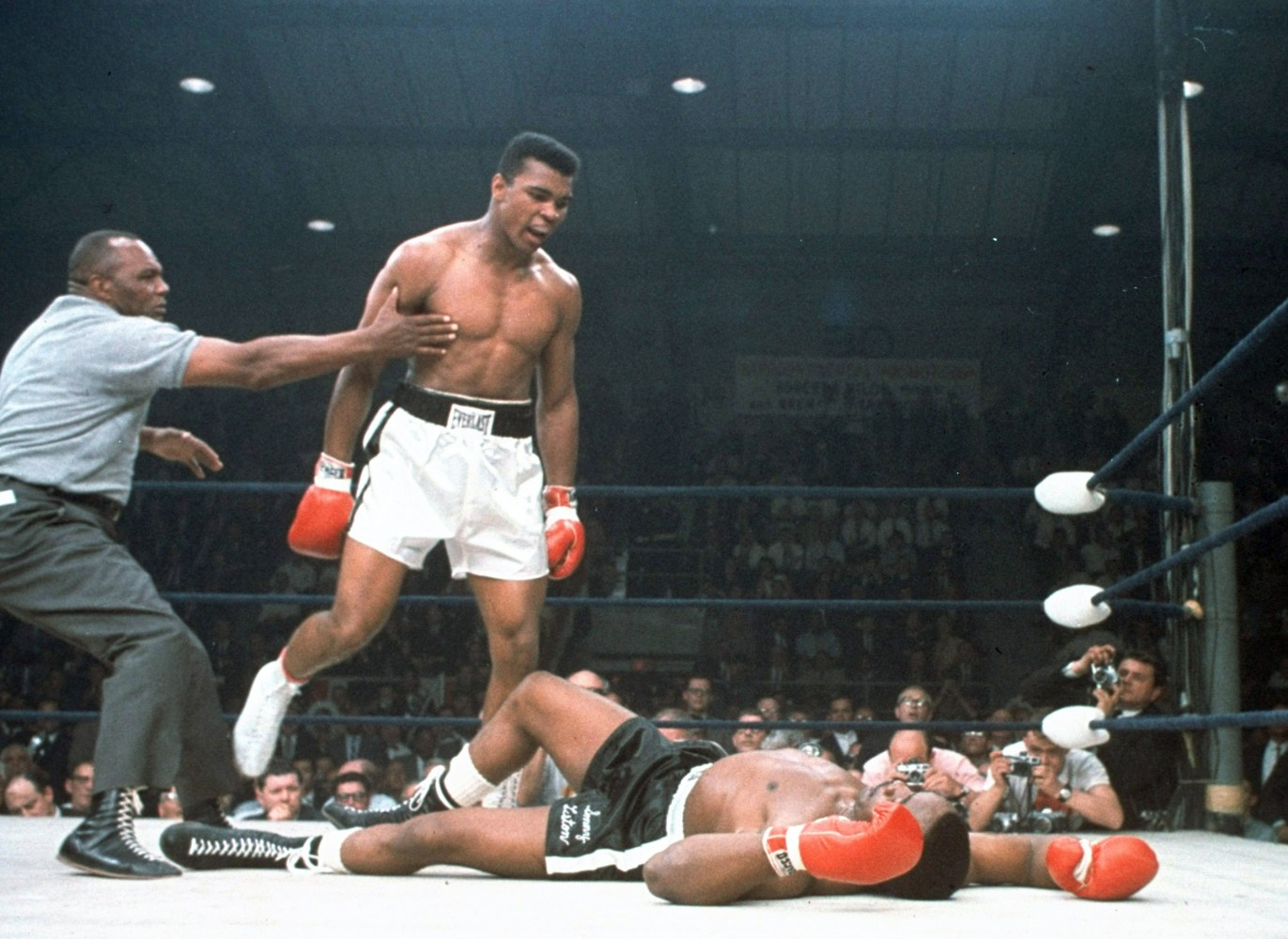
Muhammad Ali is held back by referee Joe Walcott, left, after Ali knocked out challenger Sonny Liston in the first round of their title fight in Lewiston, Maine on May 25, 1965. AP, file

Ali's fiery commentary was praised by antiwar activists and black nationalists and vilified by conservatives, including many other athletes and sportswriters.

His appeal took four years to reach the U.S. Supreme Court, which in June 1971 reversed the conviction in a unanimous decision that found the Department of Justice had improperly told the draft board that Ali's stance wasn't motivated by religious belief.


Return to the Ring

Toward the end of his legal saga, Georgia agreed to issue Ali a boxing license, which allowed him to fight Jerry Quarry, whom he beat. Six months later, at a sold-out Madison Square Garden, he lost to Joe Frazier in a 15-round duel touted as "the fight of the century." It was Ali's first defeat as a pro.

That fight began one of boxing's and sport's greatest rivalries. Ali and Frazier fought again in 1974, after Frazier had lost his crown. This time, Ali won in a unanimous decision, making him the lead challenger for the heavyweight title.

He took it from George Foreman later that year in a fight in Zaire dubbed "The Rumble in the Jungle," a spectacularly hyped bout for which Ali moved to Africa for the summer, followed by crowds of chanting locals wherever he went. A three-day music festival featuring James Brown and B.B. King preceded the fight. Finally, Ali delivered a historic performance in the ring, employing a new strategy dubbed the "rope-a-dope," goading the favored Foreman into attacking him, then leaning back into the ropes in a defensive stance and waiting for Foreman to tire. Ali then went on the attack, knocking out Foreman in the eighth round. The maneuver has been copied by many other champions since.

The third fight in the Ali-Frazier trilogy followed in 1975, the "Thrilla in Manila" that is now regarded as one of the best boxing matches of all time. Ali won in a technical knockout in the 15th round.


Ali successfully defended his title until 1978, when he was beaten by a young Leon Spinks, and then quickly took it back. He retired in 1979, when he was 37, but, seeking to replenish his dwindling personal fortune, returned in 1980 for a title match against Larry Holmes, which he lost. Ali lost again, to Trevor Berbick, the following year. Finally, Ali retired for good.
Muhammad Ali, right, takes a punch from Trevor Berbick, of Canada, during the first round of their 10-round bout in Nassau, Bahamas, in this Dec. 11, 1981 file photo. AP, file

'He's Human, Like Us'

The following year, Ali was diagnosed with Parkinson's.

"I'm in no pain," he told The New York Times. "A slight slurring of my speech, a little tremor. Nothing critical. If I was in perfect health — if I had won my last two fights — if I had no problem, people would be afraid of me. Now they feel sorry for me. They thought I was Superman. Now they can go, 'He's human, like us. He has problems.' ''


Even as his health gradually declined, Ali — who switched to more mainstream branches of Islam — threw himself into humanitarian causes, traveling to Lebanon in 1985 and Iraq in 1990 to seek the release of American hostages. In 1996, he lit the Olympic flame in Atlanta, lifting the torch with shaking arms. With each public appearance he seemed more feeble, a stark contrast to his outsized aura. He continued to be one of the most recognizable people in the world.

He traveled incessantly for many years, crisscrossing the globe in appearances in which he made money but also pushed philanthropic causes. He met with presidents, royalty, heads of state, the Pope. He told "People" magazine that his largest regret was not playing a more intimate role in the raising of his children. But he said he did not regret boxing. "If I wasn't a boxer, I wouldn't be famous," he said. "If I wasn't famous, I wouldn't be able to do what I'm doing now."

In 2005, President George W. Bush honored Ali with the Presidential Medal of Freedom, and his hometown of Louisville opened the Muhammad Ali Center, chronicling his life but also as a forum for promoting tolerance and respect.

Divorced three times and the father of nine children — one of whom, Laila, become a boxer — Ali married his last wife, Yolanda "Lonnie" Williams, in 1986; they lived for a long time in Berrien Springs, Michigan, then moved to Arizona.

In recent years, Ali's health began to suffer dramatically. There was a death scare in 2013, and last year he was rushed to the hospital after being found unresponsive. He recovered and returned to his new home in Arizona.

In his final years, Ali was barely able to speak. Asked to share his personal philosophy with NPR in 2009, Ali let his wife read his essay:


"I never thought of the possibility of failing, only of the fame and glory I was going to get when I won," Ali wrote. "I could see it. I could almost feel it. When I proclaimed that I was the greatest of all time, I believed in myself, and I still do." 

Muhammad Ali's Hometown of Louisville Honors the Late Boxer as 'Our Inspiration'
by JON SCHUPPE
As the world awoke to news of Muhammad Ali's overnight death, the people of Louisville, Kentucky, found ways Saturday to remember their hometown hero. They lowered flags in mourning. Gathered in civic squares to share local pride. And prepared to welcome him home — for the final time — with a funeral.

Outside the Muhammad Ali Center, locals created an impromptu memorial, leaving flowers and written tributes.


A few blocks away at Louisville Metro Hall, Mayor Greg Fischer marveled at the many outsize roles Ali embodied: sports champion, civil rights icon, humanitarian and "interfaith pioneer."

"The Louisville Lip spoke to everyone," Fischer said, referring to the dismissive nickname the press gave the boastful Ali early on his career. "But we heard him in a way no one else could, as our brother, our uncle and our inspiration."

Ali died late Friday night in an Arizona hospital after being admitted a day earlier with what his family described as respiratory problems. He had suffered for more than three decades from Parkinson's disease. A cause of death has not yet been announced.

Related: Muhammad Ali, 'The Greatest of All Time', Dies at 74

At the Muhammad Ali Center, CEO Donald E. Lassere read a statement from the institution, which said Ali "will be remembered for his love for all people, his athleticism, his humanitarian deeds, social justice and perhaps mostly his courage in and out of the ring."

Lassere added, "And I'm sure Muhammad would want me to say this as well: he would want to be remembered for how pretty he was."

Fischer asked his audience outside Metro Hall to imagine what it must have been like to witness Ali, born Cassius Marcellus Clay Jr. in 1942, as an infant — his long, remarkable life still ahead of him.

Photos: Float Like a Butterfly: Muhammad Ali's Life in Pictures

"Imagine that day, that little boy, eyes wide open, looking around the the room at the old Louisville General Hospital, not knowing the life that awaited him, the life he would make, the world he would shake up, and the people he would inspire," Fischer said. "And like you, I am absolutely one of those people."

The mayor added: "Muhammad Ali belongs to the world, but he only has one hometown."


To accentuate that point, Fischer pointed out some of the many honors and titles Ali accrued in his post-boxing career: Amnesty International lifetime achievement award, Presidential Medal of Freedom, Sports Illustrated's Sportsman of the Century, and co-founder, with his wife, Lonnie, of the Muhammad Ali Center, created to "promote respect, hope and understanding in Louisville and around the world."
Earlier on Saturday, a spokesman for Ban Ki-moon, secretary general of the United Nations, which named Ali a "messenger of peace" in 1998, called him "a world champion for equality and peace."
The spokesman recalled Ali first connecting with the U.N. in the 1970s to campaign against apartheid and racial injustice. Later, Ali traveled the world for the U.N. to support children's initiatives and racial and political reconciliation.

"The United Nations is grateful to have benefited from the life and work of one of the past century's great humanitarians and advocates for understanding and peace," the statement said.  

Thursday, June 2, 2016

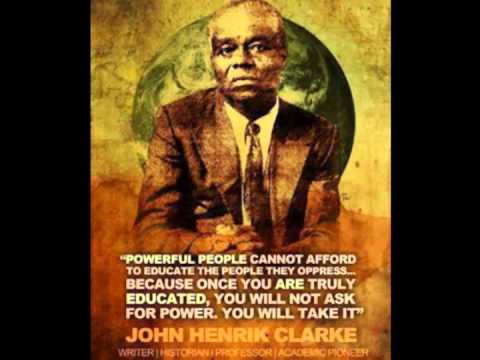
"Concept of Deity” by Dr. John Henrik Clarke

To hold a people in oppression you have to convince them first that they are supposed to be oppressed.
When the European comes to a country, the first thing he does is to laugh at your God and your God concept. And the next thing is to make you laugh at your own God concept. Then he don't have to build no jails for you then, cause he's got you in a jail more binding than iron can ever put you.
Anytime you turn on your own concept of God, you are no longer a free man. No one needs to put chains on your body, because the chains are on your mind.
Anytime someone say's your God is ugly and you release your God and join their God, there is no hope for your freedom until you once more believe in your own concept of the "deity."
And that's how we're trapped. We have been educated into believing someone else's concept of the deity, and someone else's standard of beauty. You have the right to practice any religion and politics in a way that best suits your freedom, your dignity, and your understanding. And once you do that, you don't apologize.
Nothing the European mind ever devised was meant to do anything but to facilitate the European's control over the world. Anything that you get from Europe that you are going to use for yourself, remake it to suit yourself.
Where did we go wrong educationally? After the Civil War, the period called reconstruction, a period of pseudo-democracy, we began to have our own institutions, our own schools. We had no role model for a school... our own role model. So we began to imitate White schools.
Our church was an imitation of the White church. All we did is to modify the old trap. We didn't change the images, we became more comfortable within the trap. We didn't change the images, we changed some of the concepts of the images, but the images remained the same. So the mis-education that gave us a slave mentality had been altered. But it remained basically the same.
The late Dr. John Henrik Clarke, a pre-eminent African-American historian, author of several volumes on the history of Africa and the Diaspora, taught in the Department of Black and Puerto Rican Studies at Hunter College of the City University of New York.

Friday, May 27, 2016

Donald Trump: The So-Called Phenomenon as Explained by a French Philosopher


This French Philosopher Is The Only One Who Can Explain The Donald Trump Phenomenon


BY JUDD LEGUM SEP 14, 2015 8:40 AM

Donald Trump has political pundits stumped.
They’ve been predicting his imminent downfall for months. Every “gaffe” that was supposed to destroy his support has only made him stronger. “DON VOYAGE: Trump Toast After Insult,” a headline in the New York Post blared nearly two months ago. The insult at issue, questioning John McCain’s military service, is so many insults ago that it isn’t even mentioned any more.
Meanwhile, Trump still dominates the polls, leading the GOP field by about 14 points nationally. With the exception of one poll in John Kasich’s home state of Ohio, Trump has led every state and national poll since the beginning of August.
You won’t find Roland Barthes on the Sunday morning roundtables dissecting the presidential race. Barthes is a French philosopher who died in 1980. But his work may hold the key to understanding Trump’s popularity and his staying power.
Barthes is best known for his work in semiotics, the study of signs and symbols. But he wasn’t limited to lengthy, esoteric treatises. Rather, Barthes published much of his work in short, accessible pieces breaking down elements of popular culture. The New York Times described Barthes as the godfather of the TV recap.
His most famous essay, published in his 1957 book Mythologies, focuses on professional wrestling. Could an essay about professional wrestling hold the key to understanding Trump’s appeal? It’s worth noting that, before he was a presidential candidate, Trump was an active participant in the WWE. In 2013, Trump was inducted into the WWE Hall of Fame.
TrumpWWE2

In his essay, Barthes contrasts pro wrestling to boxing.
This public knows very well the distinction between wrestling and boxing; it knows that boxing is a Jansenist sport, based on a demonstration of excellence. One can bet on the outcome of a boxing-match: with wrestling, it would make no sense. A boxing- match is a story which is constructed before the eyes of the spectator; in wrestling, on the contrary, it is each moment which is intelligible, not the passage of time… The logical conclusion of the contest does not interest the wrestling-fan, while on the contrary a boxing-match always implies a science of the future. In other words, wrestling is a sum of spectacles, of which no single one is a function: each moment imposes the total knowledge of a passion which rises erect and alone, without ever extending to the crowning moment of a result.
In the current campaign, Trump is behaving like a professional wrestler while Trump’s opponents are conducting the race like a boxing match. As the rest of the field measures up their next jab, Trump decks them over the head with a metal chair.
Others in the Republican field are concerned with the rules and constructing a strategy that, under those rules, will lead to the nomination. But Trump isn’t concerned with those things. Instead, Trump is focused on each moment and eliciting the maximum amount of passion in that moment. His supporters love it.
The key to generating passion, Barthes notes, is to position yourself to deliver justice against evil forces by whatever means necessary. “Wrestlers know very well how to play up to the capacity for indignation of the public by presenting the very limit of the concept of Justice,” Barthes writes.
Trump knows how to define his opponent — China, “illegals,” hedge fund managers — and pledges to go after them with unbridled aggression. If, in making his case, he crosses over a line or two, all the better.
TrumpWWE4

For a pro wrestler, energy is everything. A wrestling fan is less interested in what is happening — or the coherence of how one event leads to the next — than the fact that something is happening. On that score, Trump delivers. He is omnipresent on TV. When he can’t make it in front of the camera, he’ll simply call in. When he’s not on TV, he’s tweeting boasts, insults, and non-sequiturs. When he runs out of things to tweet, he retweets random comments from his supporters.
Along those lines, Trump’s favorite insult — which he has employed repeatedly against Jeb Bush and, more recently, Ben Carson — is that his opponents are “low energy.”
Frenetic action is suicidal for a boxer, or a traditional politician. But Trump is not bound by those limitations. The crazier things get — Trump suggesting a popular Fox News host asked him a tough question because she was menstruating, for example — the more Trump’s supporters love it.
Some fights, among the most successful kind, are crowned by a final charivari, a sort of unrestrained fantasia where the rules, the laws of the genre, the referee’s censuring and the limits of the ring are abolished, swept away by a triumphant disorder which overflows into the hall and carries off pell-mell wrestlers, seconds, referee and spectators.
But why can’t voters see that what Trump offers is just an act? As Barthes illustrates, that’s asking the wrong question.
It is obvious that at such a pitch, it no longer matters whether the passion is genuine or not. What the public wants is the image of passion, not passion itself. There is no more a problem of truth in wrestling than in the theater.
This analogy reveals why the attacks on Trump are so ineffective. Recently, Rand Paul and others have taken to calling out Trump as an “entertainer,” rather than a legitimate candidate. This is as effective to running into the middle of the ring during Wrestlemania and yelling: “This is all fake!” You are correct, but you will not be received well.

TrumpWWE1

One of Barthes’ central points is that boxing — or traditional rules and decorum — is not morally superior to pro wrestling. In fact, for all its artifice, one could argue that pro wrestling today is a more noble pursuit than boxing, which is hopelessly corrupt and currently dominated by a convicted domestic abuser and unrepentant misogynist.
Similarly, Trump is able to take advantage of the obvious dysfunction of the traditional political system. In 2016, the candidates are shadowed by massively funded Super PACs that often rely on just a few donors. Many Republican candidates hold positions supported by this elite donor class but not the electorate at large. Others refuse to answer questions at all.
Compared to this system, the things that Trump is offering — passion, energy, a sense of justice — may not seem so bad.
Does this mean that Trump will be the Republican nominee? No one really knows. But we do know that traditional punditry is incapable of understanding his appeal.
Roland Barthes has been dead for 35 years, but he may be onto something.

Monday, May 16, 2016

"VIRUS" warning popped up? Don't call that number! Don't get scammed!


Practical Computer Advice
from Martin Kadansky
Volume 9 Issue 8August 2015

A "virus" warning popped up? Don't call that number! Don't get scammed!

Whether you have a Windows computer or a Macintosh, this could happen to you.

How it starts
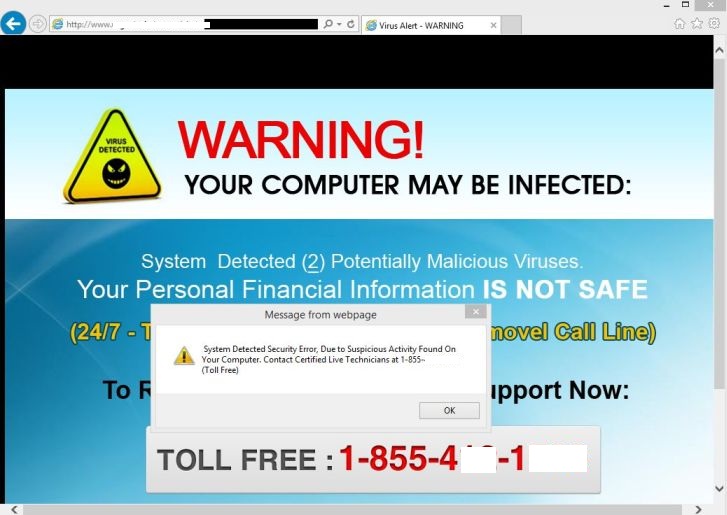
You're using your computer when out of the blue a "virus" or "infection" or "suspicious connection" warning pops up on your screen. It will probably use a variety of technical-sounding phrases to tell you that there's a problems, and that you are at risk for all kinds of scary consequences ("computer damage," "data corruption", etc.). You might see multiple pop-ups. At the end of this text there is a phone number you can call to get help.

In addition you may see a "blue screen" or other colorful text and images, claiming there is a problem with your computer.

You may also hear a man's or woman's voice coming from your computer, telling you that this is urgent, call immediately, you are at risk, etc. Or you might hear a siren noise.

Don't believe it! This is a scam, pure and simple. These messages and sounds are all designed to scare you, make you leave your common sense aside, and intimidate you into calling that number.
The message on your screen will probably have an "OK" button that, when you click it, closes and then immediately reopens the alert, making you feel trapped, and reinforcing the illusion that you have only one option, to call that number.

Don't fall for this! Just because it says there's a problem on your computer screen doesn't make it true.
What happens if you call
You will reach someone who will claim to be able to help you. Everything they say is designed to move you through their agenda:
  • Convince you that there is a problem with your computer, which there isn't. (Yes, it's possible that your computer might have some infections, but calling a stranger on the phone is not the way to deal with them. Trust me.)
  • If you ask them who they are or who they work for, they will tell you anything to convince you to move forward with their agenda - Microsoft, Google, Apple, etc.
  • They will use anything and everything you tell them about you or your situation to reinforce their scare tactics and manipulation.
  • Their next step is to have you download some software into your computer to permit them to make a remote connection, giving them live control of your computer.
  • Then they will run fake "scans" that "prove" that you have "infections" in order to further convince you that there is a problem. I call this the "floor show."
  • Their goal is to convince you to pay them to "remove" these supposed "infections." They may also try to sell you a service contract. The "scan" was free, but the "solution" carries a fee.
  • If you agree and pay them, probably anywhere from $40 to $200 by credit card, they will pretend to "fix" the "problems," but they are most likely installing software that may monitor your activities and steal your money and identity and passwords instead. In essence you'll be paying them to infect your computer, and in the long run this may cost you far more than the charge for just this "fix."
  • If you refuse, they may try to lock you out of your computer until you pay them.
Signs this is a scam
  • You can't tell where this "alert" came from, it is intentionally vaguely phrased. If you have antivirus or antimalware software (and you remember what it's called), wouldn't that software identify itself? If you don't have any protection software installed, why would a protection alert appear?
  • You are feeling pressured and rushed and trapped into calling that number.
  • You have no idea who you are calling. Why are you trusting your computer to a complete stranger?
  • The person you speak to is vague, manipulative, and doesn't explain what is going on.
  • You can hear that they're in a large room with other people handling similar calls.
What you should do when this happens instead of calling
Don't call that number. Do anything else instead. I suggest:
  • Stop.
  • Take a breath.
  • Don't panic.
  • If you're hearing an urgent voice or siren from the computer, turn your volume or speakers off.
  • Look at what is actually going on: You are probably looking at a web site. There is some text on the screen. Your browser might be "stuck" in an alert. That's it. Nothing is going to explode, no one's going to die.
  • Don't believe anything it says on the screen, no matter how convincing or authoritative it sounds.
  • Try to terminate the web browser.
  • Try to restart the computer, or try powering it off and on again.
  • If yours is a newer computer, it might have a very clever setting that "remembers" exactly what you had open (programs, documents, web sites) when you turned it off, so that when you turn it back on again, it reopens everything just the way it was. Unfortunately, in this instance that's exactly what you don't want, since you may end up stuck in that fake "virus" alert all over again.
  • Try a different web browser.
  • If you can't figure out how to get out of that alert, contact someone you trust to help you, or get a recommendation from someone you trust. Try to be patient, this may take a little time to fix.
What you should do if you did call that number and let that stranger get into your computer
I suggest:
  • Hang up right away. There is no need to be polite or to explain yourself.
  • Immediately turn your computer off, forcing it to power off if necessary. That will terminate the remote connection.
  • Turn your computer back on again.
  • If you find that you're still stuck in that fake "virus" alert, contact someone you trust to help you, or get a recommendation from someone you trust.
  • Also have that trusted person check your computer for infections and malware.
  • If you authorized payment to that stranger on the phone, immediately call your bank or credit card company, report that you were scammed, and contest the charges.
  • Don't beat yourself up about this. Anyone can be fooled, especially if they're taken by surprise with just the right phrasing in just the right moment. Yes, I have also been fooled from time to time.
  • Learn from this. Next time the scam may present itself in a more sophisticated way--Better phrased text, better graphics, a less-generic, more-targeted pitch. They might even use the name of someone you know and trust.

How did this happen?
From the growing number of calls I'm getting from my clients about this problem, here's what I think probably happened:
  • You were using your web browser.
  • You were searching for something, or you indirectly started a search.
  • You clicked an interesting link in the search results.
  • You landed on a malicious web site that started this process, i.e. that web site immediately put up a fake "virus" alert, designed to keep you trapped.
Or, you might have clicked a link on some other web site, or in an advertisement, or in an email, and then landed on a malicious site.

This is relatively easy to make happen. All the scammers have to do is:
  • Create the malicious web site, which simply displays the alert and won't close when you click OK.
  • Put a number of popular keywords on it - Sex, money, health issues, popular product names, celebrities, news items, etc., so it's likely to be found when people search for those things.
  • Submit that web sit to search engines like Google and Bing.
  • Set up their toll-free numbers, gather and train their people to answer the phones.
  • Sit back and wait for people like you and me to search around, find their site, and click on it.
Where to go from here
If you're confused or frustrated by something on your computer, I like to say, "You can do it!" You might just need a little encouragement, or information, or change of perspective, and that's where I come in.

How to contact me:
email: martin@kadansky.com
phone: (617) 484-6657
web: http://www.kadansky.com

On a regular basis I write about real issues faced by typical computer users. To subscribe to this newsletter, please send an email to martin@kadansky.com and I'll add you to the list, or visit http://www.kadansky.com/newsletter

Did you miss a previous issue? You can find it in my newsletter archive:http://www.kadansky.com/newsletter

Your privacy is important to me. I do not share my newsletter mailing list with anyone else, nor do I rent it out.

Copyright (C) 2015 Kadansky Consulting, Inc. All rights reserved.

I love helping people learn how to use their computers better! Like a "computer driving instructor," I work 1-on-1 with small business owners and individuals to help them find a more productive and successful relationship with their computers and other high-tech gadgets.