Thursday, March 7, 2024

Freedom Land - Co-Op City The Northeast Bronx
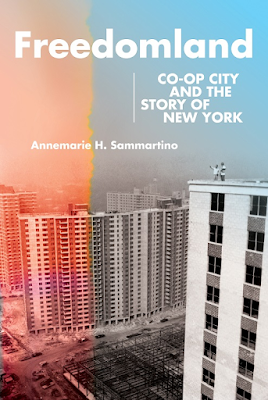
 Freedom Land - Co-Op City The Northeast Bronx


Most New Yorkers have probably never been to Co-Op City, the massive residential development in the Bronx. And that’s partially by design.

This historic development, built upon the site of the old Freedomland amusement park, is the largest single residential development in the world. It is a true city-within-a-city — and also a place seemingly outside the patterns of regular New York City life.
But a new book dispels the myth of Co-Op City’s perceived independence and refocuses it front and center as a landmark to renter’s rights and the changing nature of housing in modern New York. Freedomland
Co-Op City and the Story of New York by Annemarie H. Sammartino

Co-Op City, March 1973. Photo by Gary Miller/EPA, courtesy National Archives


‘Freedomland’: A New Book Explores the Story of Co-Op City


Freedomland

Co-Op City and the Story of New York

Annemarie H. Sammartino Three Hills/Cornell University Press

In Freedomland, Annemarie H. Sammartino, an Oberlin College history professor and a former resident of Co-Op City, reveals the rich and often contentious history of one of New York’s most famous development projects.

The massive Co-op City development, first announced in 1965, was born from the optimism of the Mitchell-Lama housing program, New York State’s push to provide its residents with affordable housing.

It is quintessential ’60s architecture. One reason it is often maligned is its stark modernist arrangement, the very anti-Jane Jacobs tower-in-the-park style more frequently seen in public housing.

Sammartino reveals those criticisms were lobbed at the development from the very start. She quotes a Columbia architecture professor, who believed “Co-Op City’s architectural banality rendered it an illegitimate ‘negation of the ideals of the great society.’ “

Life at the development, early 1970s. courtesy of Co-op City via 6Sqft

But its affordability and its modern amenities — its newness in a city of such much deteriorating housing — greatly appealed to middle class buyers, particular Jewish residents of the Western Bronx.

During the late 1920s and into the 30s, thousands of Jewish New Yorkers left the Lower East Side and moved to Bronx cooperatives associated with labor unions. Now, in the 1960s, their children were moving again, contributing to a devastating mass exodus from Bronx residential regions like the Grand Concourse.
“Co-op City’s location on the urban fringe made it attractive to those seeking to escape the city,” Sammartino writes, “but without the means to purchase a suburban home.”

Initially 70 percent of the residents were Jewish. In the first years, as more Black and Hispanic residents would move in, Co-Op City was seen as a success of social integration. The author quotes from one of Co-Op City’s most famous residents — Justice Sonia Sotomayor — recalling her childhood days and her interactions with Jewish residents.

But in a city in economic freefall during the 1970s, Co-Op City was not immune to financial woes, especially as tensions between the residents and the Co-Op City’s developer the United Housing Foundation. Saddled with mounting debt, the UHF began raising carrying charges (like maintenance fees).

“In private, UHF leaders were themselves increasingly distraught about rising costs in their developments,” Sammartino writes. “They worried that inflation meant not only their own fate, but that of the ‘entire democratic system’ was increasingly precarious.”

Things came to a head in 1975 with the “largest rent strike in American history,” a protest which eventually lead to the residents themselves being awarded control of Co-op City.

Sammartino then charts further struggles as cycles of city crime and decay belatedly arrive to Co-Op City. But today the place can be seen as exceeding all its initial expectations. Still without a direct subway line (something Robert Moses hinted at during the building’s groundbreaking), Co-Op City has developed into something those initial naysayers would not have imagined — a proper community.


Co-op City (short for Cooperative City) is a cooperative housing development located in the northeast section of the borough of the Bronx in New York City. It is bounded by Interstate 95 to the southwest, west, and north and the Hutchinson River Parkway to the east and southeast, and is partially in the Baychester and Eastchester neighborhoods. With 43,752 residents as of the 2010 United States Census,[2] it is the largest housing cooperative in the world.[3] It is in New York City Council District 12.

Co-op City was formerly marshland before being occupied by an amusement park called Freedomland U.S.A. from 1960 to 1964. Construction began in 1966 and the first residents moved in two years later, though the project was not completed until 1973. The construction of the community was sponsored by the United Housing Foundation and financed with a mortgage loan from New York State Housing Finance Agency.

The community is part of Bronx Community District 10 and its ZIP Code is 10475. Nearby attractions include Pelham Bay Park, Orchard Beach and City Island.

Co-op City's 15,372 residential units are composed of 35 high-rise buildings and seven clusters of townhouses, making it the largest residential development in the United States.[4] It sits on 320 acres (1.3 km2), though only 20% of the land was developed, leaving many green spaces. The apartment buildings range from 24 to 33 floors. There are four types of buildings: 10 Triple Core (26 stories high with 500 apartment units per building), 10 chevron (24 stories, 414 units), 15 tower (33 stories, 384 units), and 236 town houses. The townhouses are three stories high and have a separate garden apartment and upper duplex apartment.[5]

This "city within a city" also has eight parking garages, three shopping centers, a 25-acre (100,000 m2) educational park, including a high school, two middle schools, and three grade schools. More than 40 offices are rented by doctors, lawyers, and other professionals, and there are 15 houses of worship. Spread throughout the community are six nursery schools and day care centers, four basketball courts, and five baseball diamonds. The adjacent Bay Plaza Shopping Center has a 13-screen multiplex movie theater, department stores, and a supermarket.

The development was built on landfill, and the original marshland still surrounds it. The building foundations extend down to bedrock through 50,000 pilings,[6] but the land surrounding Co-op's structures settles and sinks a fraction of an inch each year, creating cracks in sidewalks and entrances to buildings.[7]

Street names[edit]

Most streets in the community are named after notable historical personalities. Generally, streets in section one begin with the letter "D", section two begins with the letter "C", section three with the letter "A", section four with the letter "B" and section five with the letter "E".[8]

  • Adler Place – named for archaeologist Cyrus Adler[8]: 16 
  • Alcott Place – named for author Louisa May Alcott, it is located directly above the former path of Rattlesnake Brook, which originated in Edenwald[8]: 17 
  • Aldrich Street – named for author Thomas Bailey Aldrich[8]: 17 
  • Asch Loop – named for author Sholem Asch[8]: 22 
  • Bellamy Loop – named for writer Edward Bellamy, it was located on the eastern edge of Pinckney's Meadow and located on the path of Rattlesnake Brook before becoming part of Freedomland[8]: 31 
  • Benchley Place – named for writer Robert Benchley[8]: 31 
  • Broun Place – named for sportswriter Heywood Broun[8]: 41 
  • Carver Loop – named for inventor George Washington Carver, it was formerly swampland and a tidal creek, not part of Freedomland[8]: 48 
  • Casals Place – named for conductor Pablo Casals, it was formerly swampland and not part of Freedomland[8]: 48 
  • Cooper Place – named for author James Fenimore Cooper, it was formerly a navigable tidal creek[8]: 59 
  • Darrow Place – named for lawyer Clarence Darrow[8]: 66 
  • Debs Place – named for socialist Eugene V. Debs[8]: 67 
  • Defoe Place – named for author Daniel Defoe[8]: 67 
  • De Kruif Place – named for microbiologist Paul de Kruif[8]: 68 
  • Donizetti Place – named for composer Gaetano Donizetti, it was a mill lane for 250 years before Co-op City was built[8]: 72 
  • Dreiser Loop – named for journalist Theodore Dreiser, it was part of the parking lot for Freedomland and located on the path of Rattlesnake Brook[8]: 74 
  • Earhart Lane – named for aviator Amelia Earhart, it was formerly occupied by barges and frame houses[8]: 76 
  • Einstein Loop – named for physicist Albert Einstein, it is the site of Givans and Barrow Creeks, on what was formerly the 14-acre Rose Island[8]: 97 
  • Elgar Place – named for composer Edward Elgar, it is the site of Givans Creek[8]: 98 
  • Erdman Place – named for poet Loula Grace Erdman, it is the site of Givans Creek[8]: 100 
  • Erskine Place – named for educator, author, pianist, and composer John Erskine[8]: 100 

Other streets include:


History
Previous land use


The land north of the Hutchinson River Parkway was a large swampy area known by residents as "the dump", and most of the land on the north side of the Hutchinson River was flat land used for recreation.

The land to the south of the Hutchinson River (now Section 5 of Co-op City) was swampland. A tidal estuary reached from the Hutchinson River at the New Haven Railroad along a route just north of Hunter and Boller Avenue to pass under the Hutchinson River Parkway. The estuary was the site of boat yards and canoe rental sites during the 1950s.

The northern portion of the site became the home of a 205-acre theme park named Freedomland U.S.A. Freedomland operated from June 19, 1960[10] until September 1964, when it closed after going bankrupt.[11][12] A small portion of the former park site at the northeast corner of Bartow and Baychester Avenues in Co-op City remains zoned as a C7 district,[13] reserved "for large open amusement parks".[14] The zoning district is a holdover from Freedomland's operation.[15][16]

Development

In February 1965, plans were announced for the residential Co-op City development, the world's largest housing cooperative, on the site.[17] The plans for Co-op City were announced in May 1965, with no provisions for an amusement park.[18] Construction on Co-op City began in May 1966.[19] While much of the Freedomland site and some of the surrounding land was infilled, several existing houses were retained along Givans Creek (near Section 5 of Co-op City) because of opposition from residents there. These houses received sewage and other utilities, though these projects were delayed. There was a controversy when Co-op City builders filled the land to grade, because the existing houses were located as much as 12 feet (3.7 m) below grade, and filling for the main development caused storm runoff to flood the existing houses.[20]

Residents began moving in during December 1968,[21] and construction was completed in 1973. The project was sponsored and built by the United Housing Foundation, an organization established in 1951 by Abraham Kazan and the Amalgamated Clothing Workers of America, and was designed by cooperative architect Herman J. Jessor. The name of the complex's corporation itself was later changed to RiverBay at Co-op City.

Financing

Co-op City in 1973; the lot in the foreground is a dump
The construction of the community was financed with a mortgage loan from New York State Housing Finance Agency (HFA). The complex defaulted on the loan in 1975 and has had ongoing agreements to pay back HFA.


Mismanagement, shoddy construction, and corruption led to the community's defaulting on its loan in 1975. The original Kazan board resigned, and the state took over control. Cooperators, faced with a 25-percent increase in their monthly maintenance fees, organized residents to refuse to pay their monthly maintenance fees. New York State threatened to foreclose on the property and evict the residents, which would mean the loss of their equity. However, cooperators stayed united and held out for 13 months (the longest and largest strike of its kind in United States history) before a compromise was finally reached, with mediation from then-Bronx Borough President Robert Abrams and then-New York Secretary of State Mario Cuomo. Cooperators would remit $20 million in back payments of maintenance fees, but they would get to take over management of the complex and set their own fees.[22]

The shares of stock that prospective purchasers bought to enable them to occupy Co-op City apartments became the subject of protracted litigation, culminating in a United States Supreme Court decision United Housing Foundation, Inc. v. Forman, 421 U.S. 837 (1975).[23] 57 residents sued because they had been charged for costs that were not described in a 1965 Information Bulletin seeking to attract residents for apartments in Co-op City. The Supreme Court held that federal courts have no jurisdiction of shares of stock that allow the purchaser to live in an apartment in Co-op City because they are not federally-regulated shares of commercial stock.[24]

In 2004, Co-op City was financially unable to continue payments to HFA due to the huge costs of emergency repairs. New York Community Bank helped RiverBay satisfy its $57 million mortgage obligation, except for $95 million in arrears, by refinancing the loan later that same year. This led to the agreement that Co-op City would remain in the Mitchell-Lama Housing Program for at least seven more years as a concession on the arrears and that any rehabilitation that Co-op City took on to improve the original poor construction (which happened under New York State's watch) would earn credit toward eliminating the debt. By 2008, RiverBay had submitted enough proof of construction repairs to pay off the balance of arrears to New York State.

Renovations

View from corner of Asch Loop/Co-op City Boulevard in 2006

Within the first decade of the 2000s, the aging development began undergoing a complex-wide $240 million renovation, replacing piping and garbage compactors, rehabilitating garages and roofs, upgrading the power plant, making facade and terrace repairs, switching to energy-efficient lighting and water-conserving technologies, replacing all 130,000 windows and 4,000 terrace doors (costing $57.9 million in material and labor) and all 179 elevators. The word "renaissance" is being used to describe this period in Co-op City history. Many of these efforts are also helping in the "greening" of the complex: the power-plant will be less polluting, the buildings will be more efficient and recycling efforts will become more extensive. The New York State Energy Research and Development Authority (NYSERDA) awarded its largest ever grant—$5.2 million—to the community under its NY Energy $mart Assisted Multifamily Program.

In 2003, after a partial collapse in one garage, inspectors found 5 of the 8 garages to be unsafe and ordered them closed for extensive repairs. The other 3 garages were able to remain partially open during repairs. To deal with the parking crisis, New York City allowed angled parking in the community, the large greenways in the complex were paved over to make outdoor parking lots and agreements were made with nearby shopping centers to use their extra parking spaces. All garages were re-opened by January 2008, and work began to restore the greenways that had been paved.

Financial responsibility for these upgrades was the subject of a protracted dispute between RiverBay and the State of New York.[25] Co-op City was developed under New York's Mitchell-Lama Program, which subsidizes affordable housing. RiverBay charged that the state should help with the costs because of severe infrastructure failures stemming from the development's original shoddy construction, which occurred under the supervision of the state. The state countered that RiverBay was responsible for the costs because of its lack of maintenance over the years. In the end, a compromise had the state supplying money and RiverBay refinancing the mortgage, borrowing $480 million from New York Community Bank in 2004, to cover the rest of the capital costs.[26]

In 2007, the power plant was in the process of upgrading from solely managing the electricity brought in from Con Edison to a 40-megawatt tri-generation facility with the ability to use oil, gas or steam (depending on market conditions) to power turbines to produce its own energy. The final cost of this energy independence could be as much as $90 million, but it is hoped to pay for itself with the savings earned—with conservative estimates at $18 million annually—within several years. Also, whatever excess power generated after satisfying the community's needs will be sold back to the electrical grid, adding another source of income for RiverBay.

In September 2007, a report by the New York Inspector General, Kristine Hamann, charged that the Division of Housing and Community Renewal (DHCR), which is responsible for overseeing Mitchell-Lama developments, was negligent in its duties to supervise the contracting, financial reporting, budgeting and the enforcement of regulations in Co-op City (and other M-L participants) during the period of January 2003 to October 2006. The report also chided Marion Scott management for trying to influence the RiverBay Board by financing election candidates and providing jobs and sports tickets to Board members and their family/friends—all violations of DHCR and/or RiverBay regulations. The DHCR was instructed to overhaul its system of oversight to better protect the residents and taxpayer money.[27]

In October 2007, a former board president, Iris Herskowitz Baez, and a former painting contractor, Nickhoulas Vitale, pleaded guilty to involvement in a kickback scheme. While on the RiverBay Board, Baez steered $3.5 million in subsidized painting contracts for needed work in Co-op City apartments, to Vitale's company, Stadium Interior Painting, in exchange for $100,000 in taxpayer money.[28] Herskowitz Baez was sentenced to 6 months in jail and 12 months' probation and given a $10,000 fine in March 2008.[29]

2010s to present
During January 2015, an outbreak of Legionnaires' disease sickened 8 people near Co-op City's cooling towers. Twelve people were diagnosed with Legionnaires' disease between December 2014 and the end of the outbreak in January 2015.[30] Another outbreak of Legionnaires' disease in 2018 sickened three people, one of whom died.[31][32][33]

As a result of the continued presence of the amusement park zoning lot at Bartow and Baychester Avenues, there were no restrictions on the heights of signs on that lot. In late 2017, the site's owner began erecting tall LED billboards on the lot, a move opposed by Co-op City residents since one of the billboards faced Co-op City, keeping residents awake at night.[34] The following year, residents proposed changing the lot's zoning to a standard commercial use.[35][16] A tall wind turbine was erected on the lot in December 2019.[36] The turbine toppled later that month, knocking down the billboard, but causing no injuries.[36][37]


Management


Co-op City in 2005


Co-op City in the distance in 2022, as seen from Harbor Hill, in the Village of East Hills, on Long Island.

RiverBay Corporation is the corporation that operates the community and is led by a 15-member board of directors. As a cooperative development, the tenants run the complex through this elected board. There is no pay for serving on the board. The corporation employs over 1000 people and has 32 administrative and operational departments to serve the development.

The complex has its own Public Safety Department with more than 100 sworn officers. In December 2007, the cable television company Cablevision gave RiverBay permission to use its fiber optic cables in order to install additional surveillance cameras throughout the complex to be viewed at the Public Safety Command Center. In 2008, trained supervisors were granted the power to write summonses for parking and noise violations[citation needed] and Segways were acquired – along with bikes – to help the officers patrol during the warmer months.

Co-op City was managed by Marion Scott Real Estate, Inc. from October 1999 to November 2014. Before then the property was run by in-house general managers. The development is currently managed by Douglas Elliman Property Management.

There are two weekly newspapers serving the community: Co-op City Times (the official RiverBay paper) and City News.

Qualifications for resident application
As of September 4, 2019, people who applied to live in Co-op City must meet the following requirements.[38]

Applicants must not have any criminal convictions for producing methamphetamine in the home
Applicants must not be legally required to be a lifetime registrant on the state sex offender registry
Applicants must have a FICO credit score of at least 650 or, if no credit score, documentation of bills paid consistently
Applicants must be subject to a home visit during the application process
Applicants' children must attend school if age 5+
The following requirements depend on the number of rooms and number of residents.[38]

Number
of rooms
Minimum
residents
Maximum
residents
Sales priceMonthly
maintenance
payment
Minimum
annual income
(age 18–61)
Minimum
annual income
(age 62+)
Maximum
annual income
(1–3 residents)
Maximum
annual income
(4+ residents)
312$22,500$751$26,778$23,093$72,964—
3.512$26,250$876$31,137$26,971$83,681—
412$30,000$1002$35,523$30,490$96,423—
4.524$33,750$1,128$40,026$34,659$107,768$116,388
524$37,750$1,251$42,764$38,487$112,939$127,884
646$45,000$1,504$53,317$-$135,030$154,857
6.546$48,750$1,618$57,806$50,053$145,410$167,225


Demographics

Co-op City in 2007, from the east

Based on data from the 2010 United States Census, the population of Co-Op City was 43,752, an increase of 3,076 (7.6%) from the 40,676 counted in 2000. Covering an area of 857.55 acres (347.04 ha), the neighborhood had a population density of 51.0 inhabitants per acre (32,600/sq mi; 12,600/km2).[2] The racial makeup of the neighborhood was 8.5% (3,723) White, 60.5% (26,452) African American, 0.2% (108) Native American, 1.2% (522) Asian, 0.0% (7) Pacific Islander, 0.3% (125) from other races, and 1.6% (681) from two or more races. Hispanic or Latino of any race were 27.7% (12,134) of the population.[39]

The entirety of Community District 10, which comprises City Island, Co-op City, Country Club, Pelham Bay, Schuylerville, Throgs Neck and Westchester Square, had 121,868 inhabitants as of NYC Health's 2018 Community Health Profile, with an average life expectancy of 81.1 years.[40]: 2, 20  This is about the same as the median life expectancy of 81.2 for all New York City neighborhoods.[41]: 53 (PDF p. 84) [42] Most inhabitants are youth and middle-aged adults: 20% are between the ages of between 0–17, 26% between 25–44, and 27% between 45–64. The ratio of college-aged and elderly residents was lower, at 9% and 18% respectively.[40]: 2 

As of 2017, the median household income in Community District 10 was $59,522.[43] In 2018, an estimated 14% of Community District 10 residents lived in poverty, compared to 25% in all of the Bronx and 20% in all of New York City. One in eleven residents (9%) were unemployed, compared to 13% in the Bronx and 9% in New York City. Rent burden, or the percentage of residents who have difficulty paying their rent, is 45% in Community District 10, compared to the boroughwide and citywide rates of 58% and 51% respectively. Based on this calculation, as of 2018, Community District 10 is considered high-income relative to the rest of the city and not gentrifying.[40]: 7 

Because of its large senior citizen block—well over 8,300 residents above the age of sixty as of 2007[44]—it is considered the largest naturally occurring retirement community (NORC) in the nation and its Senior Services Program has extensive outreach to help its aging residents, most of whom moved in as workers and remained after retiring.[45]

Co-op City was home to a large Jewish community during its early years, as well as Italian Americans and Irish Americans; many of them had relocated from other areas of the Bronx, such as the Grand Concourse. With African Americans making up a large minority, the community became known for its ethnic diversity. As early tenants grew older and moved away, the newer residents reflected the current population of the Bronx, with African American and Hispanic residents comprising the majority of residents by 1987.[46] In the 1990s, after the fall of the Soviet Union, the neighborhood received an influx of former Eastern Bloc émigrés, especially from Russia and Albania.[47]

Public safety
Police and crime
Community District 10 is patrolled by the 45th Precinct of the NYPD, located at 2877 Barkley Avenue in Throggs Neck.[48] The 45th Precinct ranked 28th safest out of 69 patrol areas for per-capita crime in 2010.[49] As of 2018, with a non-fatal assault rate of 53 per 100,000 people, Community District 10's rate of violent crimes per capita is less than that of the city as a whole. The incarceration rate of 243 per 100,000 people is lower than that of the city as a whole.[40]: 8 

The 45th Precinct has a lower crime rate than in the 1990s, with crimes across all categories having decreased by 67% between 1990 and 2022. The precinct reported five murders, 13 rapes, 235 robberies, 265 felony assaults, 108 burglaries, 609 grand larcenies, and 323 grand larcenies auto in 2022.[50]

Public Safety Department

Co-op City Department of Public Safety at the 2017 Co-op City National Night Out
The Co-op City Department of Public Safety is a privately owned and operated security force that protects the residents, visitors and property of Co-op City. The Co-op City Department of Public Safety currently employs more than 100 Public Safety officers and 10 civilian employees.[51][52][53]
Co-op City Department of Public Safety at the 2017 Co-op City National Night Out


Fire safety
Co-op City is served by the New York City Fire Department (FDNY)'s Engine Co. 66/Ladder Co. 61 fire station at 21 Asch Loop.[54][55]

Health
As of 2018, preterm births are more common in Community District 10 than in other places citywide, though births to teenage mothers are less common. In Community District 10, there were 110 preterm births per 1,000 live births (compared to 87 per 1,000 citywide), and 10.3 births to teenage mothers per 1,000 live births (compared to 19.3 per 1,000 citywide).[40]: 11  Community District 10 has a low population of residents who are uninsured. In 2018, this population of uninsured residents was estimated to be 7%, lower than the citywide rate of 14%, though this was based on a small sample size.[40]: 14 

The concentration of fine particulate matter, the deadliest type of air pollutant, in Community District 10 is 0.0075 milligrams per cubic metre (7.5×10⁻⁹ oz/cu ft), the same as the city average.[40]: 9  Fourteen percent of Community District 10 residents are smokers, which is the same as the city average of 14% of residents being smokers.[40]: 13  In Community District 10, 24% of residents are obese, 13% are diabetic, and 37% have high blood pressure—compared to the citywide averages of 24%, 11%, and 28% respectively.[40]: 16  In addition, 25% of children are obese, compared to the citywide average of 20%.[40]: 12 

Eighty-seven percent of residents eat some fruits and vegetables every day, which is the same as the city's average of 87%. In 2018, 77% of residents described their health as "good," "very good," or "excellent," about the same as the city's average of 78%.[40]: 13  For every supermarket in Community District 10, there are 7 bodegas.[40]: 10 

The nearest large hospitals are Calvary Hospital, Montefiore Medical Center's Jack D. Weiler Hospital, and NYC Health + Hospitals/Jacobi in Morris Park. The Albert Einstein College of Medicine campus is also located in Morris Park.[56]

Post offices and ZIP Code

Co-op City is located within ZIP Code 10475.[57] The United States Postal Service operates three post offices in Co-op City:

  • Co-op City Station – 3300 Conner Street[58]
  • Dreiser Loop Station – 179 Dreiser Loop[59]
  • Einstein Station – 127 Einstein Loop[60]

Parks
The largest open space in Co-op City itself is the Greenway, which is located in the superblock connecting all of the buildings.[61] The majority of Co-op City was built atop Rattlesnake Creek, a small stream that emptied into the Hutchinson River to the east. A small nature preserve called the Givans Creek Woods is located at the northern portion of Co-op City, near the intersection of Baychester Avenue and Co-op City Boulevard.[62] Despite its name, which is derived from Scottish immigrant Robert Givan, it is located above Rattlesnake Creek.[63]

Co-op City Field, located on the waterfront of Hutchinson River at Co-op City Boulevard north of Bellamy Loop North, contains two baseball fields.[64] Directly to the south is a proposed 1.4-acre (0.57 ha) waterfront park, which was announced in 2017[65][66] and is still in the planning stages.[67]

Education

Aerial view in 2009, with Harry S Truman High School in foreground
Community District 10 generally has a lower rate of college-educated residents than the rest of the city as of 2018. While 34% of residents age 25 and older have a college education or higher, 16% have less than a high school education and 50% are high school graduates or have some college education. By contrast, 26% of Bronx residents and 43% of city residents have a college education or higher.[40]: 6  The percentage of Community District 10 students excelling in math rose from 29% in 2000 to 47% in 2011, and reading achievement increased from 33% to 35% during the same time period.[68]

Community District 10's rate of elementary school student absenteeism is slightly higher than the rest of New York City. In Community District 10, 21% of elementary school students missed twenty or more days per school year, a little more than the citywide average of 20%.[41]: 24 (PDF p. 55) [40]: 6  Additionally, 75% of high school students in Community District 10 graduate on time, the same as the citywide average of 75%.[40]: 6 


Schools

The New York City Department of Education operates the following public schools in Co-op City:[69]


Library

New York Public Library, Baychester branch
The New York Public Library (NYPL)'s Baychester branch is located at 2049 Asch Loop North. The one-story branch building opened in 1973 and was renovated in 2003.[78]


Transportation

Co-op City is served by several MTA Regional Bus Operations routes. (Note that sections 1-2-3-4-5 corresponds to Dreiser, Carver, Bellamy, Asch, and Einstein Loops, respectively; buses pull into Asch and Dreiser Loops directly.)[79]

Currently, there are no subway or Metro-North commuter rail stations in Co-op City (a plan to extend the IRT Pelham Line to Co-op City as part of the 1968 Program for Action ran out of money[80]). However, as part of the Penn Station Access project to extend Metro-North service to Pennsylvania Station, the MTA plans to build the Co-op City station, an idea that has been proposed since the 1970s.[81]

Notable residents

Queen Latifah
Sonia Sotomayor

See also


References[edit]

  1. ^ "NYC Planning | Community Profiles". communityprofiles.planning.nyc.gov. New York City Department of City Planning. Retrieved February 25, 2018.
  2. ^ Jump up to:a b c Table PL-P5 NTA: Total Population and Persons Per Acre - New York City Neighborhood Tabulation Areas*, 2010 Archived June 10, 2016, at the Wayback Machine, Population Division - New York City Department of City Planning, February 2012. Accessed June 16, 2016.
  3. ^ "Urban Mass: A Look at Co-op City" Archived October 2, 2011, at the Wayback Machine, The Cooperator. Accessed December 2006.
  4. ^ A Walk Through the Bronx Archived August 24, 2007, at the Wayback Machine, WNET. Accessed June 18, 2007. "Co-op City is a middle income cooperative located in the northeastern corner of the Bronx and is the largest single residential development in the United States. Completed in 1971, it consists of 15,372 residential units, in thirty-five high-rise buildings and seven clusters of townhouses."
  5. ^ Cheslow, Jerry. "If You're Thinking of Living In/Co-op City; A City, Bigger Than Many, Within a City" Archived September 29, 2017, at the Wayback Machine, The New York Times, November 20, 1994. Accessed September 28, 2017. "There are four building styles in Co-op City: the 26-story Triple Core, which has three entrances and 500 units; the 24-story Chevron, with 414 units; the 33-story, 384-unit Tower, and the three-story town-house buildings, with one-bedroom apartments on the ground floor and three-bedroom units on the other floors. In all, there are 35 high-rise buildings and seven town-house clusters, some of which have two, some three, buildings."
  6. ^ Cheslow, J. "If You're Thinking of Living In/Co-op City Archived March 15, 2017, at the Wayback Machine" New York Times, November 20, 1994.
  7. ^ Puza, D, and Breslin, R, "Saving a Sinking City" Civil Engineering—ASCE, Vol. 67, No. 2, February 1997, pp. 48–51
  8. ^ Jump up to:a b c d e f g h i j k l m n o p q r s t u v w x McNamara, John (1984). History in asphalt : the origin of Bronx street and place names, Borough of the Bronx, New York City. Bronx, N.Y: Bronx County Historical Society. ISBN 978-0-941980-16-6. OCLC 10696584.
  9. ^ "Hutchinson, Anne". National Women's Hall of Fame. Retrieved February 2, 2020.
  10. ^ "25,000 Tons of Cooling for Complex". Beaver County Times. Beaver County, Pennsylvania. United Press International. December 12, 1967. p. B-7.
  11. ^ "FREEDOMLAND AIDES GET PAYCHECKS BACK". The New York Times. September 9, 1964. Retrieved January 31, 2019.
  12. ^ Elsa Brenner (April 6, 2008). "Evereything you need, in one giant package". New York Times.
  13. ^ "NYC's Zoning & Land Use Map". nyc.gov. Retrieved November 17, 2018.
  14. ^ "Zoning Districts & Tools : C7 - DCP". Welcome to NYC.gov. Retrieved January 6, 2020.
  15. ^ National Wind Watch (December 20, 2019). "Wind Turbine on Bartow Avenue has residents baffled". National Wind Watch. Retrieved January 6, 2020.
  16. ^ Jump up to:a b "New C8-2 Zoning Proposed for 500 Baychester Avenue". Co-op City Times. October 5, 2019. Retrieved January 6, 2020 – via Issuu.
  17. ^ Ennis, Thomas W. (February 10, 1965). "15,500-Apartment Co-op to Rise in Bronx; BIG COOPERATIVE TO RISE IN BRONX". The New York Times. ISSN 0362-4331. Retrieved January 10, 2020.
  18. ^ "PLANNERS ACCEPT BRONX CO-OP CITY; Reject Protests on Housing at Freedomland Site". The New York Times. May 13, 1965. ISSN 0362-4331. Retrieved January 10, 2020.
  19. ^ Asbury, Edith Evans (May 15, 1966). "GROUND BROKEN FOR BRONX CO-OPS; Governor Calls 15,000-Unit Project 'World's Greatest'". The New York Times. Retrieved January 31, 2019.
  20. ^ Fassler, Sally (January 2, 1977). "The town they almost buried". New York Daily News. pp. 264, 274, 275 – via newspapers.com Open access icon.
  21. ^ "News Briefs". The Sumter Daily Item. Sumter, South Carolina. Associated Press. November 25, 1968. p. 7A.
  22. ^ "Bronx Odyssey: From Rebel to Executive to Felon". The New York Times. October 10, 2006. Retrieved October 10, 2006.
  23. ^ United Housing Foundation, Inc. v. Forman, 421 U.S. 837 (1975).
  24. ^ United Housing Foundation, Inc. v. Forman, 421 U.S. 837 (1975).
  25. ^ "Co-op City secures $480m loan to pay mortgage, finance repairs" Archived July 29, 2018, at the Wayback Machine New York Times. Accessed September 15, 2004. "Many of the needed repairs stem from construction-related defects, and Co-op City residents and state officials have been arguing for years over who should pay for them."
  26. ^ "Residential Real Estate; Co-op City Hires Outside Managers" Archived July 29, 2018, at the Wayback Machine The New York Times. Accessed November 5, 1999
  27. ^ "An In-Depth Review of the Division of Housing and Community Renewal's Oversight of the Mitchell-Lama Program" Archived February 28, 2008, at the Wayback Machine. State of New York Office of the Inspector General. September 2007
  28. ^ Cornell, Kati. "PAINT MISBEHAVIN' AT CO-OP" Archived January 15, 2008, at the Wayback Machine, The New York Post, October 19, 2007. Accessed January 20, 2008.
  29. ^ "FORMER CO-OP CITY BOARD PRESIDENT SENTENCED TO JAIL TIME FOR ACCEPTING KICKBACK PAYMENTS" Archived April 13, 2008, at the Wayback Machine, United States Attorney Southern District of New York, MARCH 2008
  30. ^ Ben Kochman (January 13, 2015). "Co-op City towers contaminated with Legionnaire's Disease bacteria". New York Daily News. Retrieved August 5, 2015.
  31. ^ Greenberg, Zoe (July 12, 2018). "Legionnaires' Disease Sickens 11 in Upper Manhattan". The New York Times. ISSN 0362-4331. Retrieved February 2, 2020.
  32. ^ Musumeci, Natalie (April 25, 2018). "City investigating outbreak of Legionnaires' disease in the Bronx". New York Post. Retrieved February 2, 2020.
  33. ^ Blau, Reuven (April 25, 2018). "Co-op City Legionnaires' outbreak turns fatal as officials urge aging, ailing residents to avoid showers". nydailynews.com. Retrieved February 2, 2020.
  34. ^ "Light From Co-Op City Electronic Billboards Keeps Neighbors Awake". CBS New York – Breaking News, Sports, Weather, Traffic And The Best of NY. January 25, 2018. Retrieved February 2, 2020.
  35. ^ "BSA orders construction to be halted on the massive monopole". Bronx Times. October 10, 2018. Retrieved January 6, 2020.
  36. ^ Jump up to:a b "Massive Co-op City wind turbine collapses". News 12 The Bronx. December 30, 2019. Retrieved February 2, 2020.
  37. ^ "Billboard crashes down onto parking lot of Bronx shopping center". ABC7 New York. December 31, 2019. Retrieved February 2, 2020.
  38. ^ Jump up to:a b "Application for Co-op City Archived September 16, 2021, at the Wayback Machine". Riverbay Corporation. September 4, 2019.
  39. ^ Table PL-P3A NTA: Total Population by Mutually Exclusive Race and Hispanic Origin - New York City Neighborhood Tabulation Areas*, 2010 Archived June 10, 2016, at the Wayback Machine, Population Division - New York City Department of City Planning, March 29, 2011. Accessed June 14, 2016.
  40. ^ Jump up to:a b c d e f g h i j k l m n o "Throgs Neck and Co-op City (Including City Island, Co-op City, Country Club, Pelham Bay, Schuylerville, Throgs Neck and Westchester Square)" (PDF). nyc.gov. NYC Health. 2018. Retrieved March 2, 2019.
  41. ^ Jump up to:a b "2016-2018 Community Health Assessment and Community Health Improvement Plan: Take Care New York 2020" (PDF). nyc.gov. New York City Department of Health and Mental Hygiene. 2016. Retrieved September 8, 2017.
  42. ^ "New Yorkers are living longer, happier and healthier lives". New York Post. June 4, 2017. Retrieved March 1, 2019.
  43. ^ "NYC-Bronx Community District 10--Co-op City, Pelham Bay & Schuylerville PUMA, NY". Archived from the original on November 28, 2020. Retrieved July 17, 2018.
  44. ^ "Identifying Risks to Healthy Aging in New York City's Varied NORCs – NORC Program Characteristics, 2007" Archived December 3, 2013, at the Wayback Machine "Fredda Vladeck and Rebecca Segel, United Hospital Fund". Accessed August 14, 2013
  45. ^ "Haven for Workers in Bronx Evolves for Their Retirement" The New York Times. Accessed August 5, 2002
  46. ^ "Co-op City Sets New Goal: Attract More Whites" Archived July 1, 2018, at the Wayback Machine The New York Times. November 30, 1987.
  47. ^ "Urban Mass: A Look at Co-op City" Archived October 2, 2011, at the Wayback Machine The Cooperator: The Co-op & Condo Monthly. December 2006
  48. ^ "NYPD – 45th Precinct". www.nyc.gov. New York City Police Department. Retrieved October 3, 2016.
  49. ^ "Throgs Neck: City Island, Pelham Bay, Co-op City – DNAinfo.com Crime and Safety Report". www.dnainfo.com. Archived from the original on April 15, 2017. Retrieved October 6, 2016.
  50. ^ "45th Precinct CompStat Report" (PDF). www.nyc.gov. New York City Police Department. Retrieved May 9, 2021.
  51. ^ "Uniformed Patrol". ccpd.us. Retrieved June 1, 2015.
  52. ^ "Community Policing". ccpd.us. Retrieved June 1, 2015.
  53. ^ "Organization". ccpd.us. Retrieved June 1, 2015.
  54. ^ "Engine Company 66/Ladder Company 61". FDNYtrucks.com. Retrieved March 14, 2019.
  55. ^ "FDNY Firehouse Listing – Location of Firehouses and companies". NYC Open Data; Socrata. New York City Fire Department. September 10, 2018. Retrieved March 14, 2019.
  56. ^ "Best 30 Hospitals in Bronx, NY with Reviews". Yellow Pages. Retrieved March 14, 2019.
  57. ^ "Country Club, New York City-Bronx, New York Zip Code Boundary Map (NY)". United States Zip Code Boundary Map (USA). Retrieved March 17, 2019.
  58. ^ "Location Details: Co-op City". USPS.com. Retrieved March 7, 2019.
  59. ^ "Location Details: Dreiser Loop". USPS.com. Retrieved March 7, 2019.
  60. ^ "Location Details: Einstein". USPS.com. Retrieved March 7, 2019.
  61. ^ Feuer, Alan (August 9, 2003). "Utopia's $500 Million Repair Bill; Co-op City, Once a Working-Class Dream, Is Crumbling". The New York Times. Retrieved May 30, 2019.
  62. ^ "Givans Creek Woods Highlights : NYC Parks". New York City Department of Parks & Recreation. June 26, 1939. Retrieved May 30, 2019.
  63. ^ Kadinsky, Sergey (2016). Hidden Waters of New York City: A History and Guide to 101 Forgotten Lakes, Ponds, Creeks, and Streams in the Five Boroughs. New York, NY: Countryman Press. p. 72. ISBN 978-1-58157-566-8.
  64. ^ "Field and Court Usage Report for Co-op City Field : NYC Parks". New York City Department of Parks & Recreation. June 26, 1939. Retrieved May 30, 2019.
  65. ^ "Riverbay Corporation to donate land to city for park". Bronx Times. June 2, 2017. Retrieved May 30, 2019.
  66. ^ "Co-op City land to become waterfront park". News 12 The Bronx. May 31, 2017. Retrieved May 30, 2019.
  67. ^ "Co-op City Waterfront Park Construction : NYC Parks". New York City Department of Parks & Recreation. June 26, 1939. Retrieved May 30, 2019.
  68. ^ "Throgs Neck / Co-op City – BX 10" (PDF). Furman Center for Real Estate and Urban Policy. 2011. Retrieved October 5, 2016.
  69. ^ "Co-op City New York School Ratings and Reviews". Zillow. Retrieved March 17, 2019.
  70. ^ "P.S. 153 Helen Keller". New York City Department of Education. December 19, 2018. Retrieved March 17, 2019.
  71. ^ "P.S. 160 Walt Disney". New York City Department of Education. December 19, 2018. Retrieved March 17, 2019.
  72. ^ "P.S. X176". New York City Department of Education. December 19, 2018. Retrieved March 17, 2019.
  73. ^ "P.S. 178 - Dr. Selman Waksman". New York City Department of Education. December 19, 2018. Retrieved March 17, 2019.
  74. ^ "M.S. 180 Dr. Daniel Hale Williams". New York City Department of Education. December 19, 2018. Archived from the original on June 19, 2022. Retrieved March 17, 2019.
  75. ^ "I.S. 181 Pablo Casals". New York City Department of Education. December 19, 2018. Archived from the original on June 14, 2022. Retrieved March 17, 2019.
  76. ^ "Harry S Truman High School". New York City Department of Education. December 19, 2018. Retrieved March 17, 2019.
  77. ^ "Bronx Health Sciences High School". New York City Department of Education. December 19, 2018. Archived from the original on July 4, 2020. Retrieved March 17, 2019.
  78. ^ "About the Baychester Library". The New York Public Library. Retrieved March 14, 2019.
  79. ^ "Bronx Bus Map" (PDF). Metropolitan Transportation Authority. October 2018. Retrieved December 1, 2020.
  80. ^ Raskin, Joseph B. (2013). The Routes Not Taken: A Trip Through New York City's Unbuilt Subway System. New York, New York: Fordham University Press. doi:10.5422/fordham/9780823253692.001.0001. ISBN 978-0-82325-369-2.
  81. ^ Penn Station Access Project Overview Archived February 2, 2017, at the Wayback Machine, Metropolitan Transportation Authority, December 12, 2016. Accessed October 9, 2017.
  82. ^ "Adjusting to Albany: Senator Jamaal Bailey".
  83. ^ Peterson, Armand. "Stan Jefferson" Archived September 29, 2017, at the Wayback Machine, Society for American Baseball Research. Accessed September 28, 2017. "Jefferson's baseball exploits attracted the attention of Earl Battey, the four-time All-Star catcher with the Minnesota Twins in the 1960s. Battey was also a resident of Co-op City and since 1968 had been running the Con Ed Answer Man community relations program for Consolidated Edison of New York."
  84. ^ Case File: David Berkowitz Archived January 18, 2000, at the Wayback Machine Retrieved June 17, 2009
  85. ^ Radar: Big Tigger Archived April 5, 2008, at the Wayback Machine, SixShot.Com, date December 27, 2007, Retrieved June 17, 2009
  86. ^ Jump up to:a b On Da Come Up with Clap Cognac Archived August 17, 2011, at the Wayback Machine, HipHopRuckus.com, date February 24, 2009. Retrieved June 13, 2009
  87. ^ Super Bowl champs preach importance of education at charter school Archived May 13, 2019, at the Wayback Machine from News 12 Networks, January 29, 2019. Accessed January 29, 2019
  88. ^ "Eddie Carrel, 500‐Pound Giant at Ringling Circus, Dies at 36". The New York Times. July 31, 1972.
  89. ^ "An Interview With Filmmaker Christopher Scott Cherot" Archived November 26, 2010, at the Wayback Machine from The New Times Holler, April 7, 2008. Accessed June 13, 2009
  90. ^ Golianopoulos, Thomas. "The Bridge Is Over; The Queensbridge Houses were once at the center of the rap universe. What happened to hip-hop's most storied housing project? " Archived June 25, 2017, at the Wayback Machine, Complex, November 25, 2014. Accessed July 16, 2017. "Born Cory McKay in Brooklyn, Cormega moved at an early age from Bedford-Stuyvesant to Co-Op City in the Bronx where he lived on a 22nd floor apartment with a balcony."
  91. ^ Stanley, Alessandra. "Out of Cell (and Sickbed), Biaggi Tries Anew" Archived September 29, 2017, at the Wayback Machine, The New York Times, September 12, 1992. Accessed July 16, 2017. "Mr. Engel, 45, a former teacher and State Assemblyman who grew up in Co-op City, where he still lives, is so subdued and unflamboyant that on Capitol Hill, where he serves on the Foreign Affairs Committee, he is sometimes mistaken for a Congressional aide."
  92. ^ Harris, Frederick. "Professor of History & AAADS Frank Guridy – DT6" Archived May 17, 2022, at the Wayback Machine, The Dean's Table. Accessed July 12, 2022. "Fredrick Harris: And where? Where did you grow up? Frank Guridy: Co-op City."
  93. ^ Coffey, Wayne. Former Met Stanley Jefferson struggles to cope with horror of life as 9/11 cop" Archived June 29, 2011, at the Wayback Machine, New York Daily News, March 9, 2007. Accessed June 18, 2007.
  94. ^ Akashic Books: Miles Marshall Lewis Archived February 10, 2009, at the Wayback Machine, from www.akashicbooks.com
  95. ^ Barker, Cyril Josh. "Tamika Mallory: The beauty of activism" Archived January 2, 2023, at the Wayback Machine,New York Amsterdam News, October 24, 2013. Accessed July 12, 2022. "Born and raised in Manhattanville Houses in Harlem, her family moved to Co-Op City in the Bronx when she was 14."
  96. ^ Smith, Danyel. "Her Own Space Melina Matsoukas — Grammy-winning director for Beyoncé and Rihanna — makes her Hollywood feature debut with the kind of story Hollywood has overlooked." Archived July 12, 2022, at the Wayback Machine, California magazine, November 18, 2019. Accessed July 12, 2022. "Young Matsoukas lived in the Bronx’s 4,000-apartment Co-op City, a middle-income housing development, with her mother, an Afro-Cuban and Jamaican math teacher, and her father, a Greek and Jewish construction worker (her grandmother lives in the complex to this day)."
  97. ^ "Bronx Native Writes Book about Jazz-Hip-Hop Folklore – Bronx Times". March 19, 2020.
  98. ^ Vanderbilt, Tom. "City Lore; Stagecoach Wreck Injures 10 in Bronx" Archived January 28, 2018, at the Wayback Machine, The New York Times, September 1, 2002. Accessed September 28, 2017. "After a few years, the world's largest theme park, and New York's last, gave way to the world's largest housing development, Co-op City. Mr. Price, who joined the electrical workers' union, helped build it.... A year later, Mr. Price got an apartment in Co-op City: I wound up living in Freedomland, so to speak."
  99. ^ Gest, Emily. "9/11 SURVIVORS FEEL DUTY TO KIN Mission of remembrance a cornerstone of their lives" Archived June 30, 2016, at the Wayback Machine, New York Daily News, August 5, 2002. Accessed June 6, 2016. "ally Regenhard, of Co-op City in the Bronx, who lost her son Christian, a firefighter, has quit her two jobs at nursing homes to devote herself full-time to her passion - improving skyscraper safety."
  100. ^ Jump up to:a b Schwartzapfel, Beth. "It’s All About Love" Archived November 30, 2016, at the Wayback Machine, Brown Alumni Magazine, July 22, 2009. Accessed July 12, 2022. "If you think scholarly research and hip-hop music don't go together, you don't know Tricia Rose '87 AM, '93 PhD.... In 1970, when Rose was nine, the family moved to Co-op City, a brand-new housing development in the northeast Bronx. Her brother Chris, five years her senior, remembers the move as 'a revelation.'"
  101. ^ "New York City Council: Larry Seabrook". Council.nyc.gov. Retrieved June 14, 2011.
  102. ^ My Beloved World, 2013 Knopf, Chapter 11
  103. ^ Sonia Sotomayor: At Last a Bronx Candidate! Archived June 19, 2009, at the Wayback Machine Concurring Opinions, date May 2009. Accessed June 17, 2009.
  104. ^ "Rod Strickland - Gaucho from 1978-1985".
  105. ^ "Get To Know Ron Suno and his latest project Swag Like Mike" Archived January 2, 2023, at the Wayback Machine, Kazi, June 19, 2020. Accessed July 12, 2022. "Born Keron Foriest in Co-op City, a cooperative housing development in the northeast section of the Bronx, Suno emerged last fall on the New York drill scene, when he dropped his first hit, 'Pinnochio.'"
  106. ^ Feuer, Alan. "For Brooklyn's District Attorney, Year One Is a Trial by Fire" Archived January 2, 2023, at the Wayback Machine, The New York Times, March 13, 2015. Accessed September 28, 2017. "He also noted that although he was raised in the Robert Wagner Houses, his mother, Clara, eventually moved the family to Co-op City in the Bronx, where they did not live in Section 5 — 'where the black folk live,' he said — but in Section 2, where he spent his teenage years as a bookworm and a paperboy for his neighbors, most of whom were Jewish."


Tuesday, March 5, 2024

The truth about Galileo and his conflict with the Catholic Church

 The truth about Galileo 

and his conflict with the Catholic Church

The year 2016 marked the 400th anniversary of the beginning of the investigation into the Italian astronomer
Galileo mural
Fidgit the Time Bandit/Flickr
In his later years Italian astronomer Galileo Galilei insisted on the truth of the geocentric system, said UCLA professor Henry Kelly.

Jessica Wolf December 22, 2016

Today virtually every child grows up learning that the earth orbits the sun.

But four centuries ago, the idea of a heliocentric solar system was so controversial that the Catholic Church classified it as a heresy, and warned the Italian astronomer Galileo Galilei to abandon it.

Many people believe that Galileo was hounded by the church for almost two decades, that he openly maintained a belief in heliocentrism, and that he was only spared torture and death because his powerful friends intervened on his behalf. But an examination of the fine details of Galileo’s conflict with church leaders doesn’t bear that out, according to English department distinguished research professor Henry Kelly.

In an article published this month in the journal “Church History,” Kelly clarifies some popularly held notions around Galileo’s travails with the church.

“We can only guess at what he really believed,” said Kelly, who for his research undertook a thorough examination of the judicial procedure used by the church in its investigation of Galileo. “Galileo was clearly stretching the truth when he maintained at his trial in 1633 that after 1616 he had never considered heliocentrism to be possible. Admitting otherwise would have increased the penance he was given, but would not have endangered his life, since he agreed to renounce the heresy — and in fact it would have spared him even the threat of torture.”

This year marks the 400th anniversary of the beginning of the Catholic Church’s investigation into Galileo.

When first summoned by the Roman Inquisition in 1616, Galileo was not questioned but merely warned not to espouse heliocentrism. Also in 1616, the church banned Nicholas Copernicus’ book “On the Revolutions of the Celestial Spheres,” published in 1543, which contained the theory that the Earth revolved around the sun. After a few minor edits, making sure that the sun theory was presented as purely hypothetical, it was allowed again in 1620 with the blessing of the church.

Sixteen years after his first encounter with the church Galileo published his “Dialogue on the Two World Systems” in 1632, and the pope, Urban VIII, ordered another investigation against him. This time he was prosecuted, following the usual methods of the Roman Inquisition.

First, on April 12, 1633, before any charges were laid against him, Galileo was forced to testify about himself under oath, in the hopes of obtaining a confession. This had long been a standard practice in heresy proceedings, even though it was a violation of the canonical law of inquisitorial due process, Kelly said. However, the interrogation was not successful. Galileo failed to admit any wrongdoing.

The cardinal inquisitors realized that the case against Galileo would be very weak without an admission of guilt, so a plea bargain was arranged. He was told that if he admitted to having gone too far in his treatment of heliocentrism, he would be let off with a light punishment. Galileo agreed and confessed that he had given stronger arguments to the heliocentric proponent in his dialogue than to the geocentric champion. But he insisted that he did not do so because he himself believed in heliocentrism, Kelly said. Rather, he claimed he was simply showing off his debating skills.

After his formal trial, which took place on May 10 of that year, Galileo was convicted of a “strong suspicion of heresy,” a lesser charge than actual heresy.

“In sum, the 1616 event was not the beginning of a 17-year-long trial, as is often said, but a non-trial,” Kelly said. “Galileo’s actual trial lasted for only a fraction of a single day, with no fanfare at all.”

Kelly also noted that by the practice of the time, Galileo’s guilty plea, which denied actual belief in the heresy, triggered an automatic examination of his private beliefs under torture, a new procedure adopted by the church around the turn of the 17th century. Galileo was never tortured, however. The pope decreed that the interrogation should stop short with the mere threat of torture. This was a routine kind of limitation for people of advanced age and ill health like Galileo, and it should not be attributed to the influence of the scientist’s supporters.

Ultimately, Galieo’s book was banned, and he was sentenced to a light regimen of penance and imprisonment at the discretion of church inquisitors. After one day in prison, his punishment was commuted to “villa arrest” for the rest of his life. He died in 1642.

In his later years Galileo insisted on the truth of the geocentric solar system, Kelly said. The story that after he formally renounced the motion of the earth at his sentencing he muttered, “And yet it moves,” is a romantic invention of a later generation.

“If he had ever come out and said he believed in heliocentrism after swearing it off, he would have been liable to receive an automatic death sentence,” Kelly said.

The church, however, made efforts to ensure their version of Galileo’s scientific beliefs were prevalent.

“The most unusual aspect of the proceedings was that the sentence was ordered to be widely publicized in scientific circles,” Kelly said. “The cardinals asserted that Galileo had always been orthodox in his belief concerning the cosmos and had never believed in or affirmed the heliocentric heresy.”

Galileo vs. the Pope: Two Views of the Universe

 Two Views of the Universe

Galileo vs. the Pope
/
A Copernican map of the universe published in 1660 features the sun at the center. Galileo's advocacy of this theory incurred the wrath of Pope Urban VIII. (Image From the Granger Collection, New York)

By Hal Hellman
Special to The Washington Post
Wednesday, September 9, 1998; Page H01

On June 22, 1633, Galileo Galilei was put on trial at Inquisition headquarters in Rome. All of the magnificent power of the Roman Catholic Church seemed arrayed against the famous scientist. Under threat of torture, imprisonment and even burning at the stake, he was forced, on his knees, to "abjure, curse and detest" a lifetime of brilliant and dedicated thought and labor.

By then an old man of 69 who in his defense referred to his "pitiable state of bodily indisposition," Galileo was charged with "vehement suspicion of heresy." He had to renounce "with sincere heart and unfeigned faith" his belief that the sun, not Earth, was the center of the universe and that Earth moved around the sun and not vice versa, as ecclesiastical teaching dictated.

Because he was willing to do this, at least verbally, the more serious of the threats remained only that. As one of his punishments, for example, he was to recite the seven penitential psalms once a week for three years. He also was placed under house arrest for the rest of his life.

Finally, his book, Dialogue on the Great World Systems, Ptolemaic and Copernican (1632), which lay at the heart of the trial, was added to the index of banned books, Index Librorum Prohibitorum, maintained by the Inquisition.

Ten cardinals sat in judgment of Galileo. Pope Urban VIII was not present in person, but he was there in spirit, for his personal feelings of anger and frustration were the driving force behind the extraordinary proceedings. Urban recognized just how seriously Galileo's new science challenged established church doctrine. Worse, Galileo had declared that the book of nature was written in the language of mathematics, not in biblical terms.

Cardinal Maffeo Barberini had taken the name Urban VIII in 1623 at age 55. Until then, he was, by all accounts, a warm, compassionate, intelligent human being and one of the few with whom Galileo felt that he could discuss his work intelligently.

During one of Galileo's visits to Rome soon after Urban's election, the famous scientist was granted six audiences, each lasting more than an hour, an extraordinary allocation of the pope's time. In fact, it was largely because of Urban's election that Galileo began to think he could safely write the Dialogue.

Both men had been born and raised in Florence and attended the University of Pisa, where Galileo studied medicine and Urban took a law degree. As a cardinal, Barberini had even interceded on Galileo's behalf during a confrontation with church authorities in 1616 when Galileo had been warned that his support of the concept of a sun-centered universe could bring trouble.

engraving
The Roman Catholic Church dictated that Earth, not the sun, was the center of the universe. This classical, or Ptolemaic, view is represented in an engraving from 1660. (Image From the Granger Collection, New York)

Galileo was told then that he could consider the concept as a hypothetical idea. He was not to present it as a reality, however, and should not even think of it in that way.

By 1632, about 16 years after that foreboding event, Galileo was a widely known and respected scientist and the official astronomer and philosopher at the court of the grand duke of Tuscany.

After deciding to publish the Dialogue, Galileo had followed strict protocol. He had his book scrutinized by church censors and received the church's official imprimatur. He had clearly fooled all of the officials into thinking that his ideas were being presented only as hypotheses. He had almost gotten away with publishing a heretical work without provoking papal fury.

A Loyal Son

Galileo, however, was no scoffing atheist nor angry escapee from religion. He had attended Catholic school, both of his daughters had become nuns and, most important, he considered himself a loyal son of the church. He felt that he was trying to save, not hurt, the church. He was trying to prevent the church from having to defend a doctrine that he thought subject to disproof.

Galileo with telescope
Galileo demonstrates his telescopic discovery of Jupiter's moons to the councilors of Venice in 1610. (Image From the Granger Collection, New York)

Nonetheless, the mere mention of Galileo's name provoked fury in Urban. At one point before the trial, the Tuscan ambassador to Rome, a good friend of Galileo's, merely entered the pope's chamber and was met by an angry blast: "Your Galileo has ventured to meddle with things that he ought not to and with the most important and dangerous subjects that can be stirred up these days."

Galileo was far from the first to challenge authority.

In 1543, the Polish astronomer Nicolaus Copernicus had proposed the heliocentric (sun-centered) system. A canon in the Polish Catholic Church, he had recognized the possibility of trouble and delayed publication for many years. It is likely that he far overestimated the impact of his writing, which turned out to be one of history's major unread works.

As long as the doctrine lay shrouded in Latin, just another long-winded academic treatise that few read or cared about, the church could safely ignore it. The book never made the index, a sure sign of impotence -- at least not until 1616, when Galileo's support of the doctrine forced the church to recognize the fertility of Copernicus's revolutionary idea.

The traditional view had been codified about 150 A.D. by Ptolemy of Alexandria, an astronomer and geographer who put together an astronomical system to explain the apparent motion of the night sky. Ptolemy's solution was a system in which Earth was at rest in the center of the universe, with the moon, sun, planets and stars revolving around it, all embedded in a system of concentric, crystal spheres.

The advantage of Ptolemy's system was that it worked, enabling astronomers to predict with some accuracy the motions of heavenly bodies. For the calculations, Ptolemy assumed that all such bodies moved in circular paths.

To help these match observed activity, which is much more complicated, he added a set of additional smaller circular orbits called epicycles. The result was a very complex geometry, but it was the best there was.

Copernicus's idea stood Ptolemy's on its head. Copernicus considered the Ptolemaic system too complex. He hypothesized as follows: Suppose that the sun is at rest, and Earth has a twofold motion. It rotates once a day on its axis and revolves around the sun once a year.

Ptolemy and Aquinas

Copernicus was not the first to advance this heliocentric idea. Several ancient Greeks, including the astronomer Aristarchus of Samos, had proposed it about 260 B.C. Like Galileo, he was denounced for impiety but apparently unharmed. Aristarchus could advance no proof for the heliocentric idea, however, and it went into hibernation.

Ptolemy's system was the first thorough enough to deal with the observed mass of celestial motions. It matched what people "saw with their own eyes."

Later, Ptolemy's description of the universe became entrenched in Catholic Church teachings, largely through the work of Thomas Aquinas, a 13th-century theologian and philosopher. The centrality of mankind, for example, is an important part of Christian teaching and meshes nicely with an Earth-centered (geocentric) cosmology.

The Christian idea of heaven and hell also melded beautifully with the geocentric system, which saw the heavenly bodies as perfect and immutable. In other words, everything in heaven is eternal and incorruptible, whereas growth and, especially, degeneration and decay are restricted to Earth, punishment for the sins of our biblical forebears.

Astronomical references are not difficult to find in the Bible. For example, Psalm 19: "The heavens are telling the Glory of God, and the firmament proclaims his handiwork. . . . In [the heavens] he has set a tabernacle for the sun, which comes forth like a bridegroom leaving his chamber and like a strong man runs its course with joy. Its rising is from the end of the heavens and its circuit to the end of them."

What could be clearer? Also, how could Joshua have made the sun stand still if it had not been moving?

In such an atmosphere, a heliocentric universe was a jarring concept because of the implication more than the theory itself. As brave a turnabout as the Copernican theory was, it did not offer significant gain in simplicity or accuracy.

Copernicus remained hung up on the idea that the orbits of heavenly bodies must be circular because circular motion was the most "perfect" type. This fixation on circular orbits forced him to move the center of the system away from the center of the sun, where it belongs, thus depriving his system of the basic simplicity that otherwise would have been its major advantage.

Copernicus's beliefs differed from contemporary beliefs in other ways. For instance, what made the heavenly bodies move across the sky? Angels, Aquinas said. No, Copernicus said, it is in the nature of perfect circles to rotate forever.

The basic reason for his belief in his heliocentric theory also is instructive: There can be "no better place than the center for the lamp that illuminates the whole universe." It remained for Johannes Kepler, a German astronomer, physicist and mathematician, to move the heliocentric juggernaut onto the right track, mainly through his discovery that planetary orbits were elliptical, not circular.

Strangely, although Galileo and Kepler were contemporaries and had corresponded, and although Kepler was one of few other major scientists who supported the heliocentric idea, Galileo never made use of his work. Galileo, too, clung to circular orbits, indicating the difficulty of breaking an old mold.

Objections to the heliocentric theory still had to be answered. After many years of argument, Galileo finally recognized that something more substantive was needed, but he found no existing evidence that he could use.

A significant part of Galileo's evidence was based on his own observations with a telescope that he designed and built. Answering scholastics' objections that a body cannot have two simultaneous motions, he produced Jupiter's satellites, which clearly moved around Jupiter while Jupiter moved around Earth or the sun -- it really doesn't affect the argument. Dealing with the traditional claim that heavenly bodies are perfect, Galileo showed that the sun has spots and the moon has mountains.

As for the objection that Copernican doctrine required Venus to show phases, not hitherto seen, Galileo said his observations also showed Venutian phases. These sightings, however, were being made mainly in the years 1609 and 1610 through very primitive telescopes. A practiced eye was needed to make sense of them, and many of Galileo's contemporaries saw nothing but jiggling blurs of light.

Still, his Letters on the Solar Spots (1613) offered the first published statement that only the heliocentric theory fit his telescopic observations. He concluded triumphantly, "And perhaps this planet [Saturn] also, no less than horned Venus, harmonizes admirably with the great Copernican system, to the universal revelation of which doctrine propitious breezes are now seen to be directed toward us, leaving little fear of clouds or crosswinds."

Trouble was brewing in the Catholic Church, however. By 1616, Galileo was being warned by Cardinal Robert Bellarmine, an influential Jesuit theologian, that he was on dangerous ground. Bellarmine made the church's position very clear in a letter.

Commenting on a work by the Rev. Paolo Antonio Foscarini, a Carmelite who supported the Copernican system, Bellarmine wrote, "I say that, if there were a true demonstration that the sun was in the center of the universe . . . then it would be necessary to use careful consideration in explaining the Scriptures that seemed contrary. . . . But I do not think there has been any such demonstration."

Bellarmine was correct. All of Galileo's evidence, specifically the telescopic observations, showed that Earth could be revolving around the sun but did not prove that it was. If such a demonstration were available, it would shred a significant portion of church doctrine. Church authorities had felt it far better to maintain the status quo in hopes that the disturbing situation would evaporate.

Had Galileo not thought of doing the Dialogue, tension might have eased, at least for a while. The book was clever, lively and very readable. Moreover, it was in Italian rather than Latin, the choice of Copernicus, so it was widely read and discussed.

The Dialogue

Its 500 pages are structured as a series of conversations over four days among three participants -- Salviati, Sagredo and Simplicio.

Salviati, named for an old friend of Galileo's who had died in 1614, speaks for Galileo. Sagredo, named in memory of another deceased friend, is the intelligent, impartial moderator, a man of high rank and of the world. Simplicio is a composite of all of Galileo's opponents.

Galileo's technique is to build his opponents' arguments through Simplicio, adding some of his own, and then to demolish those assertions with powerful arguments and often devastating satire.

Simplicio, for instance, reflects a common belief of the time that the sun, moon and stars, "which are ordained for no other use but to serve the Earth, need no other qualities for attaining that end save only those of light and motion."

"What's this?" Sagredo argues. "Will you affirm that nature has produced and designed so many vast perfect and noble celestial bodies, invariant, eternal and divine, to no other use but to serve this changeable, transitory and mortal earth? To serve that which you call the dregs of the universe and sink of all uncleanliness?"

But all of his arguments, Galileo knew, required evidence. In fact, the early part of his Dialogue is really just a softening-up operation for what Galileo feels are his devastating blows -- the evidence.

Toward the end of the book, Salviati has just explained a connection between Earth's motion and its tides. To Galileo, this is the clincher: Earth's waters move. That much is known. Through a long series of arguments, developed slowly and logically, he shows that this movement of waters is evidence that Earth does indeed move.

Sagredo breathes in wonderment: "If you had told us no more, this alone, in my judgment, so far exceeds the vanities introduced by so many others that my mere looking on them nauseates me, and I very much wonder that among men of high intelligence . . . not one has ever considered the incompatibility that is between the motion of the water contained and the immobility of the vessel containing it."

Ironically, Galileo also takes a potshot at Kepler, who had suggested that something in the heavenly bodies somehow caused tides. Kepler thought, however, that this heavenly cause was magnetism.

In the Dialogue, Salviati accuses Kepler of having "given his ear and assent to the moon's predominance over the water and to occult properties and such-like trifles." This sort of action at a distance seems to Galileo an example of Kepler's mystical bent.

Not until much later was Kepler's inspired guess borne out, for the tides indeed are caused by the moon's and, to a lesser extent, sun's gravitational (though not magnetic) pull. They are not caused by Earth's motion. This is a good example of Galileo's power with words, for even when wrong, he was convincing.

Clearly, in order to persuade readers, Galileo had to make solid, powerful arguments. To make them obvious and perhaps to vent some spleen, he used Simplicio as a foil. But the more foolish Simplicio's arguments are, the more clear is Galileo's real objective. He resolved to take this chance, and through most of the book, it works.

At the end, however, carried away perhaps by excessive zeal and secure in his conviction that he had found a way to vent without personal danger, he lets Simplicio sum up the church's position on the impossibility of obtaining true knowledge of the physical world.

Galileo's Intent

If God had wanted to make Earth's waters move in a way other than by making Earth move, Simplicio says, He certainly could have done so -- "Upon which I forthwith conclude that, this being granted, it would be an extravagant boldness for anyone to limit and confine the Divine power and wisdom to one particular conjecture of his own." The "particular conjecture" to which Simplicio is referring, of course, is the Copernican system.

Simplicio's closing statement doesn't sound very explosive. It seems likely that Galileo felt the same way. Yet Galileo's enemies later convinced Urban that, if the statement came from Simplicio's mouth, Galileo's intent must have been to make fun of it and, worse, of Urban himself.

Galileo was strong-minded but not stupid. The problem was that Simplicio's assertion had been a standard papal argument and censors had directed Galileo to include it in the book. Clearly, in Galileo's thinking, the argument had to come from Simplicio. Conceivably, Galileo forgot that the argument had been Urban's.

When Urban saw the result, he was furious and unforgiving. Even after Galileo's death in 1642, Urban refused to relent. The grand duke of Tuscany, Galileo's patron for many years, wanted to hold a suitable public funeral and erect a monument over Galileo's grave at the Church of Santa Croce in Florence.

Urban warned that he would consider such action a direct insult. So the remains of one of history's great scientists were quietly hidden in the basement of the church bell tower for almost a century.

Finally, permission was given for Galileo's remains to be interred under a large monument at the church entrance, where they lie today. Nearby are the tombs of two other famous Florentines: Michelangelo and Machiavelli. The Dialogue was not released from the Index until 1822.

In fall 1980, Pope John Paul II ordered a new look at evidence in Galileo's trial. In 1992 came acquittal. But the basic conflict between established religion and modern science is still being played out.

Hal Hellman is the author of "Great Feuds in Science: Ten of the Liveliest Disputes Ever" (John Wiley & Sons, Inc., 1998), from which this article is excerpted.


© Copyright 1998 The Washington Post Company

Monday, March 4, 2024

Galileo vs. the Pope

 Galileo vs. the Pope

Two Views of the Universe


By Hal Hellman

Special to The Washington Post

Wednesday, September 9, 1998; Page H01

On June 22, 1633, Galileo Galilei was put on trial at Inquisition headquarters in Rome. All of the magnificent power of the Roman Catholic Church seemed arrayed against the famous scientist. Under threat of torture, imprisonment and even burning at the stake, he was forced, on his knees, to "abjure, curse and detest" a lifetime of brilliant and dedicated thought and labor.

By then an old man of 69 who in his defense referred to his "pitiable state of bodily indisposition," Galileo was charged with "vehement suspicion of heresy." He had to renounce "with sincere heart and unfeigned faith" his belief that the sun, not Earth, was the center of the universe and that Earth moved around the sun and not vice versa, as ecclesiastical teaching dictated.

Because he was willing to do this, at least verbally, the more serious of the threats remained only that. As one of his punishments, for example, he was to recite the seven penitential psalms once a week for three years. He also was placed under house arrest for the rest of his life.

Finally, his book, Dialogue on the Great World Systems, Ptolemaic and Copernican (1632), which lay at the heart of the trial, was added to the index of banned books, Index Librorum Prohibitorum, maintained by the Inquisition.

Ten cardinals sat in judgment of Galileo. Pope Urban VIII was not present in person, but he was there in spirit, for his personal feelings of anger and frustration were the driving force behind the extraordinary proceedings. Urban recognized just how seriously Galileo's new science challenged established church doctrine. Worse, Galileo had declared that the book of nature was written in the language of mathematics, not in biblical terms.

Cardinal Maffeo Barberini had taken the name Urban VIII in 1623 at age 55. Until then, he was, by all accounts, a warm, compassionate, intelligent human being and one of the few with whom Galileo felt that he could discuss his work intelligently.

During one of Galileo's visits to Rome soon after Urban's election, the famous scientist was granted six audiences, each lasting more than an hour, an extraordinary allocation of the pope's time. In fact, it was largely because of Urban's election that Galileo began to think he could safely write the Dialogue.

Both men had been born and raised in Florence and attended the University of Pisa, where Galileo studied medicine and Urban took a law degree. As a cardinal, Barberini had even interceded on Galileo's behalf during a confrontation with church authorities in 1616 when Galileo had been warned that his support of the concept of a sun-centered universe could bring trouble.

Galileo was told then that he could consider the concept as a hypothetical idea. He was not to present it as a reality, however, and should not even think of it in that way.

By 1632, about 16 years after that foreboding event, Galileo was a widely known and respected scientist and the official astronomer and philosopher at the court of the grand duke of Tuscany.

After deciding to publish the Dialogue, Galileo had followed strict protocol. He had his book scrutinized by church censors and received the church's official imprimatur. He had clearly fooled all of the officials into thinking that his ideas were being presented only as hypotheses. He had almost gotten away with publishing a heretical work without provoking papal fury.


A Loyal Son

Galileo, however, was no scoffing atheist nor angry escapee from religion. He had attended Catholic school, both of his daughters had become nuns and, most important, he considered himself a loyal son of the church. He felt that he was trying to save, not hurt, the church. He was trying to prevent the church from having to defend a doctrine that he thought subject to disproof.

Nonetheless, the mere mention of Galileo's name provoked fury in Urban. At one point before the trial, the Tuscan ambassador to Rome, a good friend of Galileo's, merely entered the pope's chamber and was met by an angry blast: "Your Galileo has ventured to meddle with things that he ought not to and with the most important and dangerous subjects that can be stirred up these days."

Galileo was far from the first to challenge authority.

In 1543, the Polish astronomer Nicolaus Copernicus had proposed the heliocentric (sun-centered) system. A canon in the Polish Catholic Church, he had recognized the possibility of trouble and delayed publication for many years. It is likely that he far overestimated the impact of his writing, which turned out to be one of history's major unread works.

As long as the doctrine lay shrouded in Latin, just another long-winded academic treatise that few read or cared about, the church could safely ignore it. The book never made the index, a sure sign of impotence -- at least not until 1616, when Galileo's support of the doctrine forced the church to recognize the fertility of Copernicus's revolutionary idea.

The traditional view had been codified about 150 A.D. by Ptolemy of Alexandria, an astronomer and geographer who put together an astronomical system to explain the apparent motion of the night sky. Ptolemy's solution was a system in which Earth was at rest in the center of the universe, with the moon, sun, planets and stars revolving around it, all embedded in a system of concentric, crystal spheres.

The advantage of Ptolemy's system was that it worked, enabling astronomers to predict with some accuracy the motions of heavenly bodies. For the calculations, Ptolemy assumed that all such bodies moved in circular paths.

To help these match observed activity, which is much more complicated, he added a set of additional smaller circular orbits called epicycles. The result was a very complex geometry, but it was the best there was.

Copernicus's idea stood Ptolemy's on its head. Copernicus considered the Ptolemaic system too complex. He hypothesized as follows: Suppose that the sun is at rest, and Earth has a twofold motion. It rotates once a day on its axis and revolves around the sun once a year.

Ptolemy and Aquinas

Copernicus was not the first to advance this heliocentric idea. Several ancient Greeks, including the astronomer Aristarchus of Samos, had proposed it about 260 B.C. Like Galileo, he was denounced for impiety but apparently unharmed. Aristarchus could advance no proof for the heliocentric idea, however, and it went into hibernation.

Ptolemy's system was the first thorough enough to deal with the observed mass of celestial motions. It matched what people "saw with their own eyes."

Later, Ptolemy's description of the universe became entrenched in Catholic Church teachings, largely through the work of Thomas Aquinas, a 13th-century theologian and philosopher. The centrality of mankind, for example, is an important part of Christian teaching and meshes nicely with an Earth-centered (geocentric) cosmology.

The Christian idea of heaven and hell also melded beautifully with the geocentric system, which saw the heavenly bodies as perfect and immutable. In other words, everything in heaven is eternal and incorruptible, whereas growth and, especially, degeneration and decay are restricted to Earth, punishment for the sins of our biblical forebears.

Astronomical references are not difficult to find in the Bible. For example, Psalm 19: "The heavens are telling the Glory of God, and the firmament proclaims his handiwork. . . . In [the heavens] he has set a tabernacle for the sun, which comes forth like a bridegroom leaving his chamber and like a strong man runs its course with joy. Its rising is from the end of the heavens and its circuit to the end of them."

What could be clearer? Also, how could Joshua have made the sun stand still if it had not been moving?

In such an atmosphere, a heliocentric universe was a jarring concept because of the implication more than the theory itself. As brave a turnabout as the Copernican theory was, it did not offer significant gain in simplicity or accuracy.

Copernicus remained hung up on the idea that the orbits of heavenly bodies must be circular because circular motion was the most "perfect" type. This fixation on circular orbits forced him to move the center of the system away from the center of the sun, where it belongs, thus depriving his system of the basic simplicity that otherwise would have been its major advantage.

Copernicus's beliefs differed from contemporary beliefs in other ways. For instance, what made the heavenly bodies move across the sky? Angels, Aquinas said. No, Copernicus said, it is in the nature of perfect circles to rotate forever.

The basic reason for his belief in his heliocentric theory also is instructive: There can be "no better place than the center for the lamp that illuminates the whole universe." It remained for Johannes Kepler, a German astronomer, physicist and mathematician, to move the heliocentric juggernaut onto the right track, mainly through his discovery that planetary orbits were elliptical, not circular.

Strangely, although Galileo and Kepler were contemporaries and had corresponded, and although Kepler was one of few other major scientists who supported the heliocentric idea, Galileo never made use of his work. Galileo, too, clung to circular orbits, indicating the difficulty of breaking an old mold.

Objections to the heliocentric theory still had to be answered. After many years of argument, Galileo finally recognized that something more substantive was needed, but he found no existing evidence that he could use.

A significant part of Galileo's evidence was based on his own observations with a telescope that he designed and built. Answering scholastics' objections that a body cannot have two simultaneous motions, he produced Jupiter's satellites, which clearly moved around Jupiter while Jupiter moved around Earth or the sun -- it really doesn't affect the argument. Dealing with the traditional claim that heavenly bodies are perfect, Galileo showed that the sun has spots and the moon has mountains.

As for the objection that Copernican doctrine required Venus to show phases, not hitherto seen, Galileo said his observations also showed Venutian phases. These sightings, however, were being made mainly in the years 1609 and 1610 through very primitive telescopes. A practiced eye was needed to make sense of them, and many of Galileo's contemporaries saw nothing but jiggling blurs of light.

Still, his Letters on the Solar Spots (1613) offered the first published statement that only the heliocentric theory fit his telescopic observations. He concluded triumphantly, "And perhaps this planet [Saturn] also, no less than horned Venus, harmonizes admirably with the great Copernican system, to the universal revelation of which doctrine propitious breezes are now seen to be directed toward us, leaving little fear of clouds or crosswinds."

Trouble was brewing in the Catholic Church, however. By 1616, Galileo was being warned by Cardinal Robert Bellarmine, an influential Jesuit theologian, that he was on dangerous ground. Bellarmine made the church's position very clear in a letter.

Commenting on a work by the Rev. Paolo Antonio Foscarini, a Carmelite who supported the Copernican system, Bellarmine wrote, "I say that, if there were a true demonstration that the sun was in the center of the universe . . . then it would be necessary to use careful consideration in explaining the Scriptures that seemed contrary. . . . But I do not think there has been any such demonstration."

Bellarmine was correct. All of Galileo's evidence, specifically the telescopic observations, showed that Earth could be revolving around the sun but did not prove that it was. If such a demonstration were available, it would shred a significant portion of church doctrine. Church authorities had felt it far better to maintain the status quo in hopes that the disturbing situation would evaporate.

Had Galileo not thought of doing the Dialogue, tension might have eased, at least for a while. The book was clever, lively and very readable. Moreover, it was in Italian rather than Latin, the choice of Copernicus, so it was widely read and discussed.

The Dialogue

Its 500 pages are structured as a series of conversations over four days among three participants -- Salviati, Sagredo and Simplicio.

Salviati, named for an old friend of Galileo's who had died in 1614, speaks for Galileo. Sagredo, named in memory of another deceased friend, is the intelligent, impartial moderator, a man of high rank and of the world. Simplicio is a composite of all of Galileo's opponents.

Galileo's technique is to build his opponents' arguments through Simplicio, adding some of his own, and then to demolish those assertions with powerful arguments and often devastating satire.

Simplicio, for instance, reflects a common belief of the time that the sun, moon and stars, "which are ordained for no other use but to serve the Earth, need no other qualities for attaining that end save only those of light and motion."

"What's this?" Sagredo argues. "Will you affirm that nature has produced and designed so many vast perfect and noble celestial bodies, invariant, eternal and divine, to no other use but to serve this changeable, transitory and mortal earth? To serve that which you call the dregs of the universe and sink of all uncleanliness?"

But all of his arguments, Galileo knew, required evidence. In fact, the early part of his Dialogue is really just a softening-up operation for what Galileo feels are his devastating blows -- the evidence.

Toward the end of the book, Salviati has just explained a connection between Earth's motion and its tides. To Galileo, this is the clincher: Earth's waters move. That much is known. Through a long series of arguments, developed slowly and logically, he shows that this movement of waters is evidence that Earth does indeed move.

Sagredo breathes in wonderment: "If you had told us no more, this alone, in my judgment, so far exceeds the vanities introduced by so many others that my mere looking on them nauseates me, and I very much wonder that among men of high intelligence . . . not one has ever considered the incompatibility that is between the motion of the water contained and the immobility of the vessel containing it."

Ironically, Galileo also takes a potshot at Kepler, who had suggested that something in the heavenly bodies somehow caused tides. Kepler thought, however, that this heavenly cause was magnetism.

In the Dialogue, Salviati accuses Kepler of having "given his ear and assent to the moon's predominance over the water and to occult properties and such-like trifles." This sort of action at a distance seems to Galileo an example of Kepler's mystical bent.

Not until much later was Kepler's inspired guess borne out, for the tides indeed are caused by the moon's and, to a lesser extent, sun's gravitational (though not magnetic) pull. They are not caused by Earth's motion. This is a good example of Galileo's power with words, for even when wrong, he was convincing.

Clearly, in order to persuade readers, Galileo had to make solid, powerful arguments. To make them obvious and perhaps to vent some spleen, he used Simplicio as a foil. But the more foolish Simplicio's arguments are, the more clear is Galileo's real objective. He resolved to take this chance, and through most of the book, it works.

At the end, however, carried away perhaps by excessive zeal and secure in his conviction that he had found a way to vent without personal danger, he lets Simplicio sum up the church's position on the impossibility of obtaining true knowledge of the physical world.

Galileo's Intent

If God had wanted to make Earth's waters move in a way other than by making Earth move, Simplicio says, He certainly could have done so -- "Upon which I forthwith conclude that, this being granted, it would be an extravagant boldness for anyone to limit and confine the Divine power and wisdom to one particular conjecture of his own." The "particular conjecture" to which Simplicio is referring, of course, is the Copernican system.

Simplicio's closing statement doesn't sound very explosive. It seems likely that Galileo felt the same way. Yet Galileo's enemies later convinced Urban that, if the statement came from Simplicio's mouth, Galileo's intent must have been to make fun of it and, worse, of Urban himself.

Galileo was strong-minded but not stupid. The problem was that Simplicio's assertion had been a standard papal argument and censors had directed Galileo to include it in the book. Clearly, in Galileo's thinking, the argument had to come from Simplicio. Conceivably, Galileo forgot that the argument had been Urban's.

When Urban saw the result, he was furious and unforgiving. Even after Galileo's death in 1642, Urban refused to relent. The grand duke of Tuscany, Galileo's patron for many years, wanted to hold a suitable public funeral and erect a monument over Galileo's grave at the Church of Santa Croce in Florence.

Urban warned that he would consider such action a direct insult. So the remains of one of history's great scientists were quietly hidden in the basement of the church bell tower for almost a century.

Finally, permission was given for Galileo's remains to be interred under a large monument at the church entrance, where they lie today. Nearby are the tombs of two other famous Florentines: Michelangelo and Machiavelli. The Dialogue was not released from the Index until 1822.

In fall 1980, Pope John Paul II ordered a new look at evidence in Galileo's trial. In 1992 came acquittal. But the basic conflict between established religion and modern science is still being played out.

Hal Hellman is the author of "Great Feuds in Science: Ten of the Liveliest Disputes Ever" (John Wiley & Sons, Inc., 1998), from which this article is excerpted.


Galileo demonstrates his telescopic discovery of Jupiter's moons to the councilors of Venice in 1610. (Image From the Granger Collection, New York)


© Copyright 1998 The Washington Post Company

Saturday, April 22, 2023

Native Americans: When did humans migrate to the Americas?

 Native Americans


Academics generally believe that humans reached North America south of the Laurentide Ice Sheet at some point between 15,000 and 20,000 years ago. Some archaeological evidence suggests the possibility that human arrival in the Americas may have occurred prior to the Last Glacial Maximum more than 20,000 years ago.


When did humans migrate to the Americas?
approximately 13,000 to 13,500 years ago
In the 1970s, college students in archaeology such as myself learned that the first human beings to arrive in North America had come over a land bridge from Asia and Siberia approximately 13,000 to 13,500 years ago. These people, the first North Americans, were known collectively as Clovis people.


So where did the first humans enter the Americas? The currently favored theory is that humans migrated via the Bering land bridge along the western Pacific coastline at a time when sea levels were lower, exposing an ice-free coastline for travel with the possibility for transport over water.


Thousands of years before Europeans began crossing the vast Atlantic by ship and settling en masse, the first immigrants arrived in North America from Asia. They were Native American ancestors who crossed a narrow spit of land connecting Asia to North America at least 20,000 years ago, during the last Ice Age.Dec 21, 2018


What groups of people migrated to the Americas involuntarily?
While European immigrants were coming to America to escape political or religious persecution or to pursue a dream of economic security, Africans came involuntarily and were exploited to produce prosperity for others.


How did Africans get to America?
Africans came to the New World in the earliest days of the Age of Exploration. In the early 1500s, Africans trekked across the many lands in North, Central, and South America that were claimed by Spain, some coming in freedom and some in slavery, working as soldiers, interpreters, or servants.


While we commend Christopher Columbus (or should we say, Cristobal Colon) for sailing the seas in search of new land on Europe's behalf, he was not the first to make that journey. In fact, widely untaught evidence exists that Africans sailed to the Americas and settled centuries before Columbus.


According to an American historian and linguist Leo Weiner of Harvard University, one of the strongest pieces of evidence to support the fact that Africans sailed to America before Christopher Columbus was a journal entry from Columbus himself.

In Weiner’s book, “Africa and the Discovery of America,” he explains that Columbus noted in his journal that the Native Americans confirmed “black skinned people had come from the south-east in boats, trading in gold-tipped spears.” It was found also that the ratio of properties of gold, copper, and silver alloy were identical to the spears then being forged in African Guinea.

Enormous Olmec head statues with African facial characteristics found throughout Central and South America support that Africans had settled in America long before its apparent “discovery.” Ranging up to 11.15 feet in height and weighing 30 to 40 tons, these statues generally depict helmeted black men with large eyes, broad fleshy noses and full lips.

The first of these heads was discovered by explorer Jose Melgar in Veracruz in 1862. Melgar wrote that “what astonished me was the Ethiopic type which it represents. I reflected that there had undoubtedly been blacks in this country.” The headpiece worn on these Olmec sculptures is related to a type of war helmet identified as connecting them to Egyptian region Nubians.

In truth, Africans began coming to the Americas thousands of years before Columbus; and the evidence of their presence, though systematically ignored by mainstream and K-12 education curriculum, is overwhelming and undeniable.

Even early Mexican scholars were convinced that the impact of the black explorers on the New World was profound and enduring. One author, J.A. Villacorta, has written: “Any way you view it, Mexican civilization had its origin in Africa.” Indian scholar, Rafique Jairazbhoy appears to have been right when he wrote: “The black began his career in America not as slave but as master.”

It’s about time that America realizes that fact also.

DeWayne Johnson (dewayne.johnson@iamabridgebuilder.us) is co-founder and executive consultant at BridgeBuilder Education & Investments, LLC.


How did Indians get to America?

Scientists have found that Native American populations - from Canada to the southern tip of Chile - arose from at least three migrations, with the majority descended entirely from a single group of First American migrants that crossed over through Beringia, a land bridge between Asia and America that existed during the ...Jul 12, 2012


African Americans: Forced and Voluntary Immigrants Who Helped Shape America


We offer two historical perspectives on the African American experience. The first emphasizes the economic and cultural impact of Africans and their descendants in the United States. The second places Africans within the context of the immigrant experience, pointing out that African immigrants have been as ambitious and creative as any others and that their desire to live the American dream remains undiminished.

First: Different forces prompted immigration to the United States for each ethnic group. For the ancestors of most African Americans, the need for workers on plantations drove the immigration process. For nearly four centuries, European slave ships transported captive Africans from their homelands to the Americas. These Africans came to a land of bondage and faced a severe test of their powers of endurance. Among African Americans, the search for freedom in America has continued for generations.

Africans made up a substantial percentage of the population of British colonial America and then the United States. In 1790 the first census revealed that African Americans made up more than 19 percent of the non-Indian population. The southern states, where the economy relied on enslaved laborers, had African majorities in many areas. For several decades captive Africans continued to arrive on slave ships to be sold to plantation owners or local slave merchants in such cities as Baltimore, Charleston and New Orleans.

While European immigrants were coming to America to escape political or religious persecution or to pursue a dream of economic security, Africans came involuntarily and were exploited to produce prosperity for others.

Second: Conventional wisdom encourages the belief that people of African descent came to the United States as latecomers, with the only early immigrants arriving as enslaved people and becoming, through acquired status and conditioning, a confined, secluded, homogeneous and subordinate group in society. Yet so much of this conventional thinking is untested and perhaps untrue.

Myths, mistakes or misunderstandings, the misconceptions nevertheless play a crucial role in shaping the images held about African Americans and the way they are regarded and treated in everyday life as well as in popular history. One such image ignores the fact that some came to this country knowingly, sometimes more willingly than others, in hopes of bettering their personal, political or socioeconomic condition. Despite their fears as people of color, they came from distant homelands, attracted to the unlimited possibilities promised in the lore of the American way of life. (Text and photographs from the Americans All Classroom Resources.)


Native American populations descend from three key migrations
12 July 2012


Scientists have found that Native American populations - from Canada to the southern tip of Chile - arose from at least three migrations, with the majority descended entirely from a single group of First American migrants that crossed over through Beringia, a land bridge between Asia and America that existed during the ice ages, more than 15,000 years ago.


By studying variations in Native American DNA sequences, the international team found that while most of the Native American populations arose from the first migration, two subsequent migrations also made important genetic contributions. The paper is published in the journal Nature today.

"For years it has been contentious whether the settlement of the Americas occurred by means of a single or multiple migrations from Siberia," said Professor Andres Ruiz-Linares (UCL Genetics, Evolution and Environment), who coordinated the study. "But our research settles this debate: Native Americans do not stem from a single migration. Our study also begins to cast light on patterns of human dispersal within the Americas."

In the most comprehensive survey of genetic diversity in Native Americans so far, the team took data from 52 Native American and 17 Siberian groups, studying more than 300,000 specific DNA sequence variations called Single Nucleotide Polymorphisms to examine patterns of genetic similarities and differences between the population groups.

The study of Native American populations is technically very challenging because of the widespread occurrence of European and African mixture in Native American groups


Professor Andres Ruiz-Linares

The second and third migrations have left an impact only in Arctic populations that speak Eskimo-Aleut languages and in the Canadian Chipewyan who speak a Na-Dene language. However, even these populations have inherited most of their genome from the First American migration. Eskimo-Aleut speakers derive more than 50% of their DNA from First Americans, and the Chipewyan around 90%. This reflects the fact that these two later streams of Asian migration mixed with the First Americans they encountered after they arrived in North America.

"There are at least three deep lineages in Native American populations," said co-author David Reich, Professor of genetics at Harvard Medical School. "The Asian lineage leading to First Americans is the most anciently diverged, whereas the Asian lineages that contributed some of the DNA to Eskimo-Aleut speakers and the Na-Dene-speaking Chipewyan from Canada are more closely related to present-day East Asian populations."

The team also found that once in the Americas, people expanded southward along a route that hugged the coast with populations splitting off along the way. After divergence, there was little gene flow among Native American groups, especially in South America.

Two striking exceptions to this simple dispersal were also discovered. First,  Central American Chibchan-speakers have ancestry from both North and South America, reflecting back-migration from South Americaand mixture of two widely separated strands of Native ancestry. Second, the Naukan and coastal Chukchi from north-eastern Siberia carry 'First American' DNA. Thus, Eskimo-Aleut speakers migrated back to Asia, bringing Native American genes.

The team's analysis was complicated by the influx into the hemisphere of European and African immigrants since 1492 and the 500 years of genetic mixing that followed. To address this, the authors developed methods that allowed them to focus on the sections of peoples' genomes that were of entirely Native American origin.

"The study of Native American populations is technically very challenging because of the widespread occurrence of European and African mixture in Native American groups," said Professor Ruiz-Linares.

"We developed a method to peel back this mixture to learn about the relationships among Native Americans before Europeans and Africans arrived," Professor Reich said, "allowing us to study the history of many more Native American populations than we could have done otherwise."

The assembly of DNA samples from such a diverse range of populations was only possible through a collaboration of an international team of 64 researchers from the Americas (Argentina, Bolivia, Brazil, Canada, Chile, Colombia, Costa Rica, Guatemala, Mexico, Peru, Russia and the USA), Europe (England, France, Spain and Switzerland) and Russia.

Ancient Genome Suggests Native Americans Really Did Descend from the First Americans

The new analysis of "Clovis boy" DNA also stirs an ethics debate about the handling of tribal remains


By Ewen Callaway, Nature magazine on February 12, 2014


The remains of a young boy, ceremonially buried some 12,600 years ago in Montana, have revealed the ancestry of one of the earliest populations in the Americas, known as the Clovis culture.

Published in this issue of Nature, the boy’s genome sequence shows that today’s indigenous groups spanning North and South America are all descended from a single population that trekked across the Bering land bridge from Asia (M. Rasmussen et al. Nature 506, 225–229; 2014). The analysis also points to an early split between the ancestors of the Clovis people and a second group, whose DNA lives on in populations in Canada and Greenland (see page 162).

But the research underscores the ethical minefield of studying ancient Native American remains, and rekindles memories of a bruising legal fight over a different human skeleton in the 1990s.


To avoid such a controversy, Eske Willerslev, a paleobiologist at the University of Copenhagen who led the latest study, attempted to involve Native American communities. And so he embarked on a tour of Montana’s Indian reservations last year, talking to community members to explain his work and seek their support. “I didn’t want a situation where the first time they heard about this study was when it’s published,” he says.

Construction workers discovered the Clovis burial site on a private ranch near the small town of Wilsall in May 1968 (see ‘Ancient origins’). About 100 stone and bone artefacts, as well as bone fragments from a male child aged under two, were subsequently recovered.

The boy’s bones were found to date to the end of the Clovis culture, which flourished in the central and western United States between about 13,000 and 12,600 years ago. Carved elk bones found with the boy’s remains were hundreds of years older, suggesting that they were heirlooms. The ranch, owned by Melvyn and Helen Anzick, is the only site yet discovered at which Clovis objects exist alongside human bones. Most of the artefacts now reside in a museum, but researchers returned the human remains to the Anzick family in the late 1990s.

At that time, the Anzicks’ daughter, Sarah, was conducting cancer and genome research at the National Institutes of Health in Bethesda, Maryland, and thought about sequencing genetic material from the bones. But she was wary of stoking a similar debate to the one surrounding Kennewick Man, a human skeleton found on the banks of the Columbia River in Kennewick, Washington, in July 1996. Its discovery sparked an eight-year legal battle between Native American tribes, who claimed that they were culturally connected to the individual, and researchers, who said that the roughly 9,000-year-old remains pre-dated the tribes.

The US government sided with the tribes, citing the federal Native American Graves Protection and Repatriation Act (NAGPRA). The act requires that human remains discovered on federal lands — as Kennewick Man was — are returned to affiliated tribes for reburial. But a court ruled that the law did not apply, largely because of the age of the remains, and ordered that Kennewick Man be stored away from public view in a museum.


Sarah Anzick sought the advice of local tribes over the Clovis boy, but she could not reach a consensus with the tribes on what to do. She gave up on the idea, stored the bones in a safe location and got on with her other research.

In 2009, archaeologist Michael Waters, of Texas A&M University in College Station, contacted Anzick with the idea of sending the remains to Willerslev’s lab. (In early 2010, the lab published one of the first genome sequences of an ancient human, a 4,000-year-old resident of Greenland; see M. Rasmussen et al. Nature 463, 757–762; 2010.) “I said, ‘I will allow you guys to do this, but I want to be involved,’” recalls Anzick, who has published more than a dozen papers in leading journals.

In Copenhagen, she extracted DNA from fragments of the boy’s skull ready for mitochondrial genome sequencing, which offers a snapshot of a person’s maternal ancestry. Back in Montana months later, she received the sequencing data and discovered that the genome’s closest match was to present-day Native Americans. “My heart just stopped,” she says.

Right to remains
After Willerslev’s team confirmed the link by sequencing the boy’s nuclear genome (a more detailed indicator of ancestry), Willerslev sought advice from an agency that handles reburial issues. He was told that, because the remains were found on private land, NAGPRA did not apply and no consultation was needed. Despite this, Willerslev made his own attempt to consult local tribes. This led to a meeting in September at the burial site, with Anzick, Willerslev and their co-author Shane Doyle, who works in Native American studies at Montana State University in Bozeman, and is a member of the Crow tribe.

“That place is very special to me, that’s my ancestral homeland,” says Doyle. He told Willerslev and Anzick that they should rebury the child where he was found. “I think you need to put the little boy back where his parents left him,” Doyle recalls telling them.


Doyle and Willerslev then set off on a 1,500-kilometer road trip to meet representatives of four Montana tribes; Doyle later consulted another five. Many of the people they talked to had few problems with the research, Doyle says, but some would have preferred to have been consulted before the study started, and not years after.

Willerslev says that researchers studying early American remains should assume that they are related to contemporary groups, and involve them as early as possible. But it is not always clear whom to contact, he adds, particularly when remains are related to groups spread across the Americas. “We have to engage with Native Americans, but how you deal with that question in practice is not an easy thing,” he says.

Hank Greeley, a legal scholar at Stanford University in California who is interested in the legal and ethical issues of human genetics, commends the approach of Willerslev’s team. But he says that there is no single solution to involving Native American communities in such research. “You’re looking to try to talk to the people who might be most invested in, or connected with, particular sets of remains,” he advises.

Dennis O’Rourke, a geneticist at the University of Utah in Salt Lake City, who studies ancient DNA from populations native to the islands around Alaska, notes that indigenous groups have varying concerns: some want remains reburied, others do not, for instance.

The Montana tribes overwhelmingly wanted the Clovis boy’s bones interred. Plans for a reburial ceremony, possibly at an undisclosed site, are now being hashed out, with the Crow Nation playing a lead role. It is expected to take place in the spring, after the ground thaws.


This article is reproduced in Scientific American with permission from the magazine Nature. The article was first published on February 12, 2014.