Tuesday, July 7, 2009

Jackson Memorial

Tears and Tributes at Jackson Memorial

Jackson's Daughter Gives Tearful Farewell to the King of Pop

michael-jackson

Michael Jackson's star-studded memorial at the Staples Center had many moments of emotion, including a tear-filled message from his 11-year-old daughter Paris in the closing moments of the ceremony.
"I just wanted to say, ever since I was born, daddy has been the best father you could ever imagine! I just wanted to say I love him so much," a crying Paris said before diving into Janet Jackson's arms.
Paris was flanked by her two brothers -- 12-year-old Michael Joseph and 7-year-old 'Blanket' Prince Michael -- in a rare public moment. Jackson famously shielded his children from the media, covering their faces with veils or masks.
The show, which included performances from performers across many decades, concluded with Jackson's entire family on stage, leaving the King of Pop with their final words.
"Michael, when you left us, a part of me went with you. ... I will treasure the good times, singing, dancing, laughing. ... We will never understand what he endured ... being judged, ridiculed. How much pain can one take? Maybe, now, Michael, they will leave you alone," brother Marlon said as he fought back tears.
Actress Brooke Shields, who was friends with Jackson since both were children, said that "Michael always knew he could count on me to support him or be his date. ... We had a bond and maybe it was because we both understood what it was like to be in the spotlight from a very, very young age ... Both of us needed to be adults very early, but when we were together, we were two little kids having fun. ... M.J.'s laugh was the sweetest and purest of anyone I've known," Shields said.
Jackson's public memorial, watched by millions around the world, struck a tone more spiritual than spectacular Tuesday, opening with a church choir serenading his golden casket and continuing with somber speeches and gospel-themed musical performances.
Skip over this content
"Those young kids grew up from being teenage, comfortable fans of Michael's to being 40 years old and being comfortable to vote for a person of color to be the president of the United States of America. Michael did that. Michael made us love each other. Michael taught us to stand with each other, " Reverend Al Sharpton said during his time on stage.
Millions of fans around the world gathered at odd hours to watch the ceremony, which was broadcast from Tokyo to Paris and streamed everywhere online.
Among those who saluted Jackson were music mogul Barry Gordy, the Rev. Al Sharpton and basketball greats Magic Johnson and Kobe Bryant. Jennifer Hudson sang Jackson's hit "Will You Be There" and John Mayer played guitar on a whisper-light rendition of "Human Nature."
Skip over this content

Notes From the MJ Memorial:
>> Jackson's Daughter, Paris: "I just wanted to say, ever since I was born, daddy has been the best father you could ever imagine! I just wanted to say I love him so much."
>> 'Britain's Got Talent' star Shaheen Jafargholi stole the show. Watch
>> Usher traded in his dancing shoes for the emotional ballad, 'Gone Too Soon.'
>> Jermaine Jackson, wearing a sparkly glove, sang 'Smile' for his little brother.
>> Tearful Brooke Shields on her old friend: "He was a lover of life." Watch
>> Bursting with emotion, Jennifer Hudson sang 'Will You Be There.' Watch
>>Stevie Wonder aired his regrets before singing. Watch
>> Magic Johnson gave an anecdote about eating fried chicken with MJ.
>> Motown's Berry Gordy delivered touching eulogy. "You will live in my heart forever."
>> Queen Latifah read a poem by Maya Angelou, titled 'We Had Him.' Watch
>> Mariah Carey belted out 'I'll Be There' to start the show. Watch
>> The Jackson brothers carried in the amazing, gold-plated casket.

"This is a moment that I wished I didn't live to see," Stevie Wonder said before his performance.

The singer Smokey Robinson began the service by reading statements from Jackson's close friends Diana Ross and Nelson Mandela. The South African leader's statement ended with a poignant admonition: "Be strong."
After a long period of silence punctuated only by camera flashes, the tension broke with the organ strains of a black spiritual, "Hallelujah, hallelujah, going to see the King."
Lionel Richie gave a gospel-infused performance in front of a shaft of light evoking a cross.
An estimated 20,000 people were in the Staples Center as Jackson's flower-draped casket was brought to the venue in a motorcade under law enforcement escort. Those who gathered constituted a visual representation of Jackson's life: black, white and everything in between, wearing fedoras and African headdresses, sequins and surgical masks.
"Words really can't explain how I feel," said Dani Harris, a 35-year-old stay-at-home mom from Los Angeles. "I'm happy to be here, but the occasion is not so cool. I'm happy to be here and have some closure. It still doesn't seem real."
Fans with a ticket wore gold wristbands and picked up a metallic gold program guide on their way in. Acting as pallbearers, Jackson's brothers each wore a gold necktie, a single spangly white glove and sunglasses.
Members of the Jackson family sat in the front row of the Staples Center, including his brothers and what appeared to be his three children. Brother Jermaine Jackson took the stage and sang the standard "Smile" as he fought back tears.
Jackson's hearse had been part of a motorcade that smoothly whisked his body 10 miles across closed freeways from a private service at a Hollywood Hills cemetery to his public memorial and awaiting fans.
The traffic snarls and logistical nightmares that had been feared by police and city officials had not materialized. The thousands of fans with tickets began filing in early and encountered few problems, and traffic was actually considered by police to be lighter than normal.
"I think people got the message to stay home," said California Highway Patrol Officer Miguel Luevano. "When you have people staying home, it clears up those freeways."
Deputy Police Chief Sergio Diaz, operations chief for the event, said authorities had expected a crowd of 250,000. Besides reporters and those with tickets to the memorial service, the crowd around the Staples Center perimeter numbered only about 1,000, he said.
Outside the Staples Center, Claudia Hernandez, 29, said she loved Jackson's music as a girl growing up in Mexico. Now a day-care teaching assistant in Los Angeles, Hernandez said she cried watching TV coverage of his death.
"I'm trying to hold in my emotions," said Hernandez, wearing a wristband to allow her admittance to the service and holding a framed photograph of Jackson. "I know right now he's teaching the angels to dance."
More than 1.6 million people registered for the lottery for free tickets to Jackson's memorial. A total of 8,750 were chosen to receive two tickets each.
"There are certain people in our popular culture that just capture people's imaginations. And in death, they become even larger," President Barack Obama told CBS while in Moscow. "Now, I have to admit that it's also fed by a 24/7 media that is insatiable."
The city of Los Angeles set up a Web site Tuesday to allow fans to contribute money to help the city pay for his Staples Center memorial service. Mayoral spokesman Matt Szabo estimated the service will cost $1.5 million to $4 million.
It was not clear what will happen to Jackson's body. The Forest Lawn Memorial Park Hollywood Hills cemetery is the final resting place for such stars as Bette Davis, Andy Gibb, Freddie Prinze, Liberace and recently deceased David Carradine and Ed McMahon.
But Jackson's brother Jermaine has expressed a desire to have him buried someday at Neverland, his estate in Southern California.

90707a1_jackson_m_b-gr_36Align Center
Michael Jackson funeral procession picture

Michael Jackson’s memorial service held on Tuesday, July is over, and we’ve got the pictures from Michael Jackson’s funeral.

The crowd at Michael Jackson’s funeral was star studded, as expected, including Michael’s family, and many celebrity friends including Smokey Robinson, Lionel Richie, and Brooke Shields. There were performances at the memorial service by many performers including Richie, Mariah Carey, and Usher. The service ended with Michael Jackson’s daughter Paris taking the microphone and very heartbreakingly telling the world that “He was the best father you could ever imagine.” Janet Jackson was at her side and comforted her following her speech.

We’ll have more Michael Jackson funeral pictures as they come in, so keep checking back for those. Photos will be posted as they become available.

Michael Jackson’s Daughter Paris Speaks At Memorial

paris jackson Michael Jacksons Daughter Paris Speaks At Memorial (VIDEO)


"Brooke Shields, La Toya Jackson, Janet Jackson and Michael Jackson's children Prince Michael Jackson II and Paris Jackson"
Michael Jackson Memorial "Staples Center, Los Angeles, CA" 7/7/2009
© AP Photo

"Janet Jackson, La Toya Jackson and Michael Jackson's children Prince Michael Jackson II and Paris Jackson"
Michael Jackson Memorial"Staples Center, Los Angeles, CA" 7/7/2009

Jackson brothers
Michael Jackson Memorial "Staples Center, Los Angeles, CA" 7/7/2009


Reverend Al SharptonMartin Luther King III and Bernice King

LOS ANGELES (AP) — The Rev. Al Sharpton says Michael Jackson's family is carefully considering how to celebrate the legacy of the pop star.

Sharpton and Michael Jackson's father, Joe, spoke Monday outside the family's home in the Encino area of Los Angeles.

Joe Jackson says planning for a funeral will await a finding on what happened to his son.

But Joe Jackson says the funeral will not be closed to the public.

Sharpton says the funeral plan has to be careful and deliberate and cannot be done spontaneously.

mj this is it rehearsal Skeevy Scalpers Attempt to Cash in on Jackson Funeral Tickets


Michael Jackson’s Funeral: Millions Will Mourn

michael jackson funeral Michael Jacksons Funeral: Millions Will Mourn

The death of Michael Jackson, at only 50-years-old, and so suddenly, has saddened and shocked many. He had millions of fans worldwide and when it’s time to say the final goodbye, those millions will weep and remember a music icon.

Michael Jackson

Michael Jackson staged one of his most amazing 'appearances' as his remains took center stage at his memorial service in Los Angeles.

As The Andrae Crouch Choir started singing gospel tune We Are Going To See The King, the King of Pop's coffin, covered with red roses, was carried through the Staples Center, where 18,000 people had gathered to pay tribute to the late star. Pallbearers included members of Jackson's family and friends of the Thriller star, who died last month. The choir performed before a simple church setting at the sports arena, with a sunset image of stained glass windows hanging behind the singers.

- Click here for pictures from the Michael Jackson memorial service -

Michael Jackson funeral pictures Michael Jackson funeral pictures Michael Jackson funeral pictures Michael Jackson funeral pictures Michael Jackson funeral pictures Michael Jackson funeral pictures


Smokey Robinson began proceedings at the King of Pop's memorial service by reading out a letter from Diana Ross. The soul man, dressed in a grey three-piece suit and black tie, held the official note from Ross, who refused to attend Tuesday's tribute, and read it to the 18,000 fans, celebrities and family members present.

Robinson read, "I am trying to find closure. I want you to know that even though I am not there at the Staples Center, I am there in my heart. I have decided to pause and be silent. This feels right for me. Michael was a personal love of mine, a treasured part of my world, part of the fabric of my life in a way I can't seem to find words to express. Michael wanted me to be there for his children and I will be there if they ever need me. I hope today brings closure for all those who loved him."

Michael Jackson MemorialRobinson went on to read a written tribute from Nelson Mandela. Ross was named as an alternative guardian for his three children in his 2002 will if his first choice, his mother Katherine Jackson, was unable to care for his kids.

Following a moment's silence, Pastor Lucius Smith took to the stage to begin the live tributes to the King of Pop. He recalled that the late star had been performing at Staples Center in the days leading up to his death. He stated, "As long as we remember him, he will be there forever to comfort us. In his very beautiful and human heart, Michael Jackson wanted nothing more than to give love to the world... and perhaps be loved back in return."

After the pastor's solemn words, Mariah Carey hit the stage to begin the celebrity performance tributes with her rendition of Jackson 5 hit I'll Be There, as images of Jackson appeared on a big screen behind her. She was joined onstage by Trey Lorenz, who recorded a 1992 duet of the song, which became Carey's first worldwide number one. Carey finished her tribute by stating, "We miss you."

Michael Jackson's sister La Toya has paid a heartfelt final tribute to her late brother. In among the letters and notes recalling the King of Pop's life and career, La Toya remembered a conversation she had with the pop star after he won his first Grammy Award in 1980. She writes, "He said, 'I want to be the biggest and greatest entertainer of all time.'"

The grieving sister then states, "You began to write that dream all throughout your bedroom; on walls, on the mirrors, in your books and everywhere else you could find space. You started working harder creating sounds and songs the world had never heard before. You started dancing until you literally collapsed. When most artists were trying to learn how to sing... you were singing and moonwalking."

Michael Jackson MemorialLa Toya concludes her moving note by adding, "God has called you to come home, collect your wings and fulfill your demands in heaven, and continue your magic amongst the angels. I love you deeply... Keep the magic going."

The tribute pamphlet also featured a small note honoring Jackson's mother Katherine. Mariah Carey, John Mayer, Stevie Wonder and Jennifer Hudson are slated to perform. In a post on his Twitter.com blog, Mayer writes, "I'm honored to have been asked to play at MJ's memorial service."

TV stars Jaleel White and Elizabeth Berkley joined news woman Barbara Walters and moviemaker Tyler Perry on the black carpet outside the Staples Center.

Queen Latifah delivered a poem penned by Maya Angelou in tributeto the late pop star, Latifah told the gathered 18,000 friends, family members, fans and celebrities, "Michael was the biggest star on earth." She added, "He let me know that, as an African-American, you could travel the world."

The singer/actress then read out Angelou's touching tribute, We Had Him, in which the poet called Jackson "a bright and shining star."

Motown boss Berry Gordy brought laughter to Michael Jackson's memorial in Los Angeles by recalling his first meeting with the future King of Pop. The music mogul took the stage to remember the late star, who lay in a golden coffin yards away from him.

Gordy recalled hearing Jackson sing a Smokey Robinson tune in July 1968, stating it was a better rendition than the Motown stalwart's. Seeking out a smiling Robinson in the audience, Gordy explained the soul great agreed with him.

But Gordy's comments turned somber as he referred to Jackson as "the consummate student," adding, "He studied the greats and became greater. He raised the bar and then broke the bar... The Motown family mourns the death of our friend and brother Michael Jackson, who was like a son to me. When he did his iconic moonwalk I was shocked, it was magic. Michael Jackson went into orbit and never came down."

Gordy brought the crowd to their feet by insisting Jackson was more than the King of Pop, calling him "simply the greatest entertainer that ever lived."

Brooke ShieldsMichael Jackson's longtime friend Brooke Shields fought back tears at the late star's memorial as she recalled magical moments with the King of Pop when they were just kids.

The actress insisted her pal was "one of a kind" and revealed the pair could never quite understand why the media was so mean about their friendship.

She told the audience, "The (photo) caption usually said something like 'an odd couple' or 'an unlikely pair', but, to us, it was the most natural and easiest of friendships. I was 13 when we met and from that day on, our friendship grew. Michael always knew he could count on me to support him or be his date, and that we would have fun no matter where we were... We had a bond and maybe it was because we both understood what it was like to be in the spotlight from a young age."

She brought humor to the tribute by adding, "I used to tease him and I'd say, 'I started when I was 11 months old; you're a slacker. You were what, five?'" Shields then recalled the night Jackson tried to teach her how to moonwalk, adding she and her late friend loved to laugh at her "silly imitations".

She said, "MJ's laugh was the sweetest and purest laugh of anyone's I had ever known, his sense of humor was delightful."

Recalling the night she joined Jackson on the eve of Elizabeth Taylor's wedding, the actress revealed she and Jackson were left giggling hysterically when they sneaked into Taylor's bedroom to catch a glimpse of the gown - only to discover the movie great asleep just feet away from them.

She also remembered the time Jackson "started wearing the glove," adding, "I was like, 'Look, if you're gonna hold my hand, it better be the non-gloved one.'"

Shields then brought the audience to tears by reading a passage from Antoine de Saint-Exupéry's The Little Prince and then introducing Jackson's brother Jermaine, who performed the late star's favorite song, Charlie Chaplin's Smile, sobbing, "Today, although our hearts are aching, we need to look up, where he (Jackson) is undoubtedly perched in a crescent moon - and we need to smile."

Michael Jackson’s three children were given a standing ovation at the late
King of Pop's memorial service as civil rights leader and Jackson family friend Rev. Al Sharpton assured them their father wasn't "strange."

Prince Michael, Paris and Prince Michael II were sitting among the family in the front row - yards from their father's coffin as Sharpton addressed them directly during a stirring speech.

He stated, "I want his three children to know (there) wasn't nothing strange about your dad; it was strange what your daddy had to deal with."

Sharpton had to pause as the gathered 18,000 family members, friends and fans stood to applaud the kids. Jackson's youngest son, also known as Blanket, had many in tears as he also stood, clutching a copy of the memorial's program.

Sharpton continued, "He dealt with it anyway."

Monday, July 6, 2009

Sarah Palin the Pathetic

Sarah Palin the Pathetic
During the last presidential election it was plain to see that Sarah Palin was a magnet for white racist who feel they have a better right to this country than all others. Many of the rallys she and John McCain held had KKK, Neo Nazi, and skin head types burning fires and chanting all kinds of filthy slogans against blacks, jews, any others whom they feel threatened by.
These are the same types that Rush Limbaugh and the FOX News people want to appeal to. Speaking of these clowns who are cashing in on hate and the misguided fears and paranoid delusions of the so call conservative republican base.
While watching CNN today something caught my attention. They showed the public Sarah Palins Twitter page and her friends list which included FOX News, Bill O'Reilly, and others of similar backgrounds to these race baiting crack pots.
Perhaps this says much about Sarah Palin and her mind set. Perhaps it means nothing.
What we now know is that she is a quitter. She claims to be such a target that these so called investigations have impeded her ability to govern Alaska. Do you buy that? I don't and many others don't. I find her excuse to be pathetic! I guess the heat in the kitchen became too much for the Palins and Sarah wanted out. This shows that she is not presidential material. Whatever her plans we shall see.

Timing:Politician, Peter King Calls Jackson a 'Pedophile'

Politician, Peter King Calls Jackson a 'Pedophile'

In an attempt to raise awareness about the unrecognized efforts of U.S. teachers, police officers, veterans and volunteers, New York congressman Peter King decided to rip Michael Jackson apart in his latest YouTube video. King takes a swift jab at society for putting Jackson on a pedestal, calling the singer a "low life" and "child molester."
"There is nothing good about this guy. He may have been a good singer and did some dancing, but the bottom line is would you let your child or grandchild be in the same room as Michael Jackson?" King said.
The Republican congressman believes that the media is to blame for the "day in and day out" coverage of Jackson's death and is "too politically correct."
"Let's knock out the psycho babble. He was a pervert. He was a pedophile... No one wants to stand up and say, 'We don't need Michael Jackson,'" King said.
Adding that there are Americans dying every day in Afghanistan, King says our society should be spending more time focusing on the true heroes and less on Jackson. "What are we glorifying him for? ...We shouldn't be glorying some pervert," he said.
Now good old Peter King needs a lesson concerning 'timing', good timing and bad timing. The death of Micael Jackson was bad timing since most deaths are planned. Mike did not decide to die just before the 4th of July.
Peter King's statements about the King of Pop Michael Jackson were an example of bad timing. Doesn't he realize that it is not good to talk ill of the dead especially before they are buried and their loved ones are are still mourning. Not only was MJ cleared of all of the charges he he faced in a trial, but many parents allowed their children to be in the same room as him.
While I'm on this subject let me say the following. A pedophile is a person who has sex, endulges in sexual acts, and/or views child pornography(with the intentions of sexual gratification). This sickness causes them to attempt and execute these acts every time they think they can until they are imprisoned or they die.
With the amount of children around Michael Jackson over at least two decades and the time between the only two accusations combined with the fact that the same lawyer initiated both cases it would seem that MJ was set up.
Never was he accused of actually having sex with any child. They only took advantage of Michael's weirdness and tried to make it appear that he was a pedophile when in fact he was only trying to live the childhood he felt he missed out on through kind acts he bestowed upon children of many ethnic backgrounds. These kind acts combined with over $300,000,000 of his personal money gave away to various charities puts Michael Jackson far above Peter King whom I think is a racist, no more no less. Now we know what he is about. Maybe it wasn't bad timing after all.
Peter King says that he was only saying what everyone else was thinking. That might be true of the few people he talks to, but has he noticed that millions around this planet are mourning the death of this icon?
Go to YouTUBE and listen for yourself if you have not heard it already. Decide for yourself if this doesn't sound like the words and feelingsof a hateful man.
Being a politician, Peter King should always obey and show respect for the laws and rules which govern this nation of ours. If a person is found not guilty of any charges against him or her then they should not be called that which they were acquitted of. If Peter King were accused of stealing and found not guilty he would not want to be called a thief.
Maybe Peter King should have kept his personal feelings about MJ to himself. Let us see what happens to him down the road becuase of his bad timing.


Sunday, July 5, 2009

Eclipse Calendar

NASA Eclipse Web Site

Eclipses During 2009

Fred Espenak
To Be Published in Observer's Handbook 2009, Royal Astronomical Society of Canada

During the year 2009, two solar and four lunar eclipses occur as follows:

Predictions for the eclipses are summarized in Figures 1, 2, 3, 4, 5, 6, 7, and 8. World maps show the regions of visibility for each eclipse. The lunar eclipse diagrams also include the path of the Moon through Earth's shadows. Contact times for each principal phase are tabulated along with the magnitudes and geocentric coordinates of the Sun and Moon at greatest eclipse.

All times and dates used in this publication are in Universal Time or UT. This astronomically derived time system is colloquially referred to as Greenwich Mean Time or GMT. To learn more about UT and how to convert UT to your own local time, see Time Zones and Universal Time.


Annular Solar Eclipse of January 26

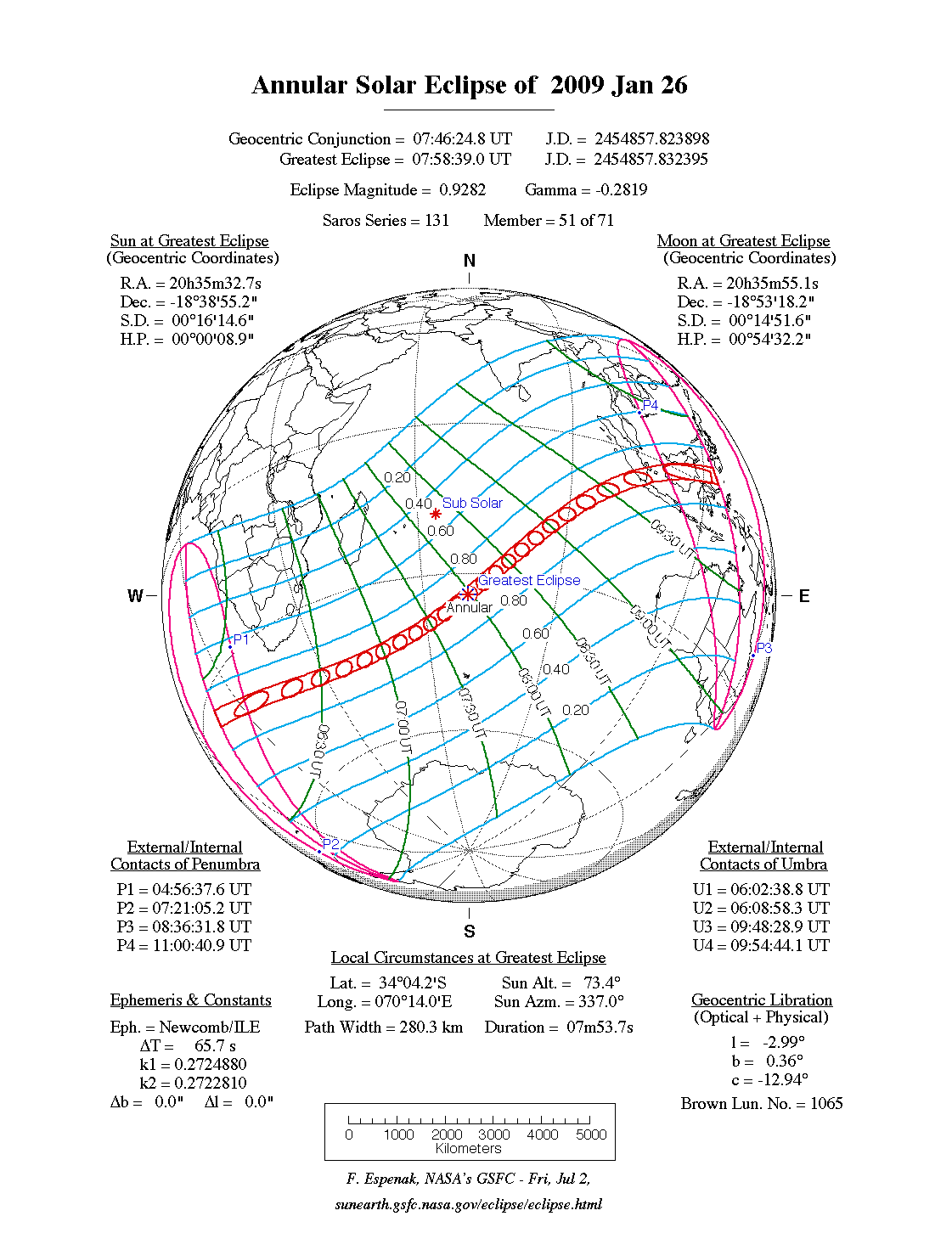
The first solar eclipse of 2009 occurs at the Moon's ascending node in western Capricornus. An annular eclipse will be visible from a wide track that traverses the Indian Ocean and western Indonesia. A partial eclipse will be seen within the much larger path of the Moon's penumbral shadow, which includes the southern third of Africa, Madagascar, Australia except Tasmania, southeast India, Southeast Asia and Indonesia. (Figure 1).

The annular path begins in the South Atlantic at 06:06 UT when the Moon's antumbral shadow meets Earth and forms a 363 kilometre wide corridor. Traveling eastward, the shadow quickly sweeps south of the African continent, missing it by approximately 900 kilometres. Slowly curving to the northeast the path crosses the southern Indian Ocean. Greatest eclipse[1] takes place at 07:58:39 UT when the eclipse magnitude[2] will reach 0.9282. At this instant, the annular duration is 7 minutes 54 seconds, the path width is 280 kilometres and the Sun is 73° above the flat horizon formed by the open ocean. The central track continues northeast where it finally encounters land in the form of the Cocos Islands and onward to southern Sumatra and western Java (Figure 2). At 09:40 UT, the central line duration is 6 minutes 18 seconds and the Sun's altitude at 25°. In its final minutes, the antumbral shadow cuts across central Borneo and clips the northwestern edge of Celebes before ending just short of Mindanao, Philippines at 09:52 UT. During a 3 hour 46 minute trajectory across our planet, the Moon's antumbra travels approximately 14,500 kilometres and covers 0.9% of Earth's surface area. Path coordinates and central line circumstances are presented in Table 1.

Partial phases of the eclipse are visible primarily from southern Africa, Australia, Southeast Asia and Indonesia. Local circumstances for a number of cities are listed in Table 2. All times are given in Universal Time. The Sun's altitude and azimuth, the eclipse magnitude and obscuration[3] are all given at the instant of maximum eclipse.

This is the 50th eclipse of Saros 131. The family began with an unusually long series of 22 partial eclipses starting on 1125 Aug 01. The first central eclipse was total in the Northern Hemisphere on 1522 Mar 27. It was followed by 5 more total eclipses before the series produce 5 hybrid eclipses from 1630 to 1702. The first annular eclipse of Saros 131 occurred on 1720 Aug 04. The series will produce 29 more annular eclipses the last of which is 2243 Jun 18. Saros 131 terminates on 2369 Sep 02 after a string of 7 partial eclipses. Complete details for 70 eclipses in the series may be found at:

http://eclipse.gsfc.nasa.gov/SEsaros/SEsaros131.html


Penumbral Lunar Eclipse of February 09

The first lunar eclipse of 2009 is one of four such events during the year. The first three eclipses are penumbral while the last (on Dec. 31) is partial. The Feb 09 event is the deepest penumbral eclipse of the year with a penumbral magnitude of 0.899. It will be easily visible to the naked eye as a dusky shading in the northern half of the Moon. The times of the major phases are listed below.

Penumbral Eclipse Begins: 12:38:46 UT
Greatest Eclipse: 14:38:15 UT
Penumbral Eclipse Ends: 16:37:40 UT

Of course, the beginning and end of a penumbral eclipse are not visible to the eye. In fact, no shading can be detected until about 2/3 of the Moon's disk is immersed in the penumbra. This would put the period of eclipse visibility from approximately 14:00 to 15:20 UT. Keep in mind that this is only an estimate. Atmospheric conditions and the observer's visual acuity are important factors to consider. An interesting exercise is to note when penumbral shading is first and last seen.

Figure 3 shows the path of the Moon through the penumbra as well as a map of Earth showing the regions of eclipse visibility. Eastern Canada and the USA will miss the eclipse entirely since the eclipse begins after moonset. Observers in western Canada and the USA will have the best views with moonset occurring sometime after mid-eclipse. To catch the entire event, one must be in Alaska, Hawaii, Australia, or East Asia.


Penumbral Lunar Eclipse of July 07

July's penumbral eclipse is only of academic interest since the magnitude is just 0.156. Although the Moon will be above the horizon from most of Canada (Figure 4), the eclipse is so minor as to be completely invisible to the naked eye.


Total Solar Eclipse of July 22

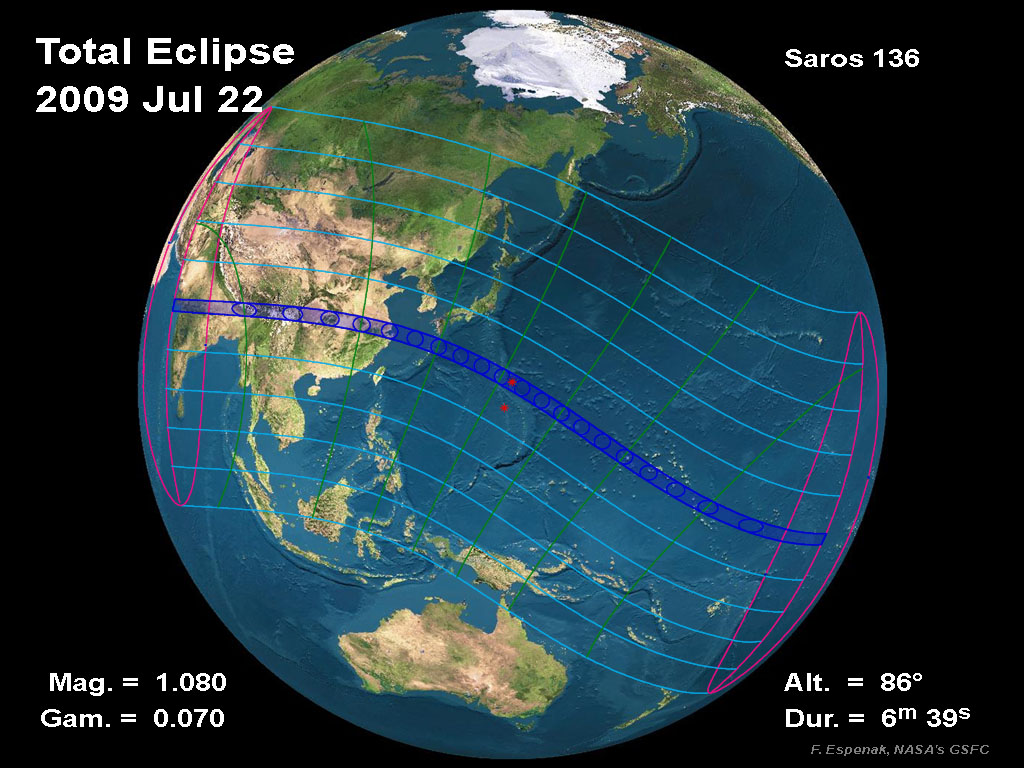
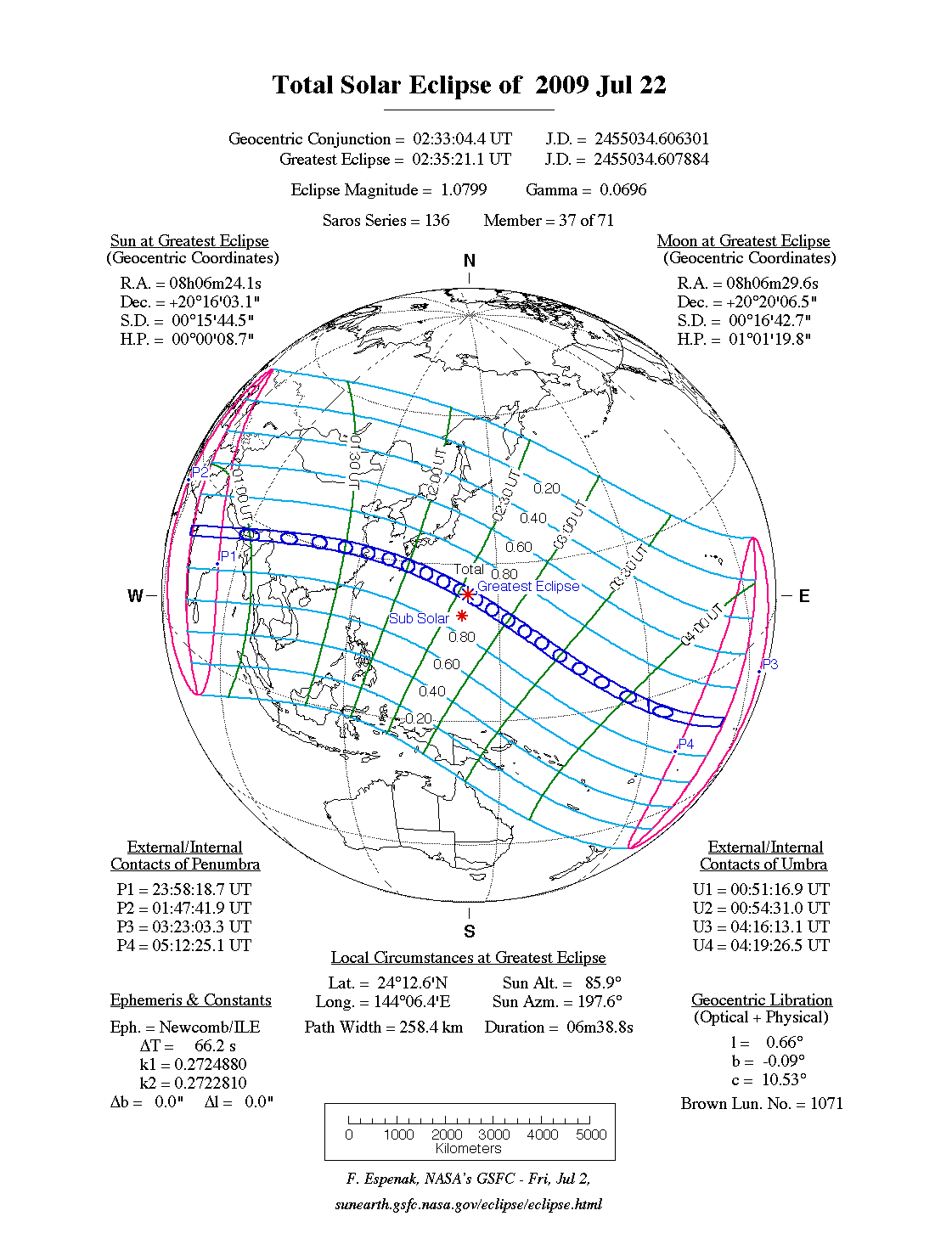
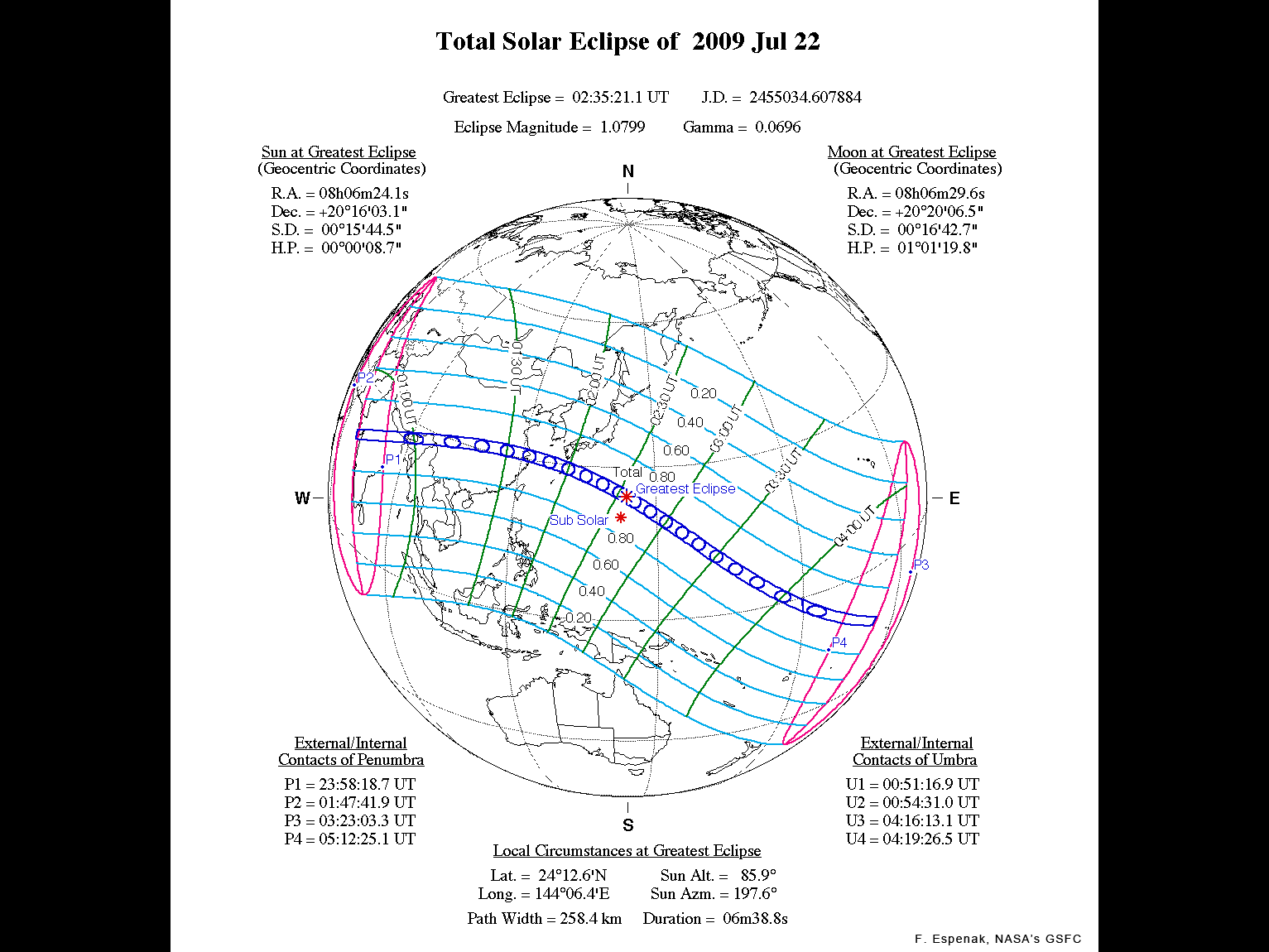
To make up for the anemic lunar eclipse earlier in the month, a major total eclipse of the Sun occurs two weeks later. The path of the Moon's umbral shadow extends across India, China, a handful of Japanese islands and the South Pacific Ocean (Espenak and Anderson, 2008). A partial eclipse is seen within the much broader path of the Moon's penumbral shadow, which includes most of eastern Asia, Indonesia, and the Pacific Ocean (Figure 5).

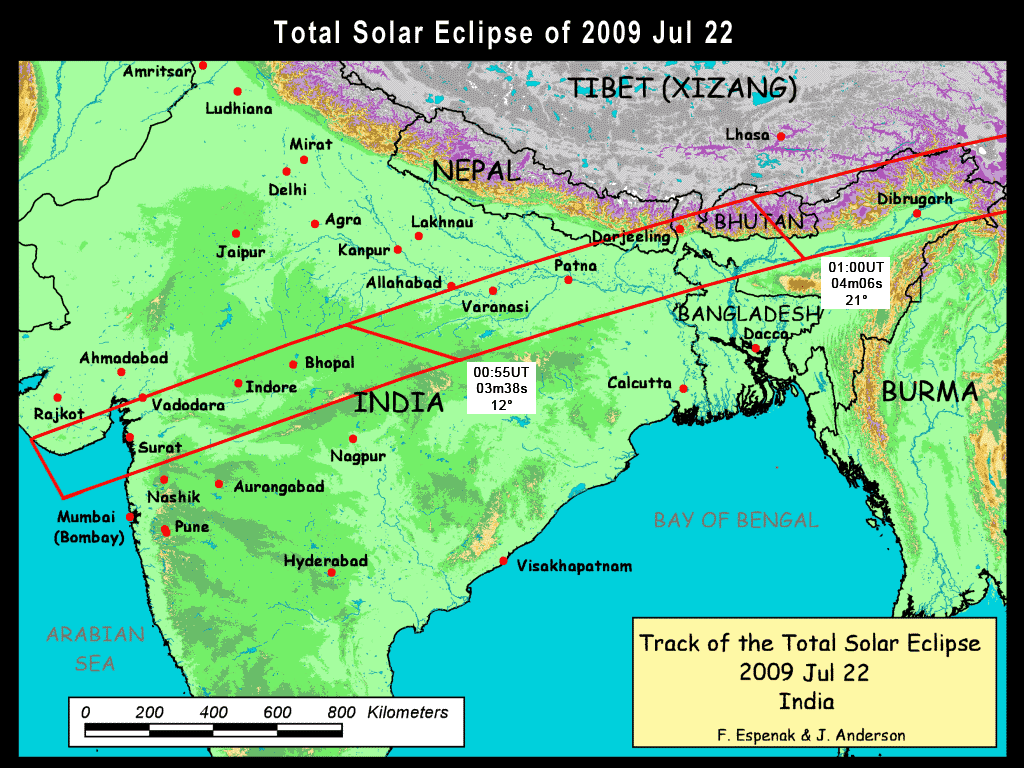
The central path begins in India's Gulf of Khambhat at 00:53 UT. The Moon passes through perigee several hours earlier, so the path of totality is unusually wide.

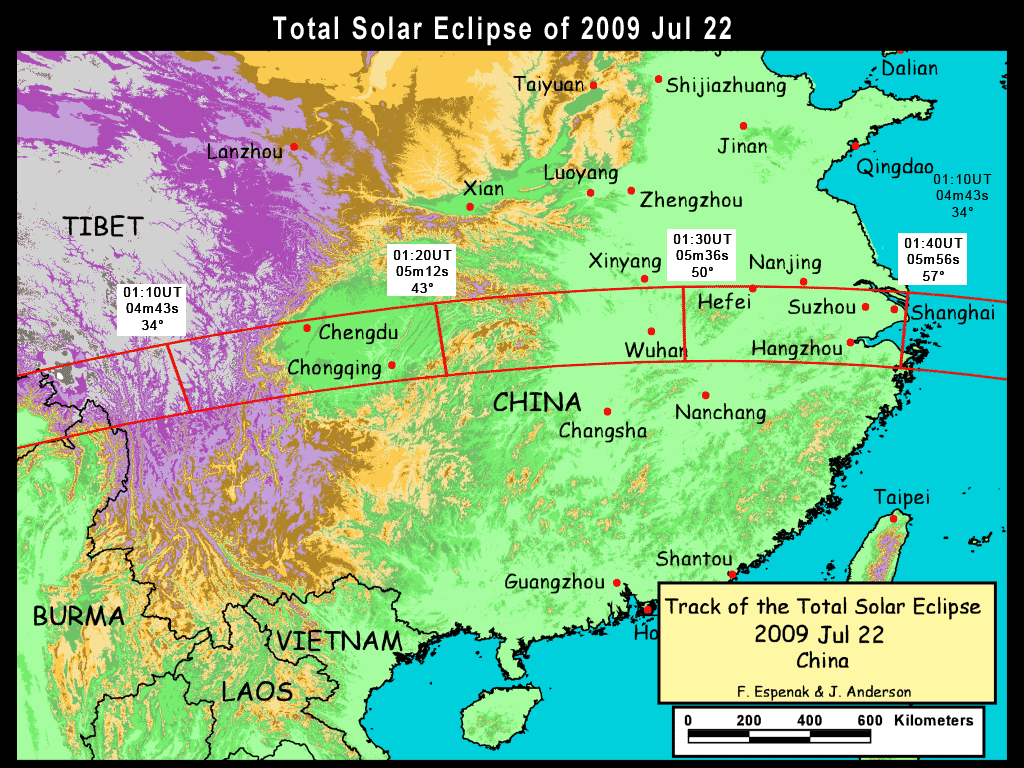
Racing inland, the shadow sweeps over the Indian cities of Surat, Indore, Bhopal, Varanasi, and Pata as its central duration heads towards the 4-minute mark. Traveling across Bhutan, the umbra clips Nepal, Bangladesh, and Burma (Myanmar), before reaching China at 01:05 UT (Figure 6). The duration of totality surpasses 5 minutes in Sichuan province where its capital city Chengdu lies within the track 85 km north of the central line. The umbra works its way across the rest of southern China where the major cities of Chongqing, Wuhan and Hangzhou stand in the eclipse path.

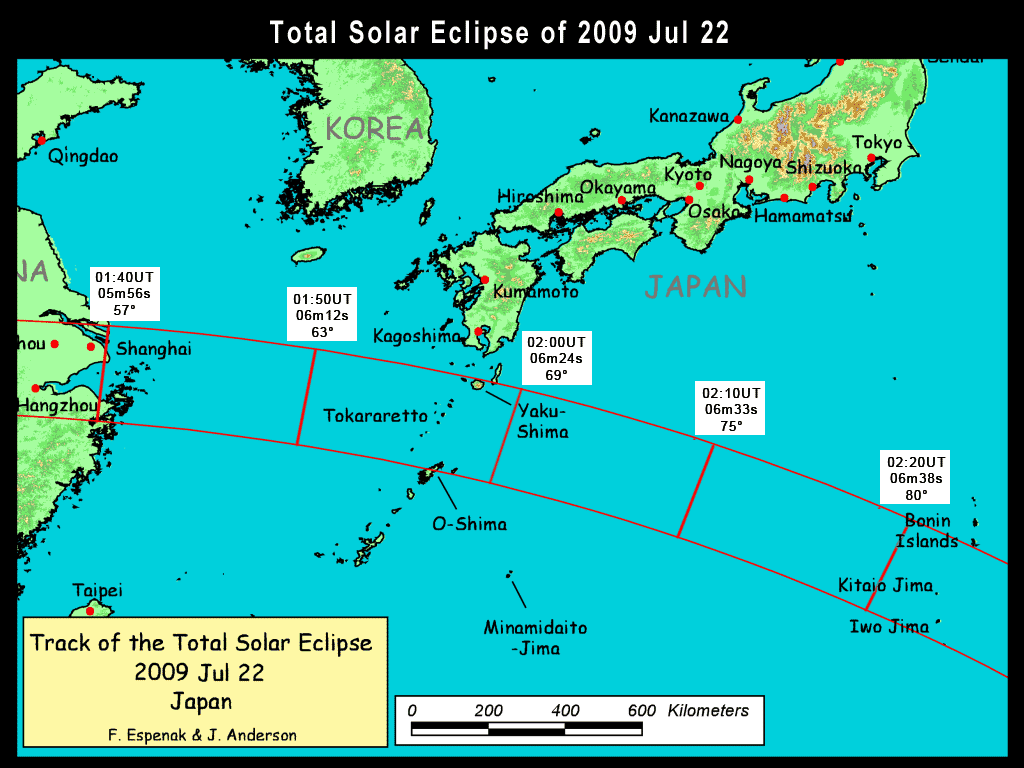
As the Moon's shadow reaches the coast, China's largest city Shanghai (pop. ~19 million) experiences totality lasting 5 minutes at 01:39 UT. Around 70 km to the south, the central line duration falls just 5 seconds short of the 6-minute mark. Across the East China Sea, the umbra sweeps over Japan's Ryukyu Islands and Iwo Jima.

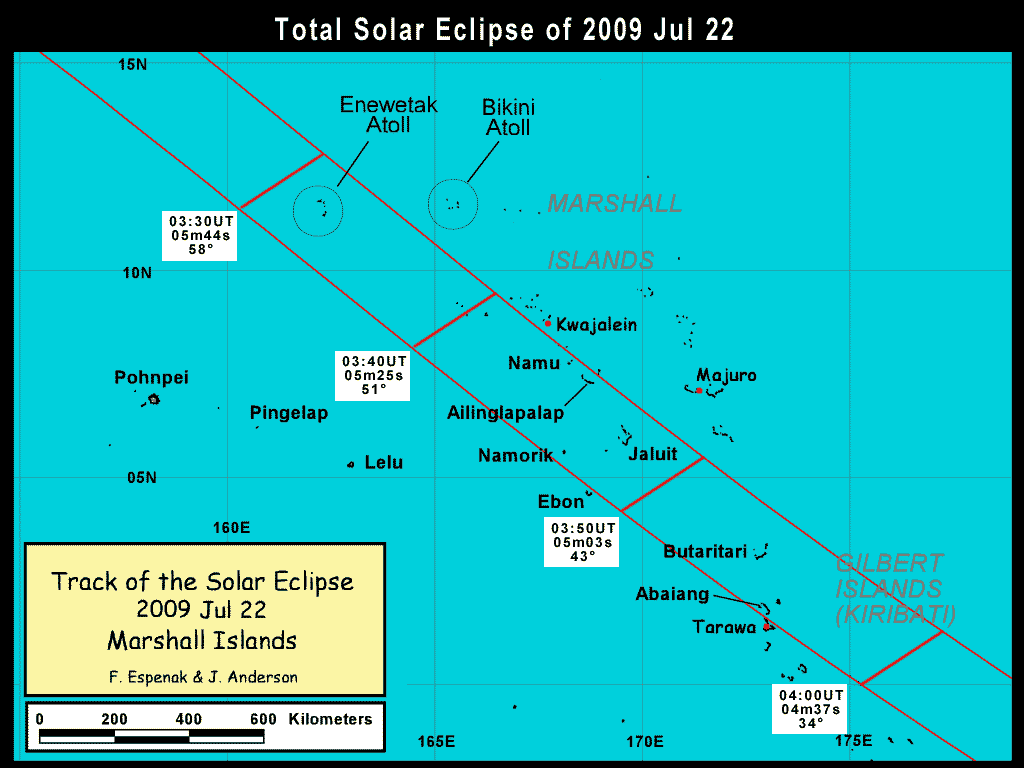
Greatest eclipse occurs in the South Pacific at 02:35:19 UT. At this instant, the axis of the Moon's shadow passes closest to Earth's center. The maximum duration of totality is 6_minutes 39_seconds, the Sun's altitude is 86°, and the path width is 258_km. The remainder of the path makes no major landfall; it arcs southeast through the Pacific hitting just a handful of small atolls in the Marshall Islands and Kiribati (Gilbert Islands).

The path of totality ends at 04:18 UT as the lunar shadow leaves Earth and returns to space 3.4 hours after it started its trek across our planet's surface. The 15,200 km long track covers 0.71% of Earth's surface. Path coordinates and central line circumstances are presented in Table 3.

A partial eclipse is seen from a much larger area covering East Asia, Indonesia, and the South Pacific. Local circumstances for a number of cities are listed in Table 4. All times are given in Universal Time. The Sun's altitude and azimuth, the eclipse magnitude and obscuration are all given at the instant of maximum eclipse.

This is the 37th eclipse of Saros 136. The series began on 1360 Jun 14 with the first of eight partial eclipses. The first central eclipse was annular on 1504 Sep 08. It was followed by 5 more annular eclipses before the series produced 6 hybrid eclipses from 1612 through 1703. The first total eclipse occurred on 1721 Jan 27. The central line duration of this series rapidly increased and peaked at 7 minutes 8 seconds on 1955 Jun 20. Since then, the duration is slowly decreasing. Of particular note is the 6-minute total eclipse passing through the central U. S. on 2045 Aug 12. The series will continue to produce total eclipses until 2496 May 13. After that, the family winds down with a string of 7 partial eclipses which ends on 2622 Jul 30. In all, Saros 136 produces 15 partial, 6 annular, 6 hybrid and 44 total eclipses. Complete details for the series can be found at:

http://eclipse.gsfc.nasa.gov/SEsaros/SEsaros136.html


Penumbral Lunar Eclipse of August 06

A shallow penumbral eclipse occurs 15 days after the total solar eclipse. Since its magnitude is only 0.402, it will not be visible to the naked eye. Details for the eclipse can be found in Figure 7.


Partial Lunar Eclipse of December 31

The last eclipse of 2009 occurs on New Year's Eve. This minor partial lunar eclipse takes place in Gemini, and is visible primarily from the Eastern Hemisphere (Figure 8). Greatest eclipse takes place at 19:23 UT when the eclipse magnitude will reach 0.0763.


Solar Eclipse Figures

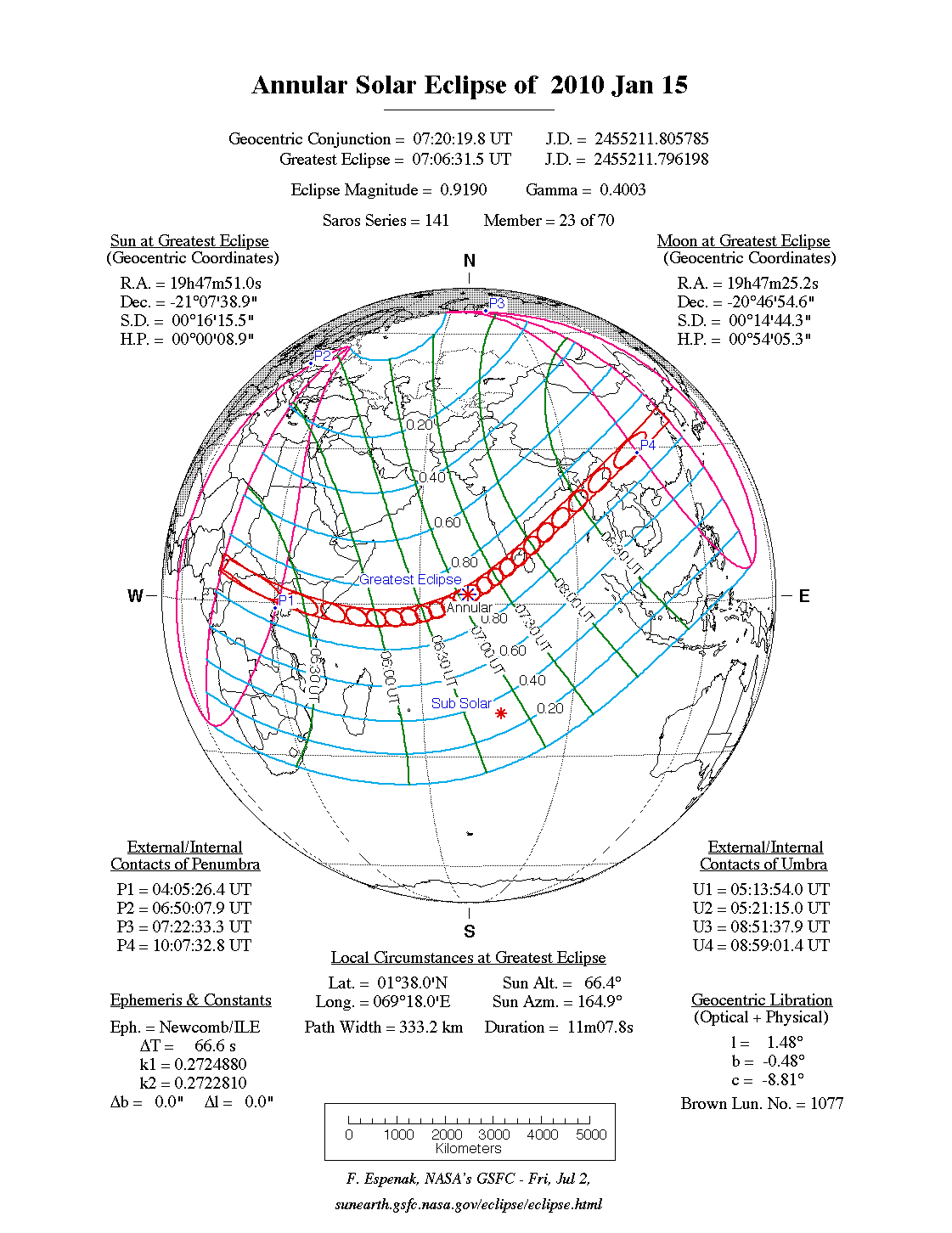
For each solar eclipse, an orthographic projection map of Earth shows the path of penumbral (partial) and umbral (total) or antumbral (annular) eclipse. North is to the top in all cases and the daylight terminator is plotted for the instant of greatest eclipse. An asterisk (*) indicates the sub-solar point[4] on Earth.

The limits of the Moon's penumbral shadow delineate the region of visibility of the partial solar eclipse. This irregular or saddle shaped region often covers more than half of the daylight hemisphere of Earth and consists of several distinct zones or limits. At the northern and/or southern boundaries lie the limits of the penumbra's path. Partial eclipses have only one of these limits, as do central eclipses when the Moon's shadow axis falls no closer than about 0.45 radii from Earth's centre. Great loops at the western and eastern extremes of the penumbra's path identify the areas where the eclipse begins/ends at sunrise and sunset, respectively. If the penumbra has both a northern and southern limit, the rising and setting curves form two separate, closed loops. Otherwise, the curves are connected in a distorted figure eight. Bisecting the 'eclipse begins/ends at sunrise and sunset' loops is the curve of maximum eclipse at sunrise (western loop) and sunset (eastern loop). The points P1 and P4 mark the coordinates where the penumbral shadow first contacts (partial eclipse begins) and last contacts (partial eclipse ends) Earth's surface. If the penumbral path has both a northern and southern limit, then points P2 and P3 are also plotted. These correspond to the coordinates where the penumbral shadow cone is internally tangent to Earth's disk.

A curve of maximum eclipse is the locus of all points where the eclipse is at maximum at a given time. Curves of maximum eclipse are plotted at each half-hour Universal Time. They generally run between the penumbral limits in the north/south direction, or from the maximum eclipse at sunrise and sunset curves to one of the limits. If the eclipse is central (i.e. total or annular), the curves of maximum eclipse run through the outlines of the umbral shadow, which are plotted at ten-minute intervals. The curves of constant eclipse magnitude delineate the locus of all points where the magnitude at maximum eclipse is constant. These curves run exclusively between the curves of maximum eclipse at sunrise and sunset. Furthermore, they are parallel to the northern/southern penumbral limits and the umbral paths of central eclipses. In fact, the northern and southern limits of the penumbra can be thought of as curves of constant magnitude of 0.0. The adjacent curves are for magnitudes of 0.2, 0.4, 0.6 and 0.8. For total eclipses, the northern and southern limits of the umbra are curves of constant magnitude of 1.0. Umbral path limits for annular eclipses are curves of maximum eclipse magnitude.

Greatest eclipse is defined as the instant when the axis of the Moon's shadow passes closest to Earth's centre. Although greatest eclipse differs slightly from the instants of greatest magnitude and greatest duration (for total eclipses), the differences are negligible. The point on Earth's surface intersected by the axis at greatest eclipse is marked by an asterisk symbol. For partial eclipses, the shadow axis misses Earth entirely, so the point of greatest eclipse lies on the day/night terminator and the Sun appears on the horizon.

Data pertinent to the eclipse appear with each map. At the top are listed the instant of ecliptic conjunction of the Sun and Moon (i.e., New Moon) and the instant of greatest eclipse, expressed in Terrestrial Dynamical Time and Universal Time. The eclipse magnitude is defined as the fraction of the Sun's diameter obscured by the Moon at greatest eclipse. For central eclipses (total or annular), the magnitude is replaced by the geocentric ratio of diameters of the Moon and the Sun. Gamma is the minimum distance of the Moon's shadow axis from Earth's centre in Earth radii at greatest eclipse. The Saros series of the eclipse is listed, followed by the member position. The first member number identifies the sequence position of the eclipse in the Saros, while the second is the total number of eclipses in the series.

In the upper left and right corners are the geocentric coordinates of the Sun and the Moon, respectively, at the instant of greatest eclipse. They are:

R.A. - Right Ascension
Dec. - Declination
S.D. - Apparent Semi-Diameter
H.P. - Horizontal Parallax

To the lower left are exterior/interior contact times of the Moon's penumbral shadow with Earth, which are defined:

P1 - Instant of first exterior tangency of Penumbra with Earth's limb. (Partial Eclipse Begins)
P2 - Instant of first interior tangency of Penumbra with Earth's limb.
P3 - Instant of last interior tangency of Penumbra with Earth's limb.
P4 - Instant of last exterior tangency of Penumbra with Earth's limb. (Partial Eclipse Ends)

Not all eclipses have P2 and P3 penumbral contacts. They are only present in cases where the penumbral shadow falls completely within Earth's disk. For central eclipses, the lower right corner lists exterior/interior contact times of the Moon's umbral shadow with Earth's limb which are defined as follows:

U1 - Instant of first exterior tangency of Umbra with Earth's limb. (Umbral [Total/Annular] Eclipse Begins)
U2 - Instant of first interior tangency of Umbra with Earth's limb.
U3 - Instant of last interior tangency of Umbra with Earth's limb.
U4 - Instant of last exterior tangency of Umbra with Earth's limb. (Umbral [Total/Annular] Eclipse Ends)

At bottom centre are the geographic coordinates of the position of greatest eclipse along with the local circumstances at that location (i.e., Sun altitude, Sun azimuth, path width and duration of totality/annularity). At bottom left is a list of parameters used in the eclipse predictions, while bottom right gives the Moon's geocentric libration (optical + physical) at greatest eclipse.


Lunar Eclipse Figures

Each lunar eclipse has two diagrams associated with it along with data pertinent to the eclipse. The top figure shows the path of the Moon through Earth's penumbral and umbral shadows. Above this figure are listed the instant of ecliptic conjunction of the Moon with the point 180° from the Sun (i.e., Full Moon) and the instant of greatest eclipse, expressed in Terrestrial Dynamical Time and Universal Time. The penumbral and umbral magnitudes are defined as the fraction of the Moon's diameter immersed in the two shadows at greatest eclipse. The radii of the penumbral and umbral shadows, P. Radius and U. Radius, are also listed. Gamma is the minimum distance in Earth radii of the Moon's centre from Earth's shadow axis at greatest eclipse, and Axis is the same parameter expressed in degrees. The Saros series of the eclipse is listed, followed by a pair of numbers. The first number identifies the sequence position of the eclipse in the Saros; the second is the total number of eclipses in the series.

In the upper left and right corners are the geocentric coordinates of the Sun and the Moon, respectively, at the instant of greatest eclipse. They are:

R.A. - Right Ascension
Dec. - Declination
S.D. - Apparent Semi-Diameter
H.P. - Horizontal Parallax

To the lower left are the semi, or half, durations of the penumbral, and partial (umbral) eclipses. Below them are the extrapolated value of ΔT (the difference between Terrestrial Dynamical Time and Universal Time) and the Sun/Moon ephemerides used in the predictions. To the lower right are the contact times of the Moon with Earth's penumbral and umbral shadows, defined as follows:

P1 - Instant of first exterior tangency of Moon with Penumbra. (Penumbral Eclipse Begins)
U1 - Instant of first exterior tangency of Moon with Umbra. (Partial Umbral Eclipse Begins)
U2 - Instant of first interior tangency of Moon with Umbra. (Total Umbral Eclipse Begins)
U3 - Instant of last interior tangency of Moon with Umbra. (Total Umbral Eclipse Ends)
U4 - Instant of last exterior tangency of Moon with Umbra (Partial Umbral Eclipse Ends)
P4 - Instant of last exterior tangency of Moon with Penumbra. (Penumbral Eclipse Ends)

The bottom figure is a cylindrical equidistant projection map of Earth that shows the regions of visibility for each stage of the eclipse. In particular, the moonrise/moonset terminator is plotted for each contact and is labeled accordingly. An asterisk indicates the point where the Moon is in the zenith at greatest eclipse. The region that is unshaded will observe the entire eclipse, while the darkly shaded area will witness no eclipse. The remaining lightly shaded areas will experience moonrise or moonset while the eclipse is in progress. The shaded zones east of the asterisk will witness moonset before the eclipse ends, and the shaded zones west will witness moonrise after the eclipse has begun.


Shadow Diameters and Lunar Eclipses

To compensate for Earth's atmosphere when calculating the circumstances for lunar eclipses, Chauvenet [1891] introduced an empirical enlargement of 1/50 to the diameters of the umbral and penumbral shadows. This rule has been employed by many of the national institutes in their official eclipse predictions (including the author's work at NASA). However, Danjon [1951] pointed out a flaw in this method because it applies the same relative correction to the umbra and penumbra instead of using the same absolute correction. From eclipse observations, Danjon proposed to enlarge Earth's diameter by 1/85 to compensate for the atmosphere. The umbral and penumbral shadow diameters are then calculated based on this modified geometry. The French almanac "Connaissance des Temps" has used the Danjon rule in its eclipse predictions since 1951. The resulting umbral and penumbral eclipse magnitudes are smaller by approximately 0.005 and 0.026, respectively, as compared to predictions using the traditional 1/50 rule.

Beginning with Eclipses During 2007, we use the Danjon rule in calculating lunar eclipse circumstances and magnitudes.


Eclipse Altitudes and Azimuths

The altitude a and azimuth A of the Sun or Moon during an eclipse depend on the time and the observer's geographic coordinates. They are calculated as follows:

h = 15 (GST + UT - α ) + λ
a = arcsin [sin δ sin φ + cos δ cos h cos φ]
A = arctan [-(cos δ sin h)/(sin δ cos φ - cos δ cos h sin φ)]

where

h = hour angle of Sun or Moon
a = altitude
A = azimuth
GST = Greenwich Sidereal Time at 0:00 UT
UT = Universal Time
α = right ascension of Sun or Moon
δ = declination of Sun or Moon
λ = observer's longitude (east +, west -)
φ = observer's latitude (north +, south -)

During the eclipses of 2009, the values for GST and the geocentric Right Ascension and Declination of the Sun or the Moon (at greatest eclipse) are as follows:

Eclipse Date GST α δ
Annular Solar 2009 Jan 26 8.383 20.592 -18.649
Penumbral Lunar 2009 Feb 09 9.321 9.528 13.527
Penumbral Lunar 2009 Jul 07 19.033 19.136 -23.861
Total Solar 2009 Jul 22 19.999 8.107 20.267
Penumbral Lunar 2009 Aug 06 20.979 21.046 -15.576
Partial Lunar 2009 Dec 31 6.690 6.756 24.020

Two web based tools that can also be used to calculate the local circumstances for all solar and lunar eclipses visible from any location. They are the Javascript Solar Eclipse Explorer and the Javascript Lunar Eclipse Explorer. The URLs for these tools are:

http://eclipse.gsfc.nasa.gov/JSEX/JSEX-index.html

http://eclipse.gsfc.nasa.gov/JLEX/JLEX-index.html


Eclipses During 2010

In 2010, there are two solar and two lunar eclipses:

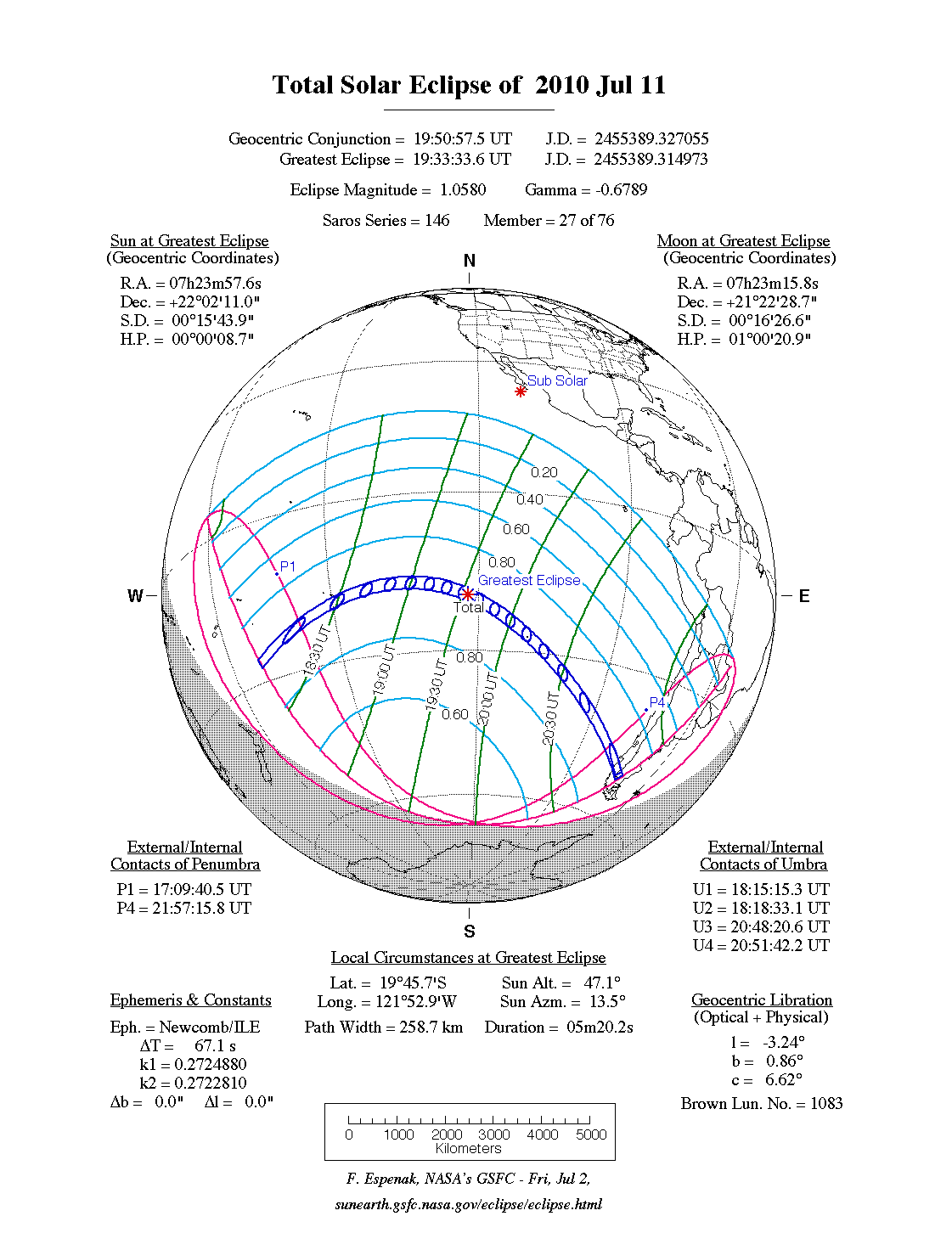
A full report on eclipses during 2010 will be published in Observer's Handbook 2010.


NASA Solar Eclipse Bulletins

Special bulletins containing detailed predictions and meteorological data for future solar eclipses of interest are prepared by Fred Espenak and Jay Anderson and are published through NASA’s Publication series. The bulletins are provided as a public service to both the professional and lay communities, including educators and the media. A list of currently available bulletins and an order form can be found at:

http://eclipse.gsfc.nasa.gov/SEpubs/RPrequest.html

The most recent bulletin of the series covers the total solar eclipse of 2008 August 01 which is visible from northern Canada, Russia, Mongolia and China. Single copies of the eclipse bulletins are available at no cost by sending a 9 x 12-in. self-addressed envelope stamped with postage for 11 oz. (310 g). Please print the eclipse year on the envelope’s lower left corner. Use stamps only, since cash and cheques cannot be accepted. Requests from outside the United States and Canada may include 10 international postal coupons. Mail requests to: Fred Espenak, NASA's Goddard Space Flight Center, Code 693, Greenbelt MD 20771, USA.

The NASA eclipse bulletins are also available over the Internet, including out-of-print bulletins. Using a Web browser, they can be read or downloaded through the NASA Eclipse Web Page at:

http://eclipse.gsfc.nasa.gov/SEpubs/bulletin.html


Eclipse Web Sites

The URL of the NASA Eclipse Web Site is:

http://eclipse.gsfc.nasa.gov/eclipse.html

The site features predictions and maps for all solar and lunar eclipses well into the 21st century, with special emphasis on upcoming eclipses. Special pages are devoted to the total solar eclipses of 2008, 2009 and 2010 that feature detailed maps, tables, graphs, and meteorological data. A world atlas of solar eclipses provides maps of all central eclipse paths from 2000 BCE to 3000 CE. The entire Five Millennium Canon of Solar Eclipses [Espenak and Meeus, 2006] can be downloaded in PDF format and all maps are also available online as individual GIFs or PDFs Additional catalogues list every solar and lunar eclipse over a 5000-year period.

A special web site is available for the 2009 total solar eclipse. It contains detailed maps, tables and meteorological data' The URL is:

http://eclipse.gsfc.nasa.gov/SEmono/TSE2009/TSE2009.html

Detailed information on solar and lunar eclipse photography and tips on eclipse observing and eye safety may be found at:

http://www.mreclipse.com/


Acknowledgments

Special thanks to National Space Club summer intern Wesley Ripley for converting the MS Word manuscript to html for this web page (July 2008).

All eclipse predictions were generated on a Macintosh G4 PowerPC computer using algorithms developed from the Explanatory Supplement [1974] with additional algorithms from Meeus, Grosjean, and Vanderleen [1966]. The solar coordinates used in the eclipse predictions are based on VSOP87 [P. Bretagnon and G. Francou, 1988]. The lunar coordinates are based on ELP-2000/82 [M. Chapront-Touzé and J. Chapront, 1983]. For lunar eclipses, the diameter of the umbral and penumbral shadows were calculated using Danjon's rule of enlarging Earth's radius by 1/85 to compensate for the opacity of the terrestrial atmosphere; corrections for the effects of oblateness have also been included.

All calculations, diagrams, tables, and opinions presented in this paper are those of the author, and he assumes full responsibility for their accuracy.


Footnotes

[1] The instant of greatest eclipse occurs when the distance between the Moon's shadow axis and Earth's geocentre reaches a minimum.

[2] Eclipse magnitude is defined as the fraction of the Sun's diameter occulted by the Moon.

[3] Eclipse obscuration is defined as the fraction of the Sun's area occulted by the Moon.

[4] The sub-solar point is the geographic location where the Sun appears directly overhead (zenith).


References

Bretagnon P., Francou G., "Planetary Theories in rectangular and spherical variables: VSOP87 solution", Astron. and Astrophys., vol. 202, no. 309 (1988).

Chapront-Touzé, M and Chapront, J., "The Lunar Ephemeris ELP 2000," Astron. and Astrophys., vol. 124, no. 1, pp 50-62 (1983).

Chauvenet, W., Manual of Spherical and Practical Astronomy, Vol.1, 1891 (Dover edition 1961).

Danjon, A., "Les éclipses de Lune par la pénombre en 1951," L'Astronomie, 65, 51-53 (Feb. 1951).

Espenak, F., Fifty Year Canon of Solar Eclipses: 1986-2035, Sky Publishing Corp., Cambridge, MA, 1988

Espenak, F., Fifty Year Canon of Lunar Eclipses: 1986-2035, Sky Publishing Corp., Cambridge, MA, 1989.

Espenak, F., and Anderson, J., Total Solar Eclipse of 2009 July 22, NASA TP-2008-214169, Goddard Space Flight Center, Greenbelt, MD, 2008.

Espenak, F., and Meeus, J., Five Millennium Canon of Solar Eclipses: -2000 to +3000 (2000 BCE to 3000 CE), NASA TP-2006-214141, Goddard Space Flight Center, Greenbelt, MD, 2006.

Explanatory Supplement to the Astronomical Ephemeris and the American Ephemeris and Nautical Almanac, Her Majesty's Nautical Almanac Office, London, 1974.

Littmann, M., Espenak, F., & Willcox, K., Totality-Eclipses of the Sun, 3rd Ed., Oxford University Press, New York, 2008.

Meeus, J., Grosjean, C.C., & Vanderleen, W., Canon of Solar Eclipses, Pergamon Press, New York, 1966.

Meeus, J. & Mucke, H., Canon of Lunar Eclipses: -2002 to +2526, Astronomisches Buro, Wien, 1979.


Total Solar Eclipse of 2009 July 22

On Wednesday, 2009 July 22, a total eclipse of the Sun is visible from within a narrow corridor that traverses half of Earth. The path of the Moon's umbral shadow begins in India and crosses through Nepal, Bangladesh, Bhutan, Myanmar and China. After leaving mainland Asia, the path crosses Japan's Ryukyu Islands and curves southeast through the Pacific Ocean where the maximum duration of totality reaches 6 min 39 s. A partial eclipse is seen within the much broader path of the Moon's penumbral shadow, which includes most of eastern Asia, Indonesia, and the Pacific Ocean.

2009 Total Solar Eclipse Global Map
Click to enlarge.

This web site has been established for the purpose of providing detailed predictions, maps, figures and information about this important event. The material here is adapted from the NASA Technical Publication "Total Solar Eclipse of 2009 July 22" (NASA/TP-2008-214169). The document will be published in 2008 March. It is part of NASA's official eclipse bulletin publication series. Instructions and a form for ordering a hard copy of this publication can be found at: Order Form for NASA Eclipse Bulletins.


Preliminary Look at the Total Solar Eclipse of 2009 Jul 22

This data was presented at: IAU Symposium 233 - Solar Activity and Its Magnetic Origin

See also: Eclipse Weather and Maps (Jay Anderson)


Interactive Map of the Path of Totality

An implementation of Google Map has been created which includes the central path of the 2009 total solar eclipse. This allows the user to select any portion of the path and to zoom in using either map data or Earth satellite data.


General Maps of the Eclipse Path

The following maps show the overall regions of visibility of the partial eclipse as well as the path of the total eclipse through Asia and the Pacific Ocean. They use high resolution coastline data from the World Data Base II (WDB). Each map was chosen to isolate a specific region along the land portion of the eclipse path. Curves of maximum eclipse are included as well as the outline of the umbral shadow.

The maps are available as high resolution (300 dpi) PDF files.

Figure
Number
Title/Description Map
File
Figure 1 Orthographic (Global) Map of 2009 Total Solar Eclipse PDF
Figure 2 Map of 2009 Eclipse Path Through Asia PDF
Figure 3 Map of 2009 Eclipse Path Through India and Bhutan PDF
Figure 4 Map of 2009 Eclipse Path Through China PDF
Figure 5 Map of 2009 Eclipse Path South of Japan PDF

From NASA Tech. Pub. "Total Solar Eclipse of 2009 July 22" (NASA/TP-2008-214169).


Detailed Maps of the Path of Totality

The following maps show path of the 2009 total eclipse in greater detail. They use high resolution coastline, city and highway data from the Digital Chart of the World (DCW). Each map was chosen to isolate a specific region along the land portion of the eclipse path. Curves of maximum eclipse are included as well as the outline of the umbral shadow. Within the umbral path, curves of constant duration have been plotted for totality.

The maps are available as high resolution (300 dpi) PDF files.

Figure
Number
Title/Description Map
File
Figure 6 India - Mumbai PDF
Figure 7 India - Bhopal PDF
Figure 8 India (Patna) - Nepal PDF
Figure 9 India - Bhutan PDF
Figure 10 India - Burma - China PDF
Figure 11 China - Chengdu PDF
Figure 12 China - Chongquig PDF
Figure 13 China - Wuhan PDF
Figure 14 China - Shanghai PDF
Figure 15 Japan - Ryukyu Islands PDF
Figure 16 Japan - Iwo Jima PDF
Figure 17 Marshall Islands PDF
Figure 18 Kiribati PDF
Figure 19 Phoenix Islands PDF

From NASA Tech. Pub. "Total Solar Eclipse of 2009 July 22" (NASA/TP-2008-214169).


Additional Figures

The following figures also appear in the NASA/TP-2008-214169, "Total Solar Eclipse of 2009 July 22".

Figure
Number
Title/Description Figure
File
Figure 20 Lunar Limb Profile for July 22 at 01:30 UT PDF
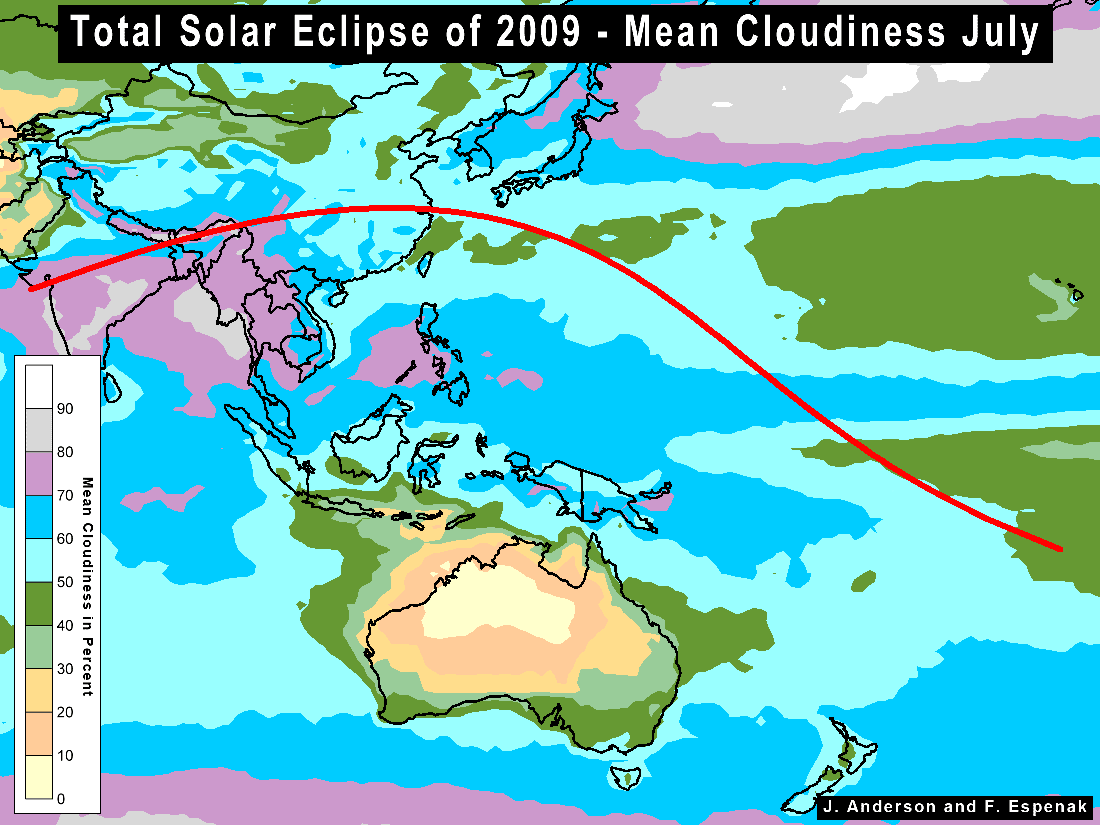
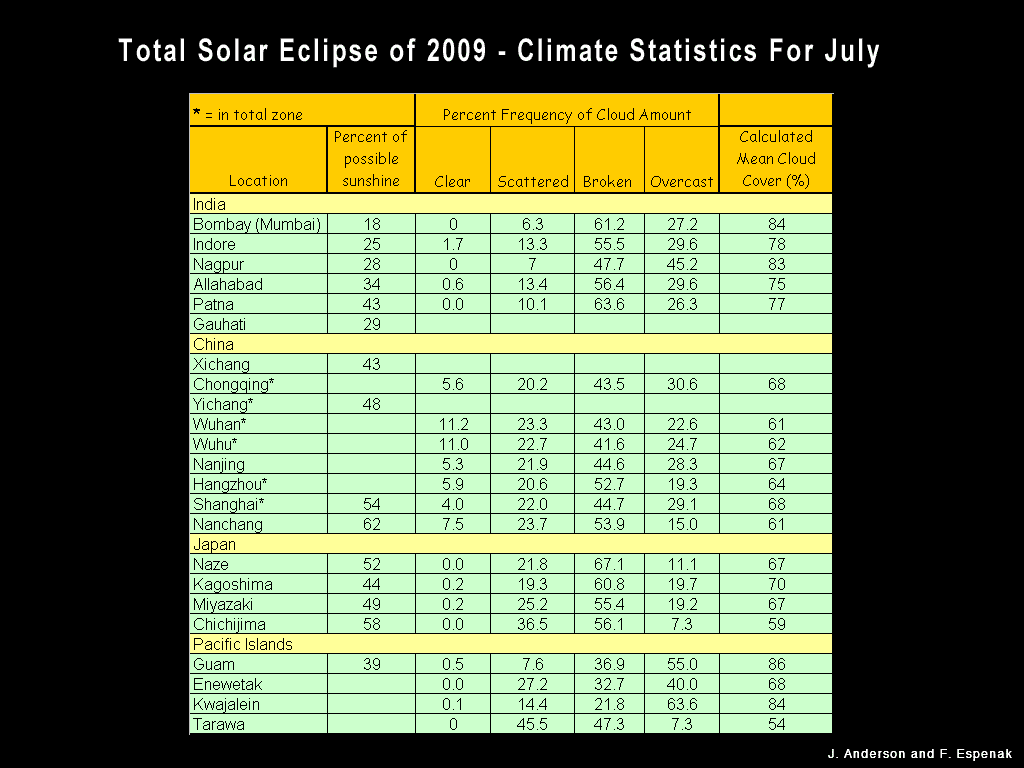
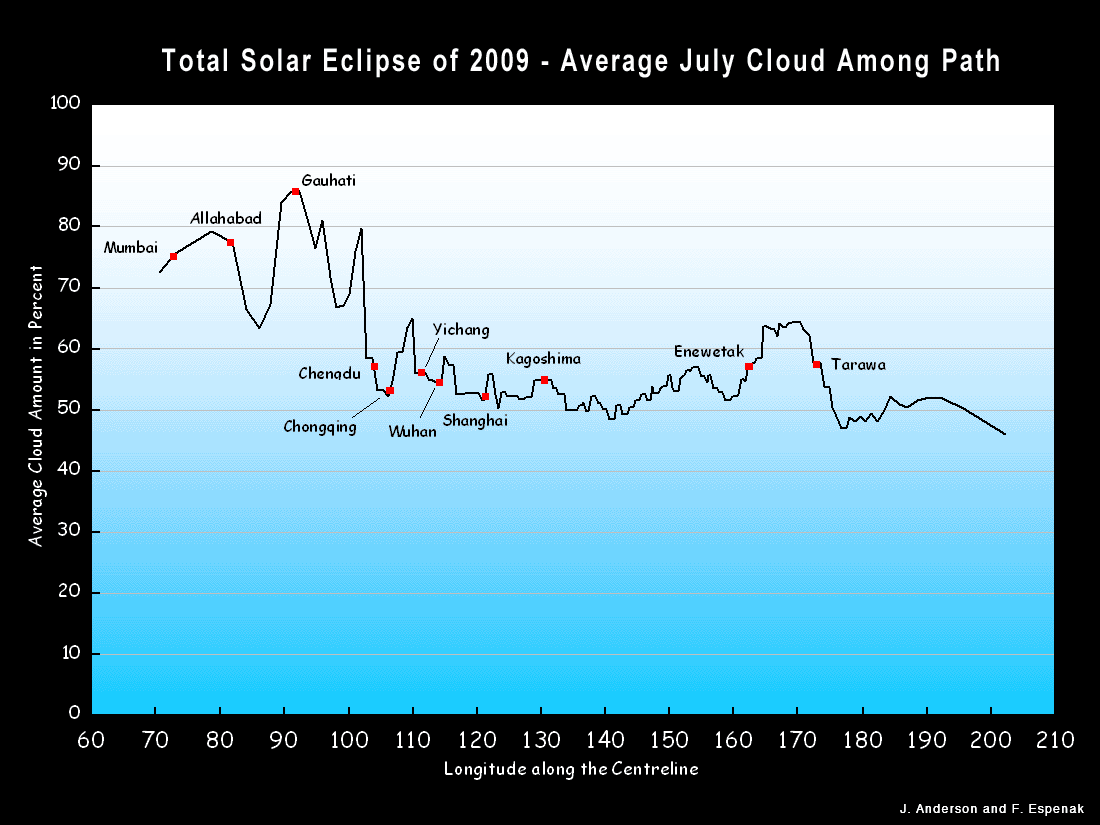
Figure 21 Average July Cloud Amount Along the Central Line PDF
Figure 22 Number of Typhoons from 1955 to 2007 PDF
Figure 23 Spectral Response of Common Solar Filters PDF
Figure 24 Focal Length Vs. Image Size for Eclipse Photography PDF
Figure 25 Sky During Totality from Central Line at 01:30 UT PDF

From NASA Tech. Pub. "Total Solar Eclipse of 2009 July 22" (NASA/TP-2008-214169).


Supplementary Figures

The following figures do not appear in the NASA 2009 Eclipse Bulletin due to page constraints. They are presented here as supplementary material for the bulletin.

Figure
Number
Title/Description Figure
File
Figure 20b Lunar Limb Profile for July 22 at 00:55 UT PDF
Figure 20c Lunar Limb Profile for July 22 at 02:00 UT PDF
Figure 20d Lunar Limb Profile for July 22 at 03:45 UT PDF
Figure 20e Lunar Limb Profile for July 22 at 04:15 UT PDF
Figure 25b Sky During Totality from Central India at 00:55 UT PDF
Figure 25c Sky During Totality from South of Japan at 02:00 UT PDF
Figure 25d Sky During Totality from Marshall Islands at 03:45 UT PDF
Figure 25e Sky During Totality from Phoenix Islands at 04:15 UT PDF

Eclipse Elements, Shadow Contacts and Path of Totality

The following tables give detailed predictions including the Besselian Elements, shadow contacts with Earth, path of the umbral shadow and topocentric data (with path corrections) along the path. Also included are special extended version tables of path coordinates and graze zones in formats convenient for plotting on maps.

From NASA Tech. Pub. "Total Solar Eclipse of 2009 July 22" (NASA/TP-2008-214169).


Local Circumstances

The following tables give the local circumstances of the eclipse from various cities throughout Asia and the Pacific Ocean. All contact times are given in the tables are in Universal Time.

From NASA Tech. Pub. "Total Solar Eclipse of 2009 July 22" (NASA/TP-2008-214169).


Additional Tables

The following tables also appear in the NASA/TP-2008-214169, "Total Solar Eclipse of 2009 July 22".


Explanation of Eclipse Maps and Tables

The following links give detailed descriptions and explanations of the eclipse maps and tables.


Reproduction of Eclipse Data

All eclipse calculations are by Fred Espenak, and he assumes full responsibility for their accuracy. Permission is freely granted to reproduce this data when accompanied by an acknowledgment:

"Eclipse Predictions by Fred Espenak, NASA's GSFC"

For more information, see: NASA Copyright Information

    2008 Mar 13
Project and Website Manager: Fred Espenak (fred.espenak-1@nasa.gov)
Responsible NASA Official: Amy Simon-Miller (amy.a.simon-miller@nasa.gov)

Thursday, July 2, 2009

Los Angeles police under scrutiny in Jackson death

Los Angeles police under scrutiny in Jackson death


LOS ANGELES – The investigation of Michael Jackson's death is widening as questions intensify about the drugs he took, the doctors who provided them and the actions of police.

Why didn't police seal the mansion where he had been living? Why didn't they get immediate search warrants? Why did they tow away a doctor's car right after the death but not declare the home a crime scene? And why was Jackson's sister Janet allowed to move possessions out of the mansion two days after the death, before police searched it?

Los Angeles police say proper procedures were followed based on the circumstances officers encountered when they were called to the home at 12:21 p.m. on June 25. A doctor was attending to Jackson and stayed with him when he was placed in an ambulance at 1:07 p.m. There was no sign of foul play.

Others say police should have assumed it was possible a crime occurred and taken precautions to ensure the scene was not disrupted so evidence wasn't lost or tainted.

"If I was the chief detective on the case, I would have said, 'We don't know what's going on. We should seal the scene,'" said defense attorney Harland Braun, who has represented celebrities including Robert Blake, Roseanne and Gary Busey. "You always have to think of the worst-case scenario and you have to think fast. I would have sealed the scene just because it was Michael Jackson."

Whether the Jackson probe turns into a criminal investigation hinges on what evidence emerges involving the drugs. Charges could be brought if authorities determine Jackson had been overly prescribed medications, if he had been given drugs inappropriate for his medical needs, or if doctors knowingly prescribed Jackson medications under an assumed name.

It's still not known what caused Jackson's death at age 50. The pop star went into cardiac arrest in his bedroom and his personal physician, Dr. Conrad Murray, performed CPR while an ambulance was called, according to Murray's lawyers. Murray has spoken to police and authorities say he is not a suspect, though his actions have come under scrutiny because his own lawyers acknowledge it may have taken up to a half-hour for an ambulance to be summoned.

An autopsy was conducted but results are not expected for several weeks. The Jackson family had a second autopsy performed and those results also are pending.

On Wednesday, The Associated Press learned Los Angeles police asked the Drug Enforcement Administration to assist in the investigation.

DEA agents participated in the investigation of the 2007 overdose death of Anna Nicole Smith at a Florida hotel. California Attorney General Jerry Brown charged her former boyfriend and two of her doctors in March with conspiring to provide Smith with prescription drugs. Brown said they broke the law because Smith was a "known addict." They deny the charges.

The DEA also probed whether painkillers found in actor Heath Ledger's system after his death last year were obtained illegally. Federal prosecutors did not charge anyone.

Jean Rosenbluth, a University of Southern California law professor, said the agency's involvement in the Jackson case suggests authorities are looking into whether drugs came from out of state. Murray lives in Las Vegas and is licensed to practice in Texas, Nevada and California.

Federal drug regulations include controls over whether and how frequently a doctor can write prescriptions over the phone, and DEA agents could be looking to see if these rules were broken, Rosenbluth said.

"You can't just get on the phone and continue to prescribe something for someone without having seen them for a long period of time," she said.

Jackson had a well-known history of using prescription medications, especially painkillers. Following his death, Cherilyn Lee, a registered nurse who had worked for Jackson, told the AP she repeatedly rejected his demands for the drug Diprivan, also known as Propofol. It's a potent anesthetic used in operating rooms and it would be highly unusual to have it in a private home.

Uri Geller, a former Jackson confidant, said he tried to keep Jackson from abusing painkillers and other prescription drugs, but others in the singer's circle kept him supplied.

"When Michael asked for something, he got it," Geller said in a telephone interview from his suburban London home.

Jackson had multiple doctors and many others like Geller who came in and out of his life. Which people are being interviewed by police is unclear because the LAPD has said virtually nothing about the probe.

"I am not going to make any comments on the investigation," Commander Patrick Gannon, the designated police spokesman on the Jackson case, said by e-mail Thursday.

Any evidence would be turned over to the district attorney's office, which has final say on criminal charges.

One of the key questions is why it took four days for police to issue a search warrant and remove medications from Jackson's home. In the meantime, several people, including Janet Jackson, removed unknown items from the home.

Although the home wasn't declared a crime scene, police did tow Murray's car the evening of the death to look for potential evidence.

Vernon J. Geberth, former commanding officer of the Bronx Homicide Task force in New York, said police should have known they were dealing with an extraordinary situation.

"If it's a high-profile person, you have to do more than you would do ordinarily," he said.

Still, Geberth, who now acts as a private forensic consultant, said he believes the LAPD acted appropriately.

"Having a doctor present altered the equation. It was not a homicide scene. It was an emergency medical scene," he said.

The LAPD has not opened any review of its handling of the case, according to the Los Angeles Police Protective League, which represents rank-and-file LAPD officers.

Rosenbluth said if the case ends up as a criminal prosecution, any defense attorney would seize on the LAPD's failure to immediately seal Jackson's home.

"If you can get even one juror think, I don't know, maybe somebody fiddled with the medicine before the police came in and collected it, that's reasonable doubt," she said. "All that the defense attorney needs is one juror."